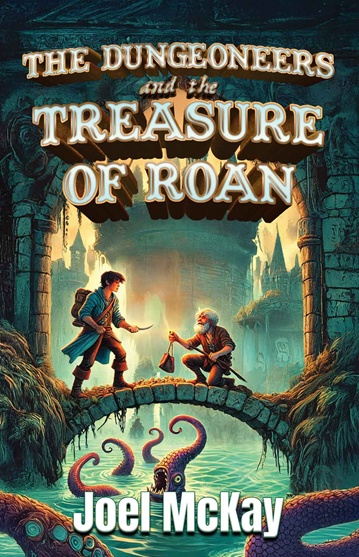
I’m writing stories I would want to read. I suppose The Dungeoneers and the Treasure of Roan is best for late-teen young adults who are working through relational issues with their parents, but just about anybody can sit down and enjoy it.
Joel McKay – 8 August 2026
The Back Flap
Wincott is a washed-up burglar with a bad back, frozen toes, and a goblin kill count that’s making his life very complicated. When he flees into the long-abandoned mountain city of Roan—just ahead of a bloodthirsty goblin horde—he finds himself knocked out cold by none other than his estranged son: Sish Torren, a fast-talking rogue with a short sword, shorter temper, and a talent for backstabbing… sometimes literally.
Roan is rumored to house an ancient treasure. It’s also filled with deadly traps, crumbling ruins, and the kind of secrets that swallow people whole. Wincott and Sish reluctantly join forces—not out of love, but because no one survives Roan solo for long. Especially not with mercenaries, monsters, and a certain vengeful former crew barreling toward them.
The Dungeoneers and the Treasure of Roan is “Dungeons & Dysfunction” meets Ocean’s Eleven—if everyone in the crew had unresolved trauma and zero impulse control. A darkly funny, fast-paced fantasy adventure full of sharp blades, sharper tongues, and just enough heart to keep you rooting for the worst people to do the right thing… eventually.
About the book
What is the book about?
The Dungeoneers and the Treasure of Roan is about two things: adventurers bumbling their way through a classic fantasy dungeon to find a lost treasure, and a father and son reconciling their relationship along the way. It’s meant to hearken back to pocketbook adventures of the 70s and 80s, a ‘yarn’ in the truest sense, with a lot of humour, fun, magic, and action.
When did you start writing the book?
It’s lost to the mists of the past now, but seven or eight years ago would probably be correct. I wrote the first chapter on a weekend writing getaway, but didn’t know where to go with it for several years. In 2021, I took another stab at it through a #NaNoWriMo challenge and got the first 50,000 words down. I finished the second half in the following couple months.
How long did it take you to write it?
Depending on how you calculate it, I either wrote it in two months or over seven years-ish. It’s more accurate to pick the longer of the two simply because even when I wasn’t actively writing, I was thinking it through, which in my mind is writing.
Where did you get the idea from?
The idea came to me on a weekend writing retreat in B.C.’s Robson Valley. It looks a lot like a medieval fantasy setting down there, and I thought it an excellent location for a fantasy tale. I wrote a short story that featured the derelict redoubt of Fort Shatterstill, which I no longer have a copy of. But that story gave me the world to play in and the germ for a longer story.
Were there any parts of the book where you struggled?
Really, it was the beginning. The first few chapters changed very little through the years of writing. I really felt I had the tone, tenor and place nailed. What troubled me was where to take the characters next—sometimes you just have to turn around, which was literally the case once they were inside Roan. And then everything flowed from there.
What came easily?
The main characters—Wincott and Sish—were fully formed almost instantly. Their relationship and dialogue came very easily.
Are your characters entirely fictitious or have you borrowed from real world people you know?
Entirely fictitious, however, at times I have transplanted traits, ways of speaking or acting and physical attributes from people I’ve met. I use these more as inspiration than any type of psychological subtext about real world people.
We all know how important it is for writers to read. Are there any particular authors that have influenced how you write and, if so, how have they influenced you?
For The Dungeoneers, the following:
- Robert E. Howard
- Margaret Weis and Tracy Hickman
- Raymond E. Feist
- Glen Cook
- Robert Jordan
Do you have a target reader?
Myself, really. I’m writing stories I would want to read. I suppose The Dungeoneers and the Treasure of Roan is best for late-teen young adults who are working through relational issues with their parents, but just about anybody can sit down and enjoy it.
About Writing
Do you have a writing process? If so can you please describe it?
I try to write a couple sentences a day. Literally two. It’s a psych hack so that I’m always moving forward. Often, I write a lot more than two. Admittedly, if I’m swamped in life there are extended periods where I don’t even get to the two. I don’t beat myself up about it, just acknowledge that if I’m not writing, I’m not making any progress on those goals and that pushes me back into it.
Do you outline? If so, do you do so extensively or just chapter headings and a couple of sentences?
I try not to. In the past, I’ve found extended outlines generate boredom with the story itself. It begins to feel like I’ve already written it so why should I write it again? That said, I’m currently experimenting with rough outlines. I mean rough, not more than a few sentences or bullet points, so it’s a blend.
Do you edit as you go or wait until you’ve finished?
Wait until I’ve finished. Editing as you go makes no sense – how can you edit what hasn’t been written yet? It’s easy to think that since a page or chapter has been written that it can be edited, but actually the story can’t be properly edited until it’s fully drafted. How do you know that page or chapter won’t be cut? You don’t. You’re wasting time. Write the whole thing, whatever its length, then begin the work on shaping it.
Did you hire a professional editor
I do when I self-publish, but obviously not for anything I sell to a publisher. For self-publishing, I find I need that extra set of eyes.
Do you listen to music while you write? If yes, what gets the fingers tapping?
Yes, typically Jeremy Soule’s music (fans of the Elder Scrolls will know his work). I need music without lyric, otherwise it’s like trying to write while someone is talking to you. Doesn’t work for me. So instrumental, steady vibes. Ambient or Lo-Fi music works really well too.
About Publishing
Did you submit your work to Agents?
Haven’t yet – I’ve only worked directly with publishers.
What made you decide to go Indie, whether self-publishing or with an indie publisher?
It really came down to the nature of the work. The business is currently structured to make it easier to sell short stories to professional markets. Part of this is simply turnaround times: short story markets are plentiful, often allow simultaneous submissions and you get a response fairly quickly. Novellas and novel publishers are long time horizon, don’t allow simultaneous submissions and don’t get back to you quickly, if at all. The strategy was to build audience and recognition through traditionally published short stories and also learn the business by self-publishing longer works. This may shift over time but so far it’s been a workable blend.
Did you get your book cover professionally done or did you do it yourself?
Professionally. I did graphic design during my undergraduate so I’m not a slouch, but I’m also not a professional. If I’m self-publishing, I want my product to be quality and the result of a group of people working together on it—a cover designer, an editor, a formatter, a publicist.
Do you have a marketing plan for the book or are you just winging it?
I typically wing it at this point, largely because I have the breadth to do so. What I mean by that is I’m still in the experimental phase of self-publishing work. I’m learning as I go. As time goes on, I zero in on what works and replicate.
Any advice that you would like to give to other newbies considering becoming Indie authors?
Self-publishing is a great way to learns the ins and outs of the business so when you eventually sell your work, you don’t get screwed—you know how it works, what works, what doesn’t, and what to avoid. Same thing with selling short stories. You get a glimpse of the difference between effective independent publishers and ones that are fly-by-night.
About You
Where did you grow up?
I grew up in the Lower Mainland of British Columbia, which is the area that includes and generally surrounds Vancouver. It’s one of the most stunning natural environments in the world.
Where do you live now?
About 10 hours by car north of there in a city called Prince George. We consider it Northern B.C. but it’s only about halfway up the province. It’s also stunningly beautiful but very different from the coast. We get real winters here.
What would you like readers to know about you?
Anyone who reads this is probably as passionate about reading and writing as I am. These things are not a choice for me. I have to write to keep my sanity, and reading is an essential component of that. If that statement resonates with you, good, then you know you’re not alone.
What are you working on now?
A sequel to my horror comedy novella Wolf at the Door. This time … vampires!
End of Interview:
Get your copy of The Dungeoneers and the Treasure of Roan from Amazon US or Amazon UK.