With that question, the book began to form. Ebony McMullen became the vessel for a question I’d been carrying my whole life: who belongs, and who decides?
Edwina Perkins – 2 August 2026
The Back Flag
Home isn’t a place. It’s a reckoning.
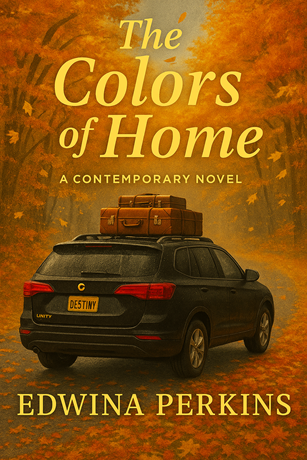
After her husband’s death from leukemia, Ebony McMullen loads her three children into an overstuffed Suburban and drives fifteen hours from Colorado to North Carolina—back to the small town her husband once fled.
She’s out of money. Out of options.
And forced to live in a house owned by the father-in-law who never wanted her.
Home is everything she feared it would be.
Her oldest son, Owen, is angry and restless after legal trouble in Colorado. Scotty is desperate to belong on the high school football team. Destiny, bright and tender with Down syndrome, sees beauty everywhere—even where others see difference.
About the Book
What is the book about?
The Colors of Home is a powerful story of grief, race, redemption, and the courage it takes to rebuild a family in a place that may not want them. Because sometimes home isn’t where you’re welcomed. It’s where you choose to belong.
When did you start writing the book?
2015.
How long did it take you to write it?
Nine years. Life happened in between. Marriage, motherhood, ministry, other people’s manuscripts. The book waited for me the way home does.
Where did you get the idea from?
I grew up in a small town in North Carolina. My brother and I were among the first to attend an integrated school in the late sixties. I never quite felt like I belonged, and for a long time I didn’t fully understand why. As I got older, I was told I was too White to be Black and too Black to be White. I didn’t have a Southern accent. Some of my features made people question where I was from. Many of my peers made sure I knew I didn’t fit neatly into either world. That experience never left me. But what if a single mom faced the same struggles in a small town, trying to help her children navigate the same thing I faced? With that question, the book began to form. Ebony McMullen became the vessel for a question I’d been carrying my whole life: who belongs, and who decides?
Were there any parts of the book where you struggled?
Mainly the end. I needed to figure out where to stop in order to prepare for a sequel. Endings are a kind of promise. I didn’t want to close a door I wasn’t ready to walk back through.
What came easily?
Developing the characters. I could see them in my mind, their personalities fully formed before I understood their story. My job was to figure out how their lives impacted each other. Destiny showed up first, and she never let me forget she was the one who mattered most.
Are your characters entirely fictitious or have you borrowed from real world people you know?
I have borrowed some from people in the real world. Not whole people, exactly. Pieces. A gesture here, a wound there. Fiction lets you tell the truth without naming names.
We all know how important it is for writers to read. Are there any particular authors that have influenced how you write and, if so, how have they influenced you?
Cec Murphey influenced me through his nonfiction books. I learned not only craft from him but a discipline of purpose. In his teaching about writing, he continues to ask the question, “Why do I write?” The day I can’t answer that question is the day I need to evaluate whether I should continue. I enjoy books that let me connect with people whose struggles I understand, even when I haven’t lived them myself. Authors like Tayari Jones and Angie Thomas tackle issues in Black communities through fiction that deals honestly with social realities. I also love Sarah Addison Allen for her vivid imagery. She makes ordinary Southern life feel like it’s holding its breath.
Do you have a target reader?
Youth and women who have had to rebuild somewhere they weren’t wanted. Readers who know what it costs to stay somewhere hard because leaving isn’t really an option. Anyone who has ever been told they don’t fit neatly into a box and had to find their own definition of belonging.
About Writing
Do you have a writing process? If so can you please describe it?
I write best in the morning. After a cup of coffee or tea, I need to focus on writing before anything else pulls at me. If I open my emails or any social media, I’ve ruined my chance to write that day. When I can, I carve out longer stretches, but with my other writing responsibilities, that’s rare. Mostly I protect small windows and trust that they add up.
Do you outline? If so, do you do so extensively or just chapter headings and a couple of sentences?
I don’t outline. When I sit down to write a novel, I see the story. Literally. It plays out in my head like a movie across a screen, and my job is to transcribe what I’m watching. The characters show me who they are. The scenes unfold. I just have to keep up.
Do you edit as you go or wait until you’ve finished?
I wait until I’m finished. I want to create before I edit. Those are two different jobs, and I don’t trust myself to do both well at the same time.
Did you hire a professional editor?
I’m published by a small press.
Do you listen to music while you write? If yes, what gets the fingers tapping?
I don’t listen to music, but I do like looking outside. There are two windows in my office, and our house is surrounded by trees. Watching the birds or squirrels run around gives me a pause, a breath, while I think about what happens next on the page.
About Publishing
Did you submit your work to Agents?
Not at this time. The CEO of the publishing company approached me before I reached out to an agent. She wanted my manuscript. Some doors open before you knock.
What made you decide to go Indie, whether self-publishing or with an indie publisher? Was it a particular event or a gradual process?
I published with a small press. It wasn’t a dramatic decision so much as the right people finding the right story at the right time.
Did you get your book cover professionally done or did you do it yourself?
Professionally, through the publishing house.
Do you have a marketing plan for the book or are you just winging it?
I’m very fortunate to work with a publishing company that gives me marketing guidance, and I work closely with Mickey Mikkelson as my publicist. I couldn’t ask for better direction and support.
Any advice that you would like to give to other newbies considering becoming Indie authors?
Be part of a writing community. Talk with other Indie authors. And don’t quit following your dream. The path rarely looks like you think it will, but the people who walk it with you make all the difference.
About You
Where did you grow up?
Eden, NC.
Where do you live now?
Cary, NC.
What would you like readers to know about you?
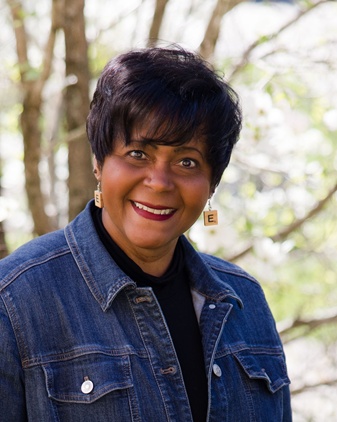
I’m a sensitivity and authenticity consultant and writing coach. I love championing honest, inclusive storytelling and equipping writers to center marginalized voices with craft and courage. When I’m not busy with other writing responsibilities, I enjoy spending time with my grandkids and curling up on the couch to watch BritBox mysteries. And I love gnomes.
What are you working on now?
The Seasons of Home continues with the relationships you met in the first book, along with a few new characters. We go deeper this time into honest relationships, doubt, questions, and anger at God. Into the messy, nonlinear paths that lead to grace. If The Colors of Home was about finding where you belong, The Seasons of Home is about what it costs to stay there.
End of Interview:
For more from Edwina Perkins visit her website and follow her on Facebook, Instagram, and Twitter.
Get your copy of The Colors of Home from Amazon US.