It all goes back to an idea I had in 1987: that the universe arbitrarily switches its fundamental operating system from rationality to magic.
Matthew Hughes – 31 July 2026
The Back Flap
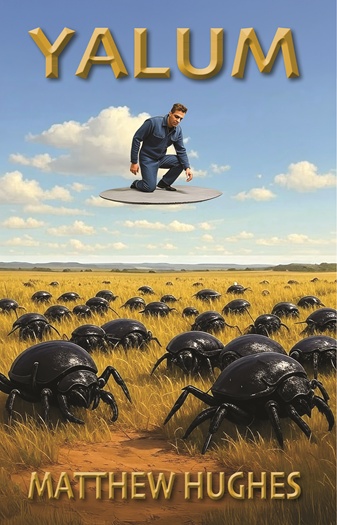
Yalum Erkatchian is captain and part owner of the space yacht Peregrinator when a distant relative lures him into returning to the planet he fled twenty-five years ago to escape a matriarchal cult. But it’s a trap and Yalum is forced into a quest to recover a sacred relic that pitches him into a desperate struggle for survival.
And then it gets worse, because he discovers that the entire universe is about to be upended by a sudden switch of its operating system from cause-and-effect rationalism to will-powered magic. Yalum and his friends try to prepare to survive, but a new threat emerges: someone has long been planning to ride the new reality into a tyranny of spellslinging, aided by a bored demon from the Seventh Plane.
About the book
What is the book about?
It’s a space opera that morphs into a Dying Earth-style fantasy.
When did you start writing the book?
July, 2025
How long did it take you to write it?
About three months
Where did you get the idea from?
It’s the third volume in a loosely conceived trilogy that started with my novel Template and continued with Passengers & Perils. It all goes back to an idea I had in 1987: that the universe arbitrarily switches its fundamental operating system from rationality to magic. I’ve set several novels in one mode or the other. Yalum is one of the few that straddles the great change.
Were there any parts of the book where you struggled?
No. I’m an old pro, and the settings and characters are familiar.
What came easily?
Having Yalum face increasing difficulties in dealing with the forces arrayed against him but finding a way through with the help of his friends and the woman he comes to love.
Are your characters entirely fictitious or have you borrowed from real world people you know?
Hard to say. I’ve had an unusual life and have met many different kinds of people. Their personalities have sunk into me and probably influence my characters as they develop.
We all know how important it is for writers to read. Are there any particular authors that have influenced how you write and, if so, how have they influenced you?
For space opera and Dying Earth fantasy I am heavily influenced by the late science fiction and fantasy grandmaster, Jack Vance. I don’t try to emulate his idiosyncratic prose style, although my dialogue and his share similarities, possible because we were both influenced by the inimitable P.G. Wodehouse. I do share his love of antiheroes, decadent settings, and louche supporting characters.
Do you have a target reader?
Vance used to say he wrote for intelligent young men. I write for his surviving fans, both male and female, and for those who discovered me through my dozens of appearances in The Magazine of Fantasy & Science Fiction and inclusion in award-winning anthologies co-edited by George R.R. Martin and the much missed Gardner Dozois.
About Writing
Do you have a writing process? If so can you please describe it?
I’ve made my living as a professional writer for more than fifty years. My process has always been to sit down, put my fingers on the keyboard, and see what my unconscious has to offer me.
Do you outline? If so, do you do so extensively or just chapter headings and a couple of sentences?
No. Tried it, can’t do it.
Do you edit as you go or wait until you’ve finished?
I usually start each day’s session by reading the last paragraphs of yesterday’s. I might make a few minor changes, but my overall approach is to wait until I’ve finished the draft then start at the beginning and edit the whole thing.
Did you hire a professional editor?
No. I have edited many books for others and know my way around.
Do you listen to music while you write? If yes, what gets the fingers tapping?
I went through a phase where somebody had given me a CD of Enya, I used to have it on while I wrote, though I never paid much attention to the music. Then I moved and left the CD behind and went back to silence while I write.
About Publishing
Did you submit your work to Agents?
I have had agents in the past and have one now who is seeking to place two historical novels of mine. A peculiar thing: although I have sold 24 novels to commercial publishers large and small, I have never had an agent pitch one of mine and receive an offer. I have sold novels after pitching myself, including ones that agents had failed to place, and I have had agents make deals after I have pitched and received an offer. But I have never yet experienced the process that is supposed to be the norm.
Nowadays, I have stopped submitting to publishers and simply self-publish on Amazon and Kobo. The money is better and I don’t have to wait months to get paid.
What made you decide to go Indie, whether self-publishing or with an indie publisher? Was it a particular event or a gradual process?
I had my shot at the big time 25 years ago, and it became clear that I am too much of a niche author to interest the corporate publishers. So, I began selling to small presses, with good success, but the advances steadily declined and royalties often didn’t appear until more than a year after release. Thirteen years ago, I began self-publishing backlist titles to which I had recovered the rights. I think my last small press title came out in 2019, with only a CAD$1,000 advance. Since then, I have self-published two titles or more a year, novels and collections of my pre-published short stories.
Did you get your book cover professionally done or did you do it yourself?
Both. Lately I have been using the Bing AI image generator to create cover art.
Do you have a marketing plan for the book or are you just winging it?
I have a monthly emailed newsletter to several hundred subscribers, who are my most reliable buyers. I promote myself on Facebook and my publicity agent secures reviews and interviews that extend my reach.
Anyone who signs up for my newsletter will receive a free ebook (epub and mobi) of 9 Tales of Henghis Hapthorn. Link: http://eepurl.com/cyNSA9
Any advice that you would like to give to other newbies considering becoming Indie authors?
Make your product as good as the commercially published competition (it’s not always that difficult). And market the hell out of every title. You’re competing for the attention of a reading public that has a great range of books to choose from. Let then know you are there.
About You
Where did you grow up?
I was born in Liverpool, came to Canada as a five-year-old (on an actual ocean liner), spent my childhood in Kitchener, Ontario, and grew to adulthood in a suburb of Vancouver. Since 2007, I have been a traveling housesitter and have lived in thirteen countries and passed through a slew of others.
Where do you live now?
I’m temporarily in the East Kootenays of British Columbia. I may go to rural Saskatchewan for the autumn, but I expect to settle down with my eldest son on the BC south coast after I help him buy a house.
What would you like readers to know about you?
I’m an entertainer. I deliver a reliable, enjoyable genre fiction experience. For those who love the work of Jack Vance—and everybody ought to read him—I’ve been called his “heir apparent,” and George R.R. Martin, a great fan of the master, has said I “do Jack Vance better than anyone except Jack himself.”
What are you working on now?
I’m polishing up the draft of a historical novel that I have been thinking about for sixty years, based on a rumor that Alexander the Great, shortly before he died young, sent out a ship to circumnavigate Africa. My agent is trying to place it, but historicals are a hard sell these days. If he can’t find someone who wants it, I will self-publish it.
End of Interview:
For more from Matthew Hughes you can follow him on Facebook and find out more about him from the entry about him on Wikipedia.