I am an academic; I spend most of my professional life recovering voices that records chose not to preserve. Giving her a voice seemed only natural.
Namita Kumari – 26 July 2026
The Back Flap
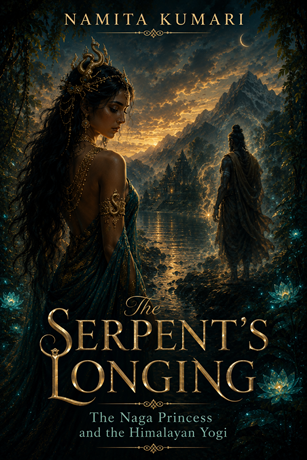
For eleven stolen days, in the warm green dark at the edge of the world, a man and a woman who were each meant to be alone forever are simply, quietly, secretly happy. She has worn a thousand shapes and never wanted to keep a single one. He crossed a sea with nothing but a dream of her, having given everything else away, and arrived wanting only the woman the dream had promised. In the hours they steal together — talking late, laughing like fools, learning the shape of each other in the firelight — they find the one thing neither of them was ever built to survive: being truly known, and not wanting to be anywhere else. But loving her is quietly spending the powers it took him a lifetime to gather. And loving him will cost her every shape she has ever worn, until she is only one woman — mortal, ageing, with a single life to give. They were never going to be allowed to keep this. Soon the world will close its hand, and something patient and kind at the bottom of everything will offer them the only mercy that could spare them the grief: stop loving, and it will never hurt at all. They will have to choose each other anyway — out loud, eyes open, knowing exactly what it costs. And whether, when the time comes to pay, they can do it not in sorrow, but gladly. A lyrical, aching standalone love story for readers of Circe and The Song of Achilles — a mythic romance about what we are willing to lose, and the courage to lose it gladly.
About the Book
What is the book about?
The Serpent’s Longing is a fantasy romance set within the founding legend of Funan — the 3rd-century CE kingdom that gave rise to the Khmer civilisation of ancient Cambodia. Soma is a Naga princess and shapeshifter of the deep waters; she has never needed to limit herself to being just one thing. Kaundinya is a Himalayan yogi who crosses the seas and encounters her. Soma is the greatest warrior and illusionist in the land. When this shapeshifter finally agrees to become one fixed thing — with love — the novel is really about the cost of her agreement, and quietly also the cost of his. It is a slow-burn, enemies-to-lovers romance with dual point of view and a full happily ever after. The mythology is drawn from both India and Cambodia — largely unknown to Western readers — and the historical setting is the ancient world of maritime Southeast Asia. This romance is clean (PG-13) and rooted in years of archival research.
When did you start writing the book?
I started with research first. I had been studying ancient India-Cambodia cultural connections for several years as part of an academic project. The novel grew out of my research almost without my planning it. I kept reading 7th-century Chinese chronicles describing the founding of Funan — a Brahmin who sails to foreign shores; a Naga princess who agrees to marry him. Then I kept thinking: we have a record of her compliance — but we have no idea how she felt. That question became the novel. I started writing in earnest sometime during late 2024.
How long did it take you to write it?
It took me about a year to actually write it, though the research behind it spans much longer than that. As a full-time faculty member, writing takes place in the margins — early mornings, weekends, semester breaks. In some ways that enforced pace helped. I had more time to sit with the characters rather than rush through them.
Where did you get your idea from?
A line in the chronicles. The founding legend of Funan appears in Chinese records: a foreign Brahmin arrives by sea; meets the daughter of the Naga king; marries her; together they build a dynasty. The story is recorded from the outside — matter-of-factly — without any interest in Soma’s inner life whatsoever. I am an academic; I spend most of my professional life recovering voices that records chose not to preserve. Giving her a voice seemed only natural.
Were there parts of the book where you struggled?
Kaundinya. He was harder to write than Soma. Soma I knew immediately — what it means to agree to become smaller for someone else’s vision of you is not abstract. But Kaundinya is a man who has spent years training himself to want nothing, and then finds someone who undoes all of that. Writing his internal resistance — the way he experiences desire as defeat — required patience beyond anything I initially
thought necessary. His chapters went through more drafts than hers.
What came easily?
The world. Ancient Southeast Asia practically wrote itself once I let loose my research. The spice markets, the monsoon seas, the way Naga mythology embedded itself into the actual landscape of the region — everything about that came with joy. I love this part of history deeply, and I believe that shows.
Are your characters entirely fictional or did you borrow from people you know in real life?
Soma and Kaundinya are historical names from the founding legend — they are real in that sense, though the chronicles provide us almost no information about who they really were. Every interior thought and every scene between them is invented. The secondary characters are entirely fictional. I will say that Soma’s particular brand of composure under pressure — the way she observes everything before speaking — is something I have watched in women I admire, without drawing from any single person.
Everyone knows how important reading is for writers. Are there any authors specifically that have influenced how you write? If so, how have they influenced you?
S.A. Chakraborty’s Daevabad Trilogy showed me that mythology-rooted fantasy romance can be truly literary and still possess a fully satisfying romantic core. Chitra Banerjee Divakaruni’s The Palace of Illusions — which restores interiority to Draupadi — is perhaps the closest kin to what I was trying to do. Further back, I was formed by classical Sanskrit poetry — especially Kalidasa — which taught me that desire and grief can coexist in the same image without either diminishing the other.
Do you have a target reader?
Readers who loved the Daevabad Trilogy or The Palace of Illusions and wished there was more Indian mythology romance — without needing prior familiarity with the mythology. Anyone who has ever read a historical record and thought: “But what did she think about all this?”
About Writing
Do you have a writing process? If so, can you please describe it?
My process involves several steps. I begin with a synopsis, then test and refine it. Next I develop the structure, characters, and narrative flow. From there I build a detailed plan — parts, chapters, each with its guiding questions or ideas. Then, for each chapter, I write out its crux before drafting the chapter itself. It is not a rigid process; I allow it to shift as the characters reveal themselves.
Do you outline? If so, do you do so extensively or just chapter headings and a couple of sentences?
Yes, I outline extensively.
Do you edit as you go or wait until you’ve finished?
I do it at the end.
Did you hire a professional editor?
No.
Do you listen to music while you write? If yes, what gets the fingers tapping?
No. Lyrics can interfere with the writing process, and music can create moods that subtly — sometimes unknowingly — influence the work in progress.
About Publishing
Did you submit your work to agents?
No.
What made you decide to go Indie, whether self-publishing or with an indie publisher? Was it a particular event or a gradual process?
I am a higher education faculty member and researcher, and this is my debut novel. I had a story I felt compelled to tell, and I could not wait out the lengthy process of traditional publishing. It was a gradual decision, shaped by my experience as a researcher over a period of time — working with institutions, with archives, with knowledge that deserves to reach people. I wanted this story in readers’ hands.
Did you get your book cover professionally done or did you do it yourself?
I did it myself, with the help of software.
Do you have a marketing plan for the book or are you just winging it?
I do not have a large marketing budget, so I am working to spread the word about the book as thoughtfully as I can — through outreach to bloggers, reviewers, and communities who love mythology and historical fiction.
Any advice that you would like to give to other newbies considering becoming indie authors?
I am still learning, so it would be difficult for me to offer advice just yet. Perhaps only this: if the story matters to you — tell it.
About You
Where did you grow up?
I grew up in eastern India and Delhi.
Where do you live now?
I live in Delhi, India.
What would you like readers to know about you?
I am primarily a researcher who was moved to fiction by questions that would not leave me alone.
What are you working on now?
I have almost finished my second novel, which is set in the same ancient Southeast Asian world.
End of Interview:
For more from Namita Kumari follow her on Instagram.
Get your copy of The Serpent’s Longing from Amazon US or Amazon UK.