The idea had been forming for a long time before I wrote a word. I wanted to write a crime series rooted in specific places — not cities as backdrop, but cities as presence. Budapest was the natural starting point. I know it well, and I wanted that intimacy to be visible on the page.
Daniel Laz – 24 July 2026
The Back Flap
A body in the Buda hills. A case that the Hungarian authorities have already closed. And a forensic consultant who cannot leave a scene until she understands it. Francesca Voss — Frankie — is called Budapest by someone who believes the official verdict is wrong. The victim is a mid-level diplomat with no public enemies and a private life nobody wants to examine. But Frankie notices things others have stopped looking for: the angle of the wound, the absence of soil on a man found outdoors, the small geometry of a staged scene. Set against the layered, melancholy beauty of Budapest — its thermal baths, its Soviet-era corridors, its river that remembers everything — VOSS: Budapest is the first book in a literary crime series built on precision, place, and the weight of what goes unsaid.
About the book
What is the book about?
VOSS: Budapest follows Francesca Voss — Frankie — a forensic consultant with a near-pathological gift for reading crime scenes. She is brought to Budapest to look at a case the authorities have closed: a diplomat found dead in the hills above the city, the verdict already written. Frankie disagrees with the verdict. What follows is an investigation conducted from the margins — no institutional authority, no badge, just the ability to see what has been overlooked. The book is as much about Budapest itself as it is about crime: the city’s history, its silences, the way the past presses against the present. It’s the first book in the VOSS series, which now runs to five published titles — Budapest, Tokyo, Istanbul, New York and and Saint Petersburg.
When did you start writing the book?
The idea had been forming for a long time before I wrote a word. I wanted to write a crime series rooted in specific places — not cities as backdrop, but cities as presence. Budapest was the natural starting point. I know it well, and I wanted that intimacy to be visible on the page. I began writing in earnest in 2023.
How long did it take you to write it?
About a year from first draft to final manuscript. The research was built into the writing — I wasn’t working from notes at a distance, I was working from the city itself.
Where did you get the idea from?
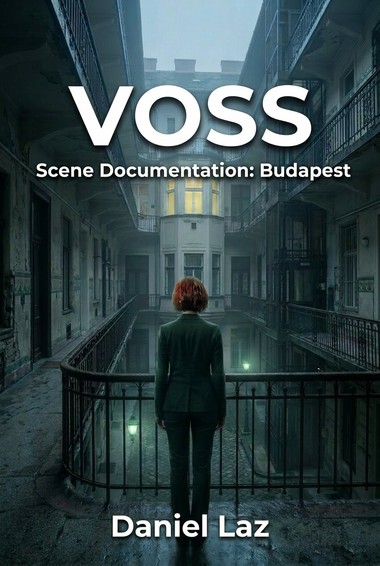
From a single image: a woman standing alone in a crime scene, noticing something everyone else has walked past. I wanted a protagonist who was not a detective in any institutional sense — someone operating without authority, which makes her both more effective and more exposed. And I wanted the series to be genuinely located. Each book is named for a city because each city is a character. Budapest came first because it felt true to start there.
Were there any parts of the book where you struggled?
The tonal balance. Literary crime is a difficult register to hold — too much atmosphere and the plot loses momentum; too much plot and the writing becomes functional. I rewrote the middle section several times. The Budapest sections also required precision: I wanted the city to feel lived-in and specific without becoming a travel piece.
What came easily?
Frankie’s voice. From the first draft, she was fully herself — precise, self-contained, slightly isolated by her own perceptiveness. I knew immediately how she moved through a room, what she noticed first, where her attention went when she was trying not to let it show. That interiority came without effort. Also, the city, in the end. Budapest translates onto the page.
Are your characters entirely fictitious or have you borrowed from real world people you know?
Entirely fictitious, though not without emotional truth. Frankie has qualities I admire in people I know — the precision, the self-containment, the particular loneliness of someone who sees too much. But she’s not based on anyone. The secondary characters are composites at most, assembled from observation rather than copied from life.
We all know how important it is for writers to read. Are there any particular authors that have influenced how you write and, if so, how have they influenced you?
John le Carré, above all. The moral seriousness, the prose that never wastes a sentence, the understanding that the real drama is internal. Tana French for the way she uses setting as psychological landscape — her Dublin is what I wanted Budapest to be. Kate Atkinson for her structural intelligence and the dry precision of her irony. Beyond crime fiction: Conrad for atmosphere, Sebald for the long shadow of the past. I write literary crime, and those are the writers who shaped what I think literary means.
Do you have a target reader?
Someone who reads crime fiction for the writing as much as the plot. A reader who is content to slow down, to notice. The books reward attention — there are layers that only become visible on a second reading. I think of my reader as someone who has grown slightly impatient with genre fiction that mistakes pace for momentum.
About Writing
Do you have a writing process? If so, can you please describe it?
I write early in the morning, before the day asserts itself. I need silence and a clear desk. I work in long sessions rather than short ones — it takes time to get back inside the prose, so interruptions are expensive. I keep a working document of notes alongside the manuscript: observations, questions, things I’ve promised myself to resolve. I don’t believe in waiting for inspiration. Sitting down is the method.
Do you outline? If so, do you do so extensively or just chapter headings and a couple of sentences?
I outline in some detail before I begin, then largely ignore the outline once I’m underway. The outline is a way of convincing myself whether the book is possible. Once I’m inside it, the characters start making decisions I didn’t plan for, and those unplanned moments are usually the best ones. I keep the outline visible but treat it as a draft, not a contract.
Do you edit as you go or wait until you’ve finished?
Both. I revise each day’s work before starting the next session — it’s how I re-enter the prose. But I try not to go back further than that until the first draft is complete. The deeper editing comes after structural editing, then line-level editing. I’m rigorous about redundancy. If a sentence isn’t doing something specific, it goes.
Did you hire a professional editor?
I work with editorial tools and trusted readers rather than a traditional developmental editor. The process is intensive, regardless — multiple drafts, careful attention to structure and rhythm. I take editing seriously as a craft.
Do you listen to music while you write? If yes, what gets the fingers tapping?
Occasionally, but only instrumental. Arvo Pärt sometimes. Or nothing at all. Lyrics compete with the sentences I’m trying to form. Silence is usually better.
About Publishing
Did you submit your work to Agents?
No. I decided to go directly to the readers. The traditional route involves years of waiting for permission. I wasn’t interested in that timeline, and I’m not convinced the gatekeeping serves the books.
What made you decide to go Indie, whether self-publishing or with an indie publisher? Was it a particular event or a gradual process?
A gradual process, followed by a clear decision. I spent time understanding how publishing works — the economics, the timelines, the loss of control over covers, titles and timing. None of it appealed to me. What appealed was writing the books I wanted to write, presenting them as I wanted, and building a readership directly. The indie model makes that possible in a way it wasn’t twenty years ago.
Did you get your book cover professionally done, or did you do it yourself?
I designed the covers myself, using Adobe Firefly and Adobe Express. I had a clear visual concept from the start: the “Scene Documentation” aesthetic, each book titled as if it were an evidence file. Dark, restrained, location-specific photography. Montserrat Extra Bold for the typography. I wanted the covers to feel like they belonged to a series with a sensibility, not a formula.
Do you have a marketing plan for the book or are you just winging it?
I have a plan. Instagram and Facebook, with content built around the books rather than around me — atmosphere, setting, the prose itself. ARC distribution for early reviews. Outreach to crime fiction platforms and readers. I believe in slow, consistent presence over short bursts. The books are marketing, in the end — if the writing is good enough, readers find each other.
Any advice that you would like to give to other newbies considering becoming Indie authors?
Learn the craft before you publish. Not just writing — editing, cover design, metadata, and how Amazon’s algorithms work. The indie path gives you control, but control requires competence. Also: finish things. A complete imperfect book is worth infinitely more than a perfect fragment. And read widely, especially outside your genre. The writers who surprise you are rarely the ones you expect.
About You
Where did you grow up?
In Central Europe. The region’s particular history — its layers, its silences, the way the past leaks into the present — is probably visible in the books, even when the setting is Tokyo or Istanbul.
Where do you live now?
Budapest.
What would you like readers to know about you?
That I take the work seriously. Daniel Laz is a pen name, and I’ve deliberately kept a certain distance between the name and the person behind it. The books should stand on their own. What I’d want readers to know is that every sentence has been considered, that the cities are real, that nothing is there by accident.
What are you working on now?
The fifth book in the VOSS series — Saint Petersburg. It’s the most structura complex of the five, and the one where several long-running threads finally begin to resolve. The first three books are available now: Budapest, Tokyo, and Istanbul. New York will be published within the next few weeks. Saint Petersburg is the work ahead.
End of Interview:
For more from Daniel Laz follow him on Facebook and Instagram.
Get your copy of VOSS: Scene Documentation: Budapest from Amazon US or Amazon UK.