My husband and I were driving across Nevada, and we started brainstorming about what the world would be like if corporations replaced the government. I realized it was a great sci-fi premise, but it wasn’t a story. So then we brainstormed what the story could be, and I thought, you know what? I can write this.
Perrin Pring – 26 May 2026
The Back Flap
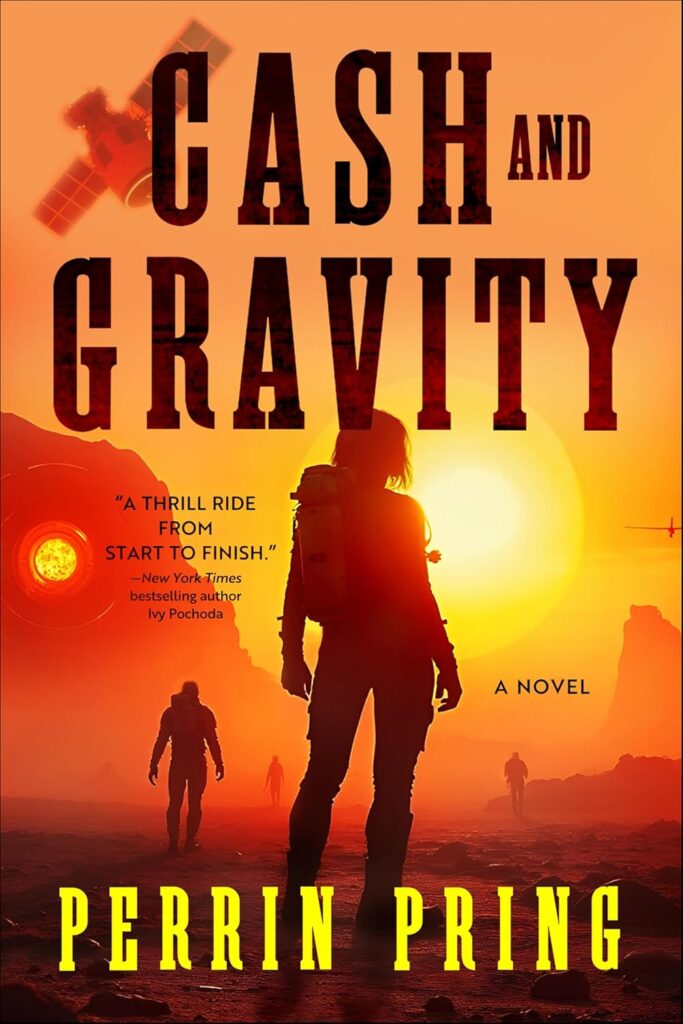
Cash and Gravity is a near future, Western, thriller. It pre-supposes mega corporations have supplanted the American government. Humans want to get off Earth for good, but we aren’t quite there in terms of technology, so corporations battle each other for physical resources so they can win the space race.
Chevy Cole is a marine in Launch Tech’s military. Launch Tech is one of the mega corporations which now rules the world. During a battle for a mine in rural Nevada, Chevy comes across a nearly-dead super soldier, and he’s got the world’s first mobile fusion battery. This device could change the fate of humanity. The only problem is that her employer, Launch Tech, stole it from a rival corporation. So Chevy has to get the device to a safehouse before the device’s rightful owner kills her.
About the book
When did you start writing the book?
I started writing it in October of 2020.
How long did it take you to write it?
I had a draft by spring of 2021, and then I put it down for about a year. I ended up getting into the University of California Riverside Palm Desert Low Residency MFA program, and in the spring of 2022, I got to take a class with Steven Graham Jones. Since he writes genre, I decided to turn in parts of Cash and Gravity to him. From there he told my thesis professor, Tod Goldberg, the book had potential. Tod read it and told me, this will be the book you sell. Tod is usually right, and in this case, he was spot on.
Where did you get the idea from?
In September of 2020, I had just gotten off of a six night river trip on the Green River starting at the Gates of Ladore. My husband and I were driving across Nevada, and we started brainstorming about what the world would be like if corporations replaced the government. I realized it was a great sci-fi premise, but it wasn’t a story. So then we brainstormed what the story could be, and I thought, you know what? I can write this.
Were there any parts of the book where you struggled?
Oh the book is TOTALLY different now than what it was in the first draft. Originally Chevy was a man and Izan’s character was female. I had four points of view, and Izan was a very uncomplicated character. The years of re-writes got it to where it is now, but I think saying I struggled makes it sound, maybe not fun? But I learned so much about writing with this book, and there were so many drafts and lessons, but it wasn’t a burden. It was a gift to get to work on it. I mean, I never want to read it again, but I always hit that point with a manuscript.
What came easily?
I think, once I started to sit down and write it, the inspiration was there so it made the writing flow. Not to say it was easy, but it was easy to budget time and sit down to do it because I was motivated.
Are your characters entirely fictitious or have you borrowed from real world people you know?
Hmmm. Well I have a friend who helped me refine Chevy. Chevy is not based off of him, but he’s a Marine, and anything I got right about the military life is thanks to my friend. He read my early chapters and gave me feedback that made Chevy’s world more realistic.
We all know how important it is for writers to read. Are there any particular authors that have influenced how you write and, if so, how have they influenced you?
I LOVE reading. I love reading genre, but I will say that I will read anything that Tana French, Donna Tartt, and Gabriel Tallent write. But really, if you give me a story that moves, I’ll binge it. I love authors who make me need to turn the page. I think that’s why I love genre so much. It just can’t be left to languish on your bedside table. Steven Graham Jone’s The Only Good Indians, Daniel Kraus’s Whalefall, Ivy Pochoda’s Sing Her Down, give me something that moves like these and I’m booked for the rest of the day. Literally.
So I guess how have they influenced me? If I find an author who can drown out all the distractions my phone offers me, I want to learn everything I can from them because in 2026, that is a rare talent.
Do you have a target reader?
Oh, anyone who likes an underdog. Anyone who wants to read a book that is set in a weird time that features an imperfect, hopeful protagonist. Anyone who occasionally wants to punch someone in the face but knows in real life they shouldn’t do that.
About Writing
Do you have a writing process? If so can you please describe it?
I write best on days where I have nothing else to do. I can write after work or on days when I only have a few hours, but really, on a weekend after I’ve done a workout and I have nothing but writing on the docket, that’s my favorite.
Do you outline? If so, do you do so extensively or just chapter headings and a couple of sentences?
I learned how to screen write during my MFA, and screenwriting is all about hitting the beats—the inciting incident, plot point one, etc. And while thrillers can be prescriptive, I really took the idea of writing toward a ‘beat’ and applied it to my manuscripts. So I do not outline, but I do diagram the major beats of a manuscript before I sit down to write it. It saves me so much time in the editing process because if you let me, I will write 50 pages of a character thinking before I, as the writer, figure out what they are actually doing. So it saves me a ton of time now knowing where the characters need to go, and then letting the magic of the writing process take them there.
But I did not have this process when I wrote this book, which is why there was soooo much re-writing.
Do you edit as you go or wait until you’ve finished?
Both. In this book, my Marine buddy helped me with each chapter in its first draft form, so that I could get Chevy’s world right. And usually I’ll sit down to work on a manuscript and then re-read the last little bit I wrote, and clean that up as I go. I’ll also get to page 170, or whatever, and realize that I now need to adjust something on page 50, or whatever. So I edit while I write, but once I get a good draft, I really dive in. That’s when the real work happens. It’s hard. It can be frustrating, and it’s when you really get into a full manuscript, that’s when you start killing your darlings, which you have to do, but it’s not easy.
Do you listen to music while you write? If yes, what gets the fingers tapping?
I listen to anything without words. If there are any words in my music I immediately focus on the music and not the writing.
About Publishing
Did you submit your work to Agents?
I did. And Jud Laghi chose to represent me.
What made you decide to go Indie, whether self-publishing or with an indie publisher? Was it a particular event or a gradual process?
I’ve always wanted to get an agent, and I am over the moon that my book sold to Diversion Books, which distributes through Simon and Schuster.
Did you get your book cover professionally done or did you do it yourself?
My cover was made by Alan Dingman, who is a veteran cover designer. I love it so very much.
Do you have a marketing plan for the book or are you just winging it?
I’m working both with Diversion Books and Books Forward for my publicity and marketing.
Any advice that you would like to give to other newbies considering becoming Indie authors?
If you have publishing dreams, the road is long and peppered with a lot of failures and no’s. You will always get more no’s than yes’s in the publishing business. But if you have a long term goal, break it down into doing the things you can control to get to that goal. The work you do will eventually put you at the crossroads of luck and opportunity, and that is how you grab those dreams. So control what you can control in terms of the work you put in, and that work gets you into position to catch the lucky opportunities.
End of Interview:
For more from Perrin Pring subscribe to her Substack and follow her on Instagram.
Get your copy of Cash and Gravity from Amazon US or Amazon UK.