Along the way, the narrative delves into various universal themes, including bereavement, mental health, deceit, and trust.
Alex Pearl – 3 May 2026
The Back Flap
The tale of a stumped policeman, a third man, and a well-placed shot.
It’s 1984. Princess Diana has just given birth to her second child. The legendary comic Tommy Cooper has died on stage (quite literally). And Angus Lovejoy and Brian Finkle are gloriously oblivious to it all as they strive to enthral the nation with their television commercials for the advertising agency Gordon Deedes Rutter. But all is not as rosy as it might seem in the frenetic world of Soho. Following a disastrous presentation to a manufacturer of diarrhoea tablets, Lovejoy and Finkle let off steam by playing cricket for an old school friend – but in doing so, stumble upon a nest of vipers involving a gay vicar, a small-time antique fraudster, a photographer, and blackmail. There can only be one outcome and it’s going to entail murder.
About the book
What is the book about?
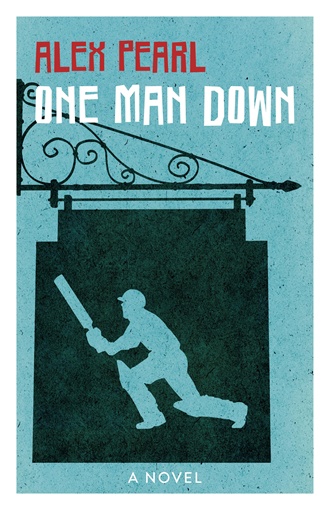
My last novel One Man Down is a comic murder mystery set in the London advertising world of 1984, and is the sequel to A Brand to Die For. Both novels can be read independently and feature the same two protagonists, Angus Lovejoy and Brian Finkle, an unlikely pair who are paired up as a creative team by their creative director, Magnus O’Shea, at the advertising agency, Gordon Deedes Rutter. Lovejoy is the product of a dysfunctional upper-middle-class family, and Finkle is the only child of two neurotic Jewish parents. Despite their differences, the two have an affinity and are on the same wavelength creatively, and as a result, produce award-winning advertising campaigns. All goes swimmingly until the pair take part in a cricket match and inadvertently stumble into a world of deceit, blackmail, and of course, murder.
The book touches on several themes. At the heart of the book is an unlikely friendship between two very different protagonists who are thrown together by chance. Together, they are hugely creative and very funny and are very successful in the cutthroat world of creative advertising in the 1980s, before the digital revolution. When a murder of a well-known photographer rocks the agency, our two protagonists apply their creative brains to try and solve the murder. Along the way, the narrative delves into various universal themes, including bereavement, mental health, deceit, and trust.
When did you start writing the book?
I started writing the book at the back end of 2023.
How long did it take you to write it?
It took me around four to five months to complete. About twice as long as the first book, A Brand to Die For.
Where did you get the idea from?
The novel is the sequel to A Brand to Die For, so the setting of the London advertising scene in the 1980s follows that book one year later. It’s an era and industry I know very well having been at the sharp end of it myself. So I didn’t have to do very much research. The storyline was developed as a detailed synopsis and many of the characters who populate the pages are based on people I knew or blends of real people.
Were there any parts of the book where you struggled?
The hardest part of writing a novel for me is the planning stage. Developing a storyline that is compelling, credible, and has a surprising conclusion, is no mean feat. It can take me longer to work this out than writing the book itself. Once I have the entire shape of the story in my head, I write a fairly detailed synopsis.
What came easily?
Once I have a road map and know where I’m going, the writing comes quite easily.
Are your characters entirely fictitious or have you borrowed from real world people you know?
Some of my characters are based very closely on real people I knew who are sadly no longer with us. Most writers (and I include myself among them) are usually a bit cagey for good reason when quizzed on the subject of their characters and whether they resemble real people. In this case, I wanted to include a couple of people I knew as affectionate portraits. And I’m sure they’d have been more than happy to have been remembered in such a way.
Lou Hart, for instance, who makes an appearance as the owner of Bunjies, a cafe and live music venue in Litchfield Street, Soho was in fact a very close family friend. He was the shortest man I have ever known, being shorter than my mother who was barely five feet tall. But what he lacked in stature he more than made up for with enormous charisma. During the war he served in the Eighth Army in Africa and was almost certainly the only man serving whose feet were so small that the army couldn’t equip him with desert boots small enough. So for the duration of the war, he carried on his person a letter from his company commander allowing him to serve in brown brogues. After the war, he won the Vernon Football pools and set himself up in business – eventually buying Bunjies. This cafe with its subterranean cellar would become one of the most iconic live music venues in London in the ‘60s. It was here that the likes of Al Stewart, David Bowie, Cat Stevens et al cut their teeth. And it was also here that one customer wasn’t let in until one of his mates had paid the entrance fee. His name was Bob Dylan.
Another character in the book is Robert Conway who is based on my brother’s colleague by the same name who was a barrister by day and would in the evening swap his wig and gown for stage makeup and perform stand-up comedy under the name Walter Zerlin junior. He would often share the bill with another talented comic – a very young Rick Mayal who he mentored. As well as performing, Robert was also a prolific writer and co-wrote ten farces – The Farndale Avenue Townswomen’s Guild productions. These were deliberately butchered productions of the classics in which everything that can go wrong does go wrong. In the very first cast was a lanky and amusing performer named Julian Clary. And in my book I contrive a scene in which Robert, Julian and others exchange banter in an Indian restaurant. Julian Clary very kindly agreed to read a couple of pages of his character’s dialogue and subsequently gave it his blessing. Robert also wrote and performed a piece entitled Running Around the Stage Like a Lunatic in which he played 17 parts including a nun with a wooden leg. The production won the prestigious Perrier Award at the Edinburgh Fringe and got him onto the Russell Harty Show. Robert died very suddenly and tragically at the tender age of 51. He was just beginning to get noticed as a writer and performer, and his obituary appeared in The Guardian. Had he survived, I’m convinced that he would have hung up his wig and gown permanently and made his name in the world of entertainment where he clearly belonged.
We all know how important it is for writers to read. Are there any particular authors that have influenced how you write and, if so, how have they influenced you?
I’m sure I’m influenced by many authors, both consciously and subconsciously. All my books have traces of humour, even The Chair Man, which is an incredibly dark book. My Lovejoy and Finkle murder mysteries are to a large extent, driven by humour and amusing situations. And I’m certainly influenced by the writing of people like Tom Sharpe and even P G Wodehouse, who have the knack of making the everyday mundane chores of life so incredibly funny. And then there’s George Orwell who writes so sparsely and beautifully. I think his writing is a masterclass in the art of brevity.
Do you have a target reader?
It’s funny, as an advertising ex-copywriter, you’d expect me to answer with a resounding, ‘yes’, but actually it’s the last thing on my mind when I sit down to write. When I used to write copy for clients, we always had to put ourselves in the shoes of potential customers and in many cases, adopt a suitable tone of voice for the brand. But writing fiction feels very different. For a start, you have a much wider and more diverse audience. It would be nigh impossible to classify your readers. So when writing, I just have to pass my own test, which is terribly simple: Were I reading this, would I find this engaging, compelling? Would I want to turn the page?
About Writing
Do you have a writing process? If so can you please describe it?
As I have already hinted, I am a planner, not a panster. I can’t write a single word without knowing where my story is going and how it’s going to end. And to be brutally honest, it’s by far the hardest part of the writing process for me. Creating a narrative that is pleasing, credible, with a suitable conclusion that isn’t obvious and disappointing is incredibly difficult and time-consuming. In some respects, having an advertising background has been very helpful because creative ads wherever they appear, are all about good ideas being beautifully executed. Novels to my mind are exactly the same. The idea behind the story and the way in which it is structured and told are the key components. So my process starts with the idea, and the idea can take a while to formulate in my head. Sometimes I have to get out of the house and go on a walk or turn it over in my head when in bed. Once I hit on the germ of an idea that I think could work, I then work on a detailed synopsis where I set out the structure of the entire story. I type this out on my PC and include character notes and names, and this can run to many pages. Once this is completed, I use it and refer to it as I write the book. It’s a road map. Sometimes my characters do unpredictable things that aren’t in my roadmap, because life is like that. But the general thread of the narrative won’t change enormously.
I find the writing process fascinating because all writers are different. During COVID, I interviewed 100 authors around the globe to delve into their backgrounds, motivations, and working methods, largely because I wanted to know how they went about this mysterious process. And I discovered that at least half of those interviewed didn’t plan their novels because they felt that doing so would somehow stifle their characters from evolving on the page and would make the storytelling feel contrived. I can see where they are coming from, but I could never write like that. In fact, I’ve tried and it just doesn’t work for me at all.
Do you outline? If so, do you do so extensively or just chapter headings and a couple of sentences?
As I say, I outline in great detail, but I don’t try to pre-guess chapter breaks. That is something that just happens naturally as I write.
Do you edit as you go or wait until you’ve finished?
That’s an interesting question. When I was a copywriter, I’d always edit as I wrote, and would just read over the piece when complete to make final edits. As a novelist, my approach is exactly the same. When I self-publish, I self-edit and use software to spell check and pick up rogue spaces and so on. My last book was published by Roundfire Books, and it was particularly satisfying that their editor made very few edits to my manuscript. It works for me, but everyone is different.
Did you hire a professional editor?
I have never hired an editor.
Do you listen to music while you write? If yes, what gets the fingers tapping?
I love all forms of music, but as a general rule I never write with music playing in the background. It would be far too distracting. It was the same when I used to work in advertising. My partner and I couldn’t abide extraneous noise when trying to think of an idea. Back in those days, we had offices and would always keep our door firmly closed. We used to baulk at the idea of the ‘open plan’ office for fear of encroaching on our quiet, creative space. This said, all my novels do include music in the narrative. One Man Down features a piano piece by Bill Evans dedicated to his brother titled, We Will Meet Again.
About Publishing
Did you submit your work to Agents?
I used to but have now given up, having received some very shoddy and questionable replies. When I penned A Brand to Die For, I received one incredibly stupid letter from an agent who couldn’t abide the fact that some of my characters were misogynistic and were foul-mouthed. And suggested that the author may have held these views. Novels are supposed to reflect the society in which we live. And I’m afraid that the advertising world of 1983 was full of sexism, misogyny, and swearing. So I don’t know what planet that particular agent was living on. And I’d like to remind him that most authors don’t hold the same views as their fictitious characters. The last rejection letter I received from an agent was peppered with typos. That, I’m afraid, was the final straw. I have no time for literary agents. They tend to be small-minded, unadventurous, and totally driven by formulas to make money. The fact that the market is now becoming flooded with books badly written by celebrities tells you everything you need to know about agents.
What made you decide to go Indie, whether self-publishing or with an indie publisher? Was it a particular event or a gradual process?
I think you can surmise from my previous answer that I don’t have time for agents. You are much better off self-publishing or approaching independent publishers, of whom there are increasing numbers. The days of the literary agent are numbered.
Did you get your book cover professionally done or did you do it yourself?
Yes. I always commission a professional designer to design my covers. John Mac, the photographer and designer did my first two. John did all the still and poster work for Guy Ritchie’s ‘Lock, Stock and Two Smoking Barrels’, so he was perfect for my gritty thriller, The Chair Man. And the Italian designer Alejandro Baigori has designed most of my other covers.
Do you have a marketing plan for the book or are you just winging it?
Despite my background in marketing, I don’t have a marketing strategy for my books. I don’t rely on them for financial remuneration, so I just wing it. I do, however, use the large American mailing list services for free and discounted offers, and have managed to shift a substantial number of e-copies through such services.
Any advice that you would like to give to other newbies considering becoming Indie authors?
Enjoy your writing. Don’t waste time with literary agents. Send your manuscript to reputable
End of Interview:
For more from Alex Pearl visit his website and follow him on Twitter.