
We’re all trying to figure out what’s going on with this life as we fly through space on a spinning rock. Who am I to say who should and shouldn’t read my book? I’d like everyone to read it!
Shane Pollard – 5 May 2026
The Back Flap
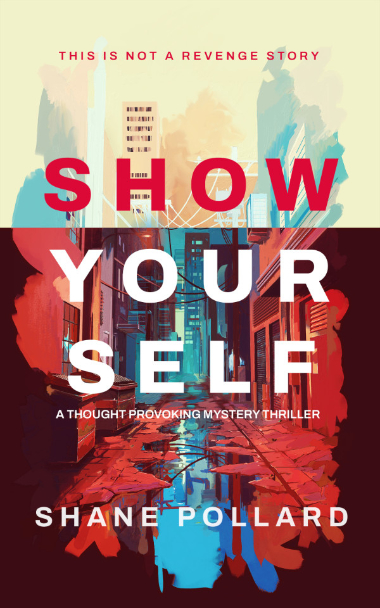
Walking home on a summer evening, Tristan’s eleven-year-old goddaughter runs ahead to hide and scare the group. A warm breeze filters through the city streets. She turns down an alley and tucks behind an old dumpster unaware of the stranger. Tristan’s best friend, James, jogs ahead of the group to catch his daughter at her own game.
James reaches the alley and turns the corner. The stranger draws a knife. In the seconds it takes for James to collapse, the worlds of those closest to him change forever.
Tristan becomes Jenavieve’s guardian. He makes her breakfast, argues with the PTA, and teaches her to cook. He also learns to disappear into crowds, lines the trunk of his car with plastic, and quietly begins hunting a killer that no one has been able to find.
Sharp, warm, and darkly funny, Show Yourself builds to a conclusion that will make you hold your breath. Shane Pollard’s debut asks not just who did it, but what you would be willing to become to make it right.
This is not a revenge story. It’s a story about what it means to be alive.
About the book
What is the book about?
It’s about a very close group of friends whose lives are shattered when one of them is murdered in front of the rest. A young daughter is left behind, with nowhere to go, and is taken in by one of the friends, Tristan. The story really follows Tristan trying to figure out how to be a father figure when he has absolutely no idea what he’s doing.
He also has no idea what he’s doing when he decides that he’s going to find the man who killed his best friend. It’s a bit quirky, with some dark humor, and occasional short chapters that are essentially conversations between Tristan and the reader—so it doesn’t feel like a typical thriller. The aim is for it to be a bit more intimate than the typical thriller.
When did you start writing the book?
The book started as scraps and sketches of an idea twenty years ago, but I didn’t sit down and begin writing it in earnest until three-ish years ago.
How long did it take you to write it?
Once I sat down, about a year.
Where did you get the idea from?
The plot came from a conversation I had while hiking with a buddy of mine back in the day. I don’t exactly know where the question came from—maybe it had to do with a movie one of us just watched or maybe it was simply one of those random, thought-experiment type of questions—but for some reason one of us said, “What would you do, seriously, if someone killed a close friend of ours?”
Were there any parts of the book where you struggled?
Definitely. The most difficult part was wrangling the twenty years of miscellaneous ideas and snippets. I had so much random material that making sense of the chaos was tough. Also, in those twenty years, I had grown and changed so much that most of what I had written over the years no longer aligned with the story I now wanted to tell. But even though they didn’t fit, I still really liked the words and ideas! Ha. I ended up having to do a lot of surgery with a chainsaw.
What came easily?
Once I stopped trying to resurrect zombie paragraphs and instead focused on writing fresh material, it just flowed. I love the process.
Are your characters entirely fictitious or have you borrowed from real world people you know?
I think, to some degree, everything we create is based on people and events we have known and experienced. I feel like that is technically unavoidable. That said, no one is a direct intentional character of anyone I know.
We all know how important it is for writers to read. Are there any particular authors that have influenced how you write and, if so, how have they influenced you?
It’s probably odd to see Shel Silverstein and Kurt Vonnegut in the same sentence, but they both wrote with incredible honesty about how they saw the world. Michael Chricton’s On Travels should be on that list as well. Stephen King, Richard Matheson, and Ray Bradbury are masters at making the otherworldly as believable as yesterday’s weather. Phillip Pulman not only created heartbreaking connections to his characters in His Dark Materials, but he somehow managed to create a bridge from a “children’s story” into an intense discussion of metaphysics. Larry Niven’s Destiny’s Road used a science fiction facade to grow a deceptively simple story of humanity. Gabrial Garcia Marquez and Voltaire were literary virtuosos—Marquez could spend three pages describing a smell and it wouldn’t be wasted reading and Voltaire could say three opposing ideas simultaneously using a single sentence. All of these are qualities that I admire and value greatly, and I have endeavored to bring some aspect of each into my own writing in whatever way I can.
Do you have a target reader?
Not really. We’re all trying to figure out what’s going on with this life as we fly through space on a spinning rock. Who am I to say who should and shouldn’t read my book? I’d like everyone to read it!
About Writing
Do you have a writing process? If so can you please describe it?
My brain is always buzzing. I write everywhere. Walking on the beach, showering, driving, everywhere. The ideas toss and tumble in my head until I am finally able to record or write them down. And they generally come in as a tangled mess. Bits and pieces from all over the shop–a smell of an idea, the texture of another, a taste of a character quirk–but while they all might be true to the story at hand, they’re often not interesting enough, or they’re too clunky or vague, so the process ends up being more about cutting things out than coming up with new material. I basically throw up on the page and try to clean up the mess until I figure out what it was that I wanted to say in the first place. Once I sort that out, I then remove all the excess until the smallest amount of effective material remains. Then I’ll start the more editing-focused passes.
Do you outline? If so, do you do so extensively or just chapter headings and a couple of sentences?
I outline the major points. I find it helps me avoid plot holes and ensures that all the important bits have logical paths connecting them. If something doesn’t make sense, I want to know about it before I write multiple chapters and fall in love with something else that has to be tossed.
Do you edit as you go or wait until you’ve finished?
I do both. I edit along the way multiple times. The first round of editing is generally for clarity, then the second is for cadence (and to make sure that I’m not excessively repeating certain excessive words or phrases excessively). Final editing is usually for grammar or anything else I missed.
Did you hire a professional editor?
I did not. I don’t necessarily enjoy editing, but I do enjoy trying to simplify an idea. I have a very strong appreciation for conveying something with the least number of words possible. However, as words are reduced the potential for misinterpretation can increase, and as I am generally trying to convey a very specific idea, for a specific reason, I tend to be quite protective of my phrasing. That said, if I could find someone on the same page, I’d love to stop looking for errors and get on with writing the next story.
Do you listen to music while you write? If yes, what gets the fingers tapping?
Absolutely! I have a passion for music, but I use it as more of a tool when I write. Sometimes I need background music to help me keep my rhythm and sometimes I need evocative music that pulls me into a specific memory and mindset. If I can’t find the right music, then I’ll shut it off. I’ll listen to almost anything though, with the only real rule I’ve discovered is that I can’t listen to new music if it has lyrics and is very engaging. It pulls me out of writing, and I end up just wanting to listen. But seriously—genre, time period, language—almost anything goes.
About Publishing
Did you submit your work to Agents?
No, and I think part of that was from lack of understanding of the business. There is so much to learn beyond the process of writing, and everyone seems to be trying to work an angle or get a cut. It was difficult to find solid information out there that I felt I could trust. My largest concern was the idea of having to compromise my art—having to prostitute a stripped-down version of my novel to make it marketable. I don’t even know if that would have been the case, but the pre-first-novel me was much more timid regarding this whole process than the post-first-novel me.
What made you decide to go Indie, whether self-publishing or with an indie publisher? Was it a particular event or a gradual process?
Some of the reasons were probably similar to why I didn’t go with an agent, but there were others as well. For a first-time author, the idea of being in a contract freaked me out. I had a ton of other ideas for future books and none of them were in the same genre. And yet at the same time, before having finished my first, I had doubts that I could even write a second. I was afraid I would have to commit to writing other novels of the same style and genre, within a certain time frame, and for an advance that was nowhere near enough to live on full-time. Also, I didn’t want to be waiting in limbo for who knows how long, to see if my book would be picked up by a corporation who would then one day finally tell me I was a published author worthy of writing other novels. Doing it the indie way, I just did it. I decided myself that I had written a novel. I didn’t need to wait for anyone’s approval. And I think that is incredibly important when creating art. It allowed me the experience and confidence to grow as a writer, with a potential future as an author. I might not ever be spectacularly successful, but I’ll sure as hell never have stalled out because I was waiting for someone to tell me I could do it.
Did you get your book cover professionally done or did you do it yourself?
I made a living as a painter-illustrator-photographer-graphic designer for a while, so I think that technically means it was done by me…professionally? That said, this was my first, so it could be up for debate.
Do you have a marketing plan for the book or are you just winging it?
Haha, originally my plan was to write a book and then “market it.” I had a general idea of how that would go, but whenever you try something new you simply don’t know what you don’t know. So, my plan and methods have developed along the way and I’ve learned a ton. My biggest mistakes were probably not doing anything ahead of time. I waited until the book was finally published before I learned anything about advertising metrics or doing any type of marketing or networking whatsoever. I’m still lagging in asking for help.
Any advice that you would like to give to other newbies considering becoming Indie authors?
Writer, editor, formatter, cover designer, legal advisor, accountant, advertiser/marketer, and public relations. Figure out which you can do, which you can learn how to do, and which you think you will need to outsource. Be honest with yourself and it’ll be less painful in the long run. Oh, and before you commit to a certain trim size make sure that your distribution method supports it. It would be a shame if you looked at your bookshelf and picked a trim size that you loved and grew up with and then designed your cover based on that size and assigned one of your not-so-cheap purchased ISBNs to the book and then found out that it’s some obscure-ish or outdated size that is apparently “American only” and now you can’t sell your paperback internationally because no one else prints in that size unless you use another ISBN for a separate international size. Not that I did that or anything.
About You
Where did you grow up?
Southern California
Where do you live now?
After bouncing back and forth from Japan, the Caribbean, and Tennessee, I’m back in Southern California.
What would you like readers to know about you?
I have no idea what I’m doing, but I appreciate every single second spent trying to figure it out. 10 out of 10, would recommend.
What are you working on now?
Still learning how to market book number one while working on books two through six in the background. And every day, trying to be a better human and artist.
End of Interview:
Get your copy of Show Yourself from Amazon US or Amazon UK.
One response to “IndieView with Shane Pollard, author of Show Yourself”