The challenge was balancing the humour and drama so the comedy did not undercut the serious parts, and the serious parts did not become heightened in the wrong places.
Benji Reid – 28 November 2026
The Back Flap
Dink Rosser has a plan.
Leave Wairoa. Move into halls. Start Health Sciences at the University of Auckland. Become a cool, independent first-year with excellent hair, excellent friends, and absolutely no emotional damage worth discussing.
Simple.
Unfortunately, Auckland has other ideas.
For the first time in his life, Dink is away from home, away from small-town gossip, and away from the people who have always known exactly who he is. Or who they think he is. Being Maori/Pakeha, gay, loud, anxious, and constantly mistaken for his polished twin brother Braden has never been simple, but university is meant to be different. Bigger. Freer. Easier to disappear into.
Then his old mate Rawiri turns up at Tennyson Brown Hall acting like he owns the city.
Rawiri has been in Auckland for a year already. He knows the shortcuts, the parties, the people, the rules. He should be the perfect guide to Dink’s new life. But something about him is off. He is jumpy, evasive, always being pulled aside by people Dink does not know, and always one step away from telling the truth before laughing it off.
Dink wants to believe his mate is just popular.
He wants to believe Braden is only being difficult because that is what Braden does.
He wants to believe one bad night out is just one bad night out.
But when notes start appearing, strangers start asking questions, and Dink gets caught in a mess that was never meant for him, his fresh start begins to crack. In a city full of new faces, having the wrong one can be dangerous.
Told through Dink’s chaotic, funny, and painfully honest diary voice, Dink: Diary of a Wairoa Boy is a New Adult coming-of-age novel about first-year freedom, queer survival, friendship, identity, brotherhood, and the messy search for belonging when every joke is hiding something sharper underneath.
For readers who like New Zealand campus stories, complicated twins, queer characters with bite, small-town boys in big-city trouble, and humour that keeps swinging even when the story gets dark.
About The Book
What is the book about?
Dink: Diary of a Wairoa Boy is about Dink Rosser, a small-town Maori and Pakeha teenager from Wairoa who moves to Auckland for his first year of university and quickly feels lost in the sea of people. While he is trying to find his feet, he gets dragged into trouble outside his control because of his friend’s hidden dealings, and people start targeting Dink as a way to get to him.
At the same time, Dink is dealing with mistaken identity, because his identical twin brother Braden is sometimes confused for him, and with his own need to fix things that may not be fixable. Along the way, new friends and connections help protect Dink and keep him grounded, while he tries to protect his friend, stay safe, keep his sanity, and somehow keep up with university.
Through all of this, Dink is also trying to build a better connection with Braden, even when those attempts go comedically wrong.
When did you start writing the book?
I started writing the book around the end of last year or the beginning of this year. Dink had already appeared in another book I had written, and he stood out to me as such a likeable and relatable character that I wanted to focus more on him. That eventually turned into a new series based around his character.
How long did it take you to write it?
It took about three to four weeks to write. I already had a lot of the ideas sitting there, so part of the process was putting Dink into interesting situations and seeing what worked.
I also already knew the later version of Dink from the earlier book: calm, relaxed, and more passive, with hints that he had not always been that way. This book became a way to reverse-engineer him. I started with a more erratic, ADHD-coded version of Dink and followed the journey that begins turning him into the character readers meet later.
Where did you get the idea from?
The idea goes back to 1996, when I was at university and a few friends and I used to entertain each other with short random stories. Those stories were set around university students living in a hall of residence, and Dink Rosser was the character I created back then. He stayed with me for decades.
The Dink Diaries is also a prequel series to the earlier book I wrote, so it lets me explore who Dink was before the calmer version of him who appears there.
Were there any parts of the book where you struggled?
The parts I struggled with were usually the practical details. For example, there is a scene involving an ATM withdrawal, and I spent more time than expected checking how much someone could realistically take out in a day. I am happy to use creative license where it serves the story, but I did not want details like that to feel careless or obviously wrong.
I also struggled with keeping the university schedule and timeline accurate. Because the story is grounded in a real university setting, I wanted the dates, classes, and sequence of events to line up properly, rather than bending reality just because it was convenient for the plot.
I also wanted the university experience to feel lived-in and believable: the start-of-year rush, the student mindset, the pressure, confusion, excitement, and all the ordinary things students have to deal with. I wanted it to feel like a real place, with real young people trying to find their footing.
What came easily?
The character’s personality came easily. I felt like I already knew Dink, so his voice and humour were natural to write. He is an extension of me in some ways, especially in how he uses comedy alongside more dramatic moments. The challenge was balancing the humour and drama so the comedy did not undercut the serious parts, and the serious parts did not become heightened in the wrong places.
Are your characters entirely fictitious or have you borrowed from real world people you know?
The characters are fictitious. I did not set out to copy real people. A lot of them began as story functions: I knew the plot points and situations I wanted Dink to encounter, and I created characters who could help move him toward those moments. From there, I shaped them into fuller, more realistic people with their own personalities, motives, and place in the story.
One character was carried over from the earlier book because he already fit what this story needed. He gave Dink a connection that helped him feel safer, while also serving the wider function of the plot.
We all know how important it is for writers to read. Are there any particular authors that have influenced how you write and, if so, how have they influenced you?
Stephen King has influenced me in the way he gives characters strong, lived-in backgrounds, even when they only play a small role in the wider story. Alan Duff has influenced me in a similar way. I like characters to feel as though they existed before the book began, with their own histories, damage, humour, and reasons for being the way they are.
Do you have a target reader?
The target reader is late teens and early twenties, especially high school leavers and first-year university students who are entering that world themselves. I also think adult readers may enjoy it, particularly parents or older readers who want a funny, honest look at what young people can get up to when they leave home and start university.
About Writing
Do you have a writing process? If so can you please describe it?
I usually start with one big plot idea or destination, then work out how the characters get there and what needs to happen along the way. With this book, I knew Dink was leaving home for university, but I also wanted him to arrive with an existing connection to that world through his friend. That meant thinking about what had happened while Dink was still at high school and his friend was already at university, then building the larger plot from that background.
Once the main structure is there, I keep adding smaller details, relationships, and bits of history until the world starts to feel lived in rather than just built around the plot.
Do you outline? If so, do you do so extensively or just chapter headings and a couple of sentences?
I outline quite extensively. I use a story circle, popularized by Dan Harmon, as a way to map the main emotional and plot beats. A story circle follows a character as they start in a familiar place, want or need something, enter an unfamiliar situation, adapt to it, get what they were after, pay a cost, return changed, and then have to live with that change.
The whole story has its own story circle, but each act, chapter, and major character can have their own story circle as well. That gives me a way to track where everyone is emotionally and narratively, and it helps me know what targets I need to hit for the story to feel right.
Do you edit as you go or wait until you’ve finished?
I edit as I go and again at the end. Sometimes, while I am writing, I will realise that a later moment, joke, or easter egg would work really well. When that happens, I go back and plant the seed earlier so the payoff feels earned.
Did you hire a professional editor?
No, I did not hire a professional editor.
Do you listen to music while you write? If yes, what gets the fingers tapping?
I do listen to music, but often I write my own music instead of relying on existing playlists. Sometimes it is hard to find songs that give me the right motivation, inspiration, or pacing, so I create music that fits the story.
For The Dink Diaries, I wrote around a dozen songs connected to Dink. They each have a story relating to him, and I play them in the background on a loop to help me keep the tone I am trying to set within a chapter. I also have them on Spotify so I can listen to them away from home.
About Publishing
Did you submit your work to Agents?
No, I did not submit the book to agents. I published through Draft2Digital and Amazon.
What made you decide to go Indie, whether self-publishing or with an indie publisher? Was it a particular event or a gradual process?
The standard publishing route felt too slow for what I wanted to do. I had all these ideas I wanted to write and get out into the universe, just to see what would happen with them.
It was not mainly about making money or becoming famous. It was about creating something tangible with my own mind and hands, then letting it out into the world. If people connect with it, that is even better.
Did you get your book cover professionally done or did you do it yourself?
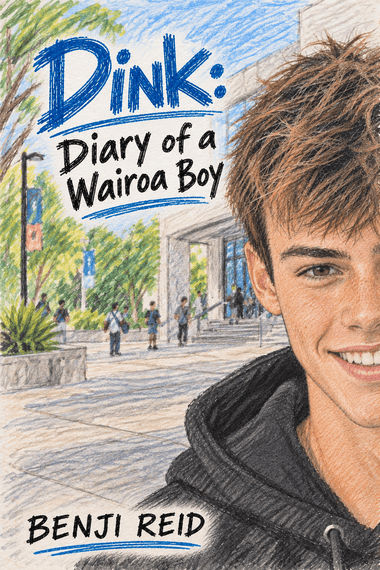
I did the book cover myself. Finding the right person, briefing them, waiting on the process, and paying for it can be time-consuming and difficult, so doing it myself gave me more control and kept things moving.
Do you have a marketing plan for the book or are you just winging it?
I am not winging it completely, but I am still building the plan as I go. I have been using review requests and interviews, the book website, a short TikTok video, Amazon and Draft2Digital, and the related music as ways to help people discover the book.
Any advice that you would like to give to other newbies considering becoming Indie authors?
Just do it. There is nothing stopping you except the belief that you have to wait for permission.
About You
Where did you grow up?
I grew up in a small northern Hawke’s Bay town in New Zealand.
Where do you live now?
I now live back in that same northern Hawke’s Bay town, after living around New Zealand and overseas before settling back here.
What would you like readers to know about you?
I love creativity in all its forms, including writing books, making music, and creating videos. I am happiest when I am using my brain to make something instead of feeling like the day has slipped by unused.
What are you working on now?
At the moment, I am mainly working on music. I have also finished another book called Tami and the Kumara, which draws on the Maori proverb about how the kumara does not say how sweet it is. It is about humility, and follows a boy who thinks he is humble because he keeps telling himself he is a kumara, until he meets someone who quietly lives those qualities for real.
End of Interview:
For more from Benji Reid visit his website.
Get your copy of Dink: Diary of a Wairoa Boy from Draft2Digital.