I usually take my ideas from life itself and pass them through a speculative filter. The core idea behind Time Clocks came from my own realization that we often fail to give the present the attention it deserves.
Yoav Avni – 27 November 2026
The Back Flap
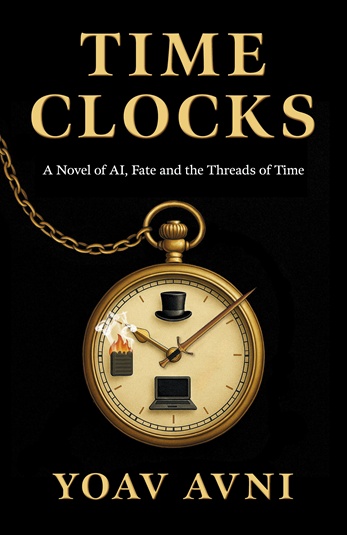
Time Clocks is a time-travel novel about learning to be present.
Boaz Grand is an AI developer whose system, FocalAI, has become famous for producing cryptic prophetic limericks on a popular television show. One unfortunate appearance on the show ends with Boaz losing his job.
On his way home, he encounters three people who seem to have arrived in present-day Israel from completely different periods of history: a biblical shepherd, a nineteenth-century Frenchman, and a policewoman from the 1980s. Somehow, their arrival appears to match part of FocalAI’s latest limerick, drawing Boaz into a much larger mystery involving artificial intelligence, friendship, memory, and time.
But beneath the time travel, the novel is really about our relationship with the present: learning to recognize it, feel at home in it, and accept that it is the only part of time we can actually live in.
About the book
What is the book about?
Time Clocks is a warm, funny, human time-travel novel about learning to be present.
It follows Boaz Grand, an AI developer in present-day Tel Aviv whose system, FocalAI, produces cryptic prophetic limericks. After publicly dismissing the prophecies and losing his job, Boaz encounters three strangers who appear to have arrived from completely different periods of history: a policewoman from the 1980s, a nineteenth-century Frenchman, and a biblical shepherd-warrior.
As Boaz tries to understand why they are here and whether their arrival is connected to the system he helped create, the four are drawn into a mystery involving artificial intelligence, memory, prophecy, friendship, and an unexpected love story. At its heart, though, the book is about something simpler: how difficult it can be to truly inhabit the present.
When did you start writing the book?
I started writing Time Clocks in 2023. The Hebrew edition was published in Israel in January 2025. I translated the novel into English during 2025, and it is now being published by Roundfire Books in September 2026.
How long did it take you to write it?
About a year and a half.
Where did you get the idea from?
I usually take my ideas from life itself and pass them through a speculative filter. The core idea behind Time Clocks came from my own realization that we often fail to give the present the attention it deserves. We obsess over mistakes in the past and anxieties about the future, while the present becomes almost the middle child of time.
I tend to think of a good idea as a thought carrying an electrical charge, something that immediately begins generating characters, scenes, and questions. This was definitely one of those ideas.
Were there any parts of the book where you struggled?
I plan a novel quite carefully before I begin writing, so by the time I start drafting, I usually know exactly where I am going. Even so, there are always moments when a scene resists or a character takes longer to understand. I tend to work through those moments alongside the characters rather than forcing my way past them.
What came easily?
Surprisingly, I loved writing the prophetic limericks produced by the AI system in the novel. They were playful, strange, and slightly ridiculous, but they also had to carry real narrative weight. That balance came very naturally to me, and I had a lot of fun with it.
Are your characters entirely fictitious or have you borrowed from real world people you know?
Always, to some degree. After careful calculations, I can say that Boaz Grand, the protagonist, is about 86% me.
The rest of the characters are also made from bits and pieces of people I know, people I have met, and people I have imagined. I do not usually copy anyone directly. I borrow gestures, habits, ways of speaking, contradictions, and then let the character become someone new.
We all know how important it is for writers to read. Are there any particular authors that have influenced how you write and, if so, how have they influenced you?
Jerome K. Jerome, Douglas Adams, Tom Robbins, and Kurt Vonnegut are probably the four writers I return to most often. What I admire in all of them is the ability to be funny without becoming lightweight, imaginative without losing emotional truth, and serious without becoming solemn. I also love writers such as Ian McEwan, Gerald Durrell, David Mitchell, and Mark Twain. More than anything, they remind me that style, humor, humanity, and story do not have to compete with one another.
Do you have a target reader?
I am usually my own Reader Zero. I write the books I want to read and cannot find on the shelf yet. If the book surprises me, moves me, makes me laugh, and keeps me curious, then I trust that there are other readers out there looking for the same thing.
About Writing
Do you have a writing process? If so can you please describe it?
Yes. It starts with a persistent thought that gradually turns into an idea for a book. From there, I work out who the characters are, shape the structure, and only then begin drafting. I plan very carefully, but that preparation gives me more freedom once I start writing.
Do you outline? If so, do you do so extensively or just chapter headings and a couple of sentences?
Extensively. Before I start writing, I build a detailed skeleton for the novel, chapter by chapter. I want to know what each chapter needs to do, what changes in it, what is revealed, and where the characters are heading. Once that framework is in place, I can write much more freely inside it.
Do you edit as you go or wait until you’ve finished?
Both. I stop at certain points and edit a group of chapters before moving on, especially when I reach a natural break in the novel. Once the full draft is finished, I read it again and again, revising each time. By the time I submit a manuscript to my publisher, I know it almost by heart.
Did you hire a professional editor?
My editors have always come through my publishers as part of the traditional publishing process, so I have never hired an editor independently.
Do you listen to music while you write? If yes, what gets the fingers tapping?
No. I need quiet when I write. My internal metronome is enough to keep my fingers moving.
But every novel I write somehow acquires its own theme song, for reasons that are sometimes obvious and sometimes known only to me. For Time Clocks, it was Cyndi Lauper’s “Time After Time,” in all its glorious 1980s form.
About Publishing
Did you submit your work to Agents?
No. My Hebrew books have always been published traditionally in Israel, and Time Clocks reached Roundfire Books through a different route rather than through an agent.
What made you decide to go Indie, whether self-publishing or with an indie publisher? Was it a particular event or a gradual process?
I did not really make a decision to “go indie.” My books have always been traditionally published. Roundfire Books is an independent publisher, but what mattered to me was finding a publisher that understood the novel and wanted to build a longer-term relationship with my work.
Did you get your book cover professionally done or did you do it yourself?
The cover was created professionally by my publisher as part of the publication process.
Do you have a marketing plan for the book or are you just winging it?
Definitely a plan. I work closely with my publisher and publicist, but I also take an active role myself: interviews, reviews, guest pieces, podcasts, events, social media, and direct outreach to readers and literary outlets. I prefer planning carefully, but I also leave room for opportunities that appear unexpectedly.
Any advice that you would like to give to other newbies considering becoming Indie authors?
I would hesitate to give advice specifically about self-publishing, because that has not been my route. But I would say this to any writer: take the work seriously, understand what you want from publication, and do not confuse finishing a manuscript with finishing the job. The writing comes first, but editing, presentation, persistence, and finding the right readers all matter too.
About You
Where did you grow up?
I grew up in Israel, mostly in central Israel. As a child, I lived for a while in a small village, which probably helped develop my habit of observing people, places, and the small details that later find their way into fiction.
Where do you live now?
I live in Tel Aviv, which is also the setting for much of Time Clocks.
I travel a lot as well. I believe in movement, both physical and mental, and in wandering without always needing a destination. Travel expands life: it changes your scale, your habits, your point of view, and sometimes your writing. Britain and Greece are the two countries I return to most often, and both have become important parts of my personal geography.
What would you like readers to know about you?
I have koumpounophobia, a fear of buttons. It sounds odd to some people, but it has always made perfect sense to me. There is something about certain buttons, especially the wrong kind in the wrong place, that I find deeply unpleasant.
What are you working on now?
Several projects are moving at once. A children’s book I wrote for my daughter years ago is being published in Israel this year. My next Hebrew novel has been accepted by Keter, my Israeli publisher, and is entering the editing process. And in English, Crossing a River Twice will be published by Roundfire Books in December 2027.
End of Interview:
For more from Yoav Avni, visit his website.
Get your copy of Time Clocks from Amazon US.