One of the challenges was balancing the real history with the fantasy. I wanted the historical battles and settings to remain recognizable without letting the history slow down the story.
Karl Kunz – 25 November 2026
The Back Flap
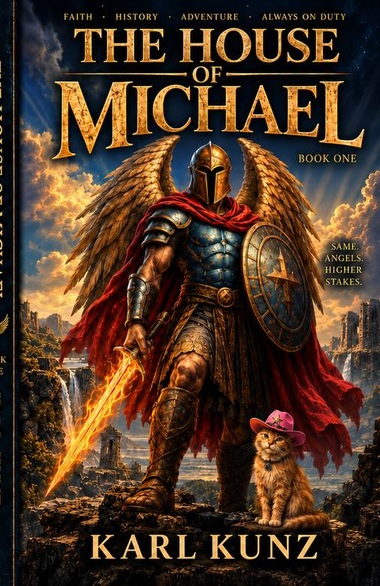
The House of Michael is an urban fantasy with a military-history twist. The story imagines the fourth dimension as a corporate workspace and military garrison where immortal warriors move through human history, recruiting and protecting some of Earth’s greatest fighters while defending humanity against supernatural threats. Real battles and historical events form the backbone of the story, but the novel approaches them through fantasy, satire, action, and a fictional spiritual-war framework. Battle maps and historical settings help connect the fictional adventure to events that actually happened.
About the Book
What is the book about?
The House of Michael is about immortal warriors who move across human timelines from a fourth-dimensional military and corporate headquarters. Their job involves protecting humanity, defending divine interests, and recruiting some of history’s greatest warriors. What makes the book different is that much of the fantasy is built around real military history. Actual battles, military events, and historical settings become part of the fictional story. I wanted readers to be entertained by the fantasy while also recognizing that there is genuine history underneath it.
When did you start writing the book?
I wrote the first few chapters about two years ago. I then put the project aside while I wrote The Dragon Wars of Texas. After The Dragon Wars of Texas was released, I returned to The House of Michael and finished it.
How long did it take you to write it?
The project stretched over roughly two years, although I was not working on it continuously. I stopped after the first few chapters to concentrate on writing and releasing The Dragon Wars of Texas, then came back and completed The House of Michael afterward.
Where did you get the idea from?
The idea grew out of my interest in history and the thought that the fourth dimension could be treated almost like an office or military installation rather than simply as something mysterious. I liked the contrast between something enormous and supernatural and something almost bureaucratic. From there, I began imagining immortal warriors moving through history and recruiting people who had already proved themselves in real battles. That gave me a way to combine fantasy with military history instead of inventing an entirely separate world.
Were there any parts of the book where you struggled?
One of the challenges was balancing the real history with the fantasy. I wanted the historical battles and settings to remain recognizable without letting the history slow down the story. Another challenge was making the fourth-dimensional world feel unusual while still giving it rules and a structure readers could understand.
What came easily?
The characters, humor, and basic concept came more naturally. Once I had the idea of the fourth dimension functioning as a military garrison and workplace, a lot of the situations developed from that. The historical material also gave me a strong foundation. Instead of starting every scene from nothing, I could work from real events and ask, ‘What if there were another story happening behind this one?’
Are your characters entirely fictitious or have you borrowed from real world people you know?
The central characters are fictional, although the novel interacts with real history and historical events. Like most writers, I think pieces of people we have known, observed, or worked with can find their way into characters, but the major characters in The House of Michael were created for the story rather than being portraits of specific people.
We all know how important it is for writers to read. Are there any particular authors that have influenced how you write and, if so, how have they influenced you?
Mark Twain, J.R.R. Tolkien, Kurt Vonnegut, and Michael Moorcock have all influenced me in different ways. Twain showed how humor and satire can exist alongside serious ideas. Tolkien demonstrated how deeply a writer can build a world and give it a sense of history beyond the immediate story. Vonnegut showed how unusual ideas, satire, and a straightforward voice can work together. Moorcock demonstrated how fantasy can be fast-moving, imaginative, and willing to take risks. I do not try to imitate any of them, but I appreciate writers who build distinctive worlds and still give readers something deeper underneath the story.
Do you have a target reader?
I think the book can appeal to several kinds of readers: people who enjoy urban fantasy, military history, historical fiction, supernatural stories, and action-adventure. A reader does not have to be a military-history expert. In fact, part of the idea is that someone may enjoy the story first and become curious about the real historical events afterward.
About Writing
Do you have a writing process? If so can you please describe it?
My process usually begins with the central idea and the world around it. I like to establish what makes the story different before worrying about every detail. With The House of Michael, the basic concept of the fourth dimension as a functioning military and corporate environment came first. From there, I could move the characters through different historical events and build the story around those encounters. I also revise heavily. I am willing to move material, rewrite sections, change pacing, and keep refining the book until the story feels right.
Do you outline? If so, do you do so extensively or just chapter headings and a couple of sentences?
I use structure, chapters, and major events as guideposts rather than trying to lock every sentence into an outline before I begin. For a book like The House of Michael, the historical battles also create natural structural points because certain events have to happen in a particular historical order.
Do you edit as you go or wait until you’ve finished?
Both. I revise while I am writing, but I also go back through the completed manuscript and make additional passes for pacing, consistency, wording, and formatting. I tend to keep improving a project rather than treating the first completed draft as the finished book.
Did you hire a professional editor?
No. I did not hire a professional editor. I handled the editing and revision process myself through repeated passes over the manuscript.
Do you listen to music while you write? If yes, what gets the fingers tapping?
Usually, I do my best writing when my wife is watching Real Housewives of Wherever in the background. Music is actually more of a distraction for me. Because of my own musical background, I tend to stop listening passively and start analyzing it. Pretty soon the music becomes a competition for my attention, so I usually write better without it.
About Publishing
Did you submit your work to Agents?
I did not build this project around finding an agent. I chose to publish The House of Michael independently, although I am now exploring traditional publishing opportunities for some of my other work.
What made you decide to go Indie, whether self-publishing or with an indie publisher? Was it a particular event or a gradual process?
It was more of a gradual process. Independent publishing gave me the ability to finish projects, make decisions about the design and presentation, and put the work in front of readers without waiting indefinitely for someone else to give permission. It also fits the way I work creatively because I am not only a writer. I am a visual artist and songwriter as well, and I like being able to bring those different areas together. That eventually led to Prometheus Fire Place, the website where I bring my books, art, music, and songwriting work together.
Did you get your book cover professionally done or did you do it yourself?
I created the cover myself. I first mapped the design out by hand and then used imaging software to build the final version and bring it up to Amazon’s technical publishing standards. That process let me keep control of the visual concept while still producing a finished cover suitable for publication.
Do you have a marketing plan for the book or are you just winging it?
I definitely have a plan, although it continues to evolve. I have been concentrating on direct outreach rather than depending heavily on social media. That includes bookstores, libraries, military-history organizations, reviewers, museums, literary sites, newsletters, and other groups whose audiences might genuinely have an interest in the books. I also created Prometheus Fire Place as a central home for all of the projects so that outreach for one book can introduce people to the rest of my work. I prefer finding the audience that is actually interested in a project rather than simply trying to advertise everywhere.
Any advice that you would like to give to other newbies considering becoming Indie authors?
Finish the work. It is very easy to spend all your time thinking about publishing, marketing, covers, websites, platforms, and everything else that surrounds a book. None of that matters if the book itself never gets finished. After that, be prepared to keep improving it. Publishing independently gives you freedom, but it also means you are responsible for things a traditional publisher would normally handle. You have to be willing to learn. I would also tell people not to assume that putting a book online automatically means people will discover it. You still have to find the audience and give them a reason to care about the book.
About You
Where did you grow up?
I grew up in Bryan, Texas. I am the son of educators, so learning, teaching, and education were always part of the environment around me.
Where do you live now?
I live in Richardson, Texas.
What would you like readers to know about you?
I work across several creative fields rather than staying in one lane. I am an author and visual artist, and I have also spent many years writing and playing music. I am a guitarist with studio experience, and I am familiar with banjo, bass, and piano as well. I also come from a family of educators, and teaching has remained part of my own life. That background carries into projects such as The Art of the Hook, where songwriting and education come together. My projects range from fantasy novels to art-and-history books, songwriting instruction, original paintings, and recorded music. Prometheus Fire Place grew out of the idea that all of those things belong under one roof.
What are you working on now?
I have several projects in different stages. I have continued developing The Dragon Wars of Texas, including a second book, while also expanding The Art of the Hook, my practical songwriting book and educational project. I am also continuing to develop my visual-art collections, music projects, and Prometheus Fire Place as the central home for the work. The common thread is that I am interested in making things—books, paintings, songs, and other creative projects—and then finding ways to put them directly in front of people who might enjoy them.
End of Interview:
For more from Karl Kunz, visit his website.
Get your copy of The House of Michael from Amazon US or Amazon UK.