I want people who have lived in that world to recognize pieces of themselves and feel that the experiences and the weight that can come with these careers are being portrayed honestly. But I also write for people who have never worn a badge and simply want a better understanding of that world—what these men and women experience, how they react to it, and what can follow them home when the shift is over.
Steven Rousell – 20 November 2026
The Back Flap
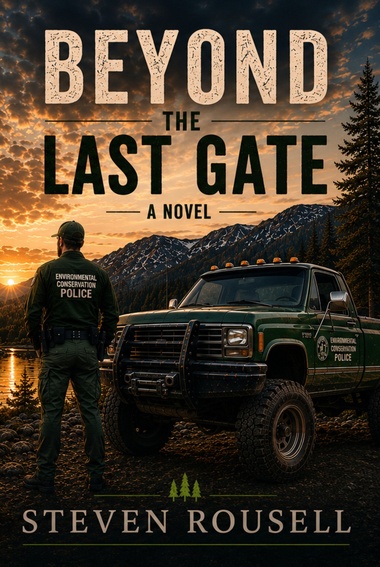
A son steps into a life of service under a very different kind of badge. Beyond the Last Gate follows the son of the main character from The Other Side of the Badge as he grows into his own man and builds a career as a DEC officer. His calls take him into the woods, onto the water, and into situations where judgment, courage, and responsibility can matter in an instant. The badge may be different from his father’s, but the weight can be just as real. As the incidents add up, he learns that some parts of the job do not stay behind when the shift ends. Beyond the Last Gate is a story about service, family, faith, the outdoors, and the unseen weight carried home by the people behind the badge.
About the Book
What is the book about?
Beyond the Last Gate follows the son of the main character from my second book, The Other Side of the Badge. It gives readers a chance to watch him grow into his own man and build his own career as a DEC officer. He carries a different kind of badge than his father did, and the situations he faces are different, but there are some strong parallels between them. He deals with his own dangerous calls, difficult decisions, and experiences that most people never see. And just like his father, he eventually learns that the weight of wearing a badge doesn’t always stay at work when the shift ends. Some of it follows you home.
When did you start writing the book?
The ideas for Beyond the Last Gate actually started forming while I was still writing The Other Side of the Badge. As I was developing that story, I started thinking about what life might look like for his son and how wearing a different kind of badge could affect him in his own way. I began writing Beyond the Last Gate almost immediately after finishing The Other Side of the Badge, while those characters and ideas were still fresh in my mind.
How long did it take you to write it?
I would say Beyond the Last Gate took me somewhere around four to six months to write. Because I had already started thinking about the story while I was finishing The Other Side of the Badge, I was able to move into it pretty quickly. The characters and the direction I wanted to take the story were already fresh in my mind, so there really wasn’t much of a break between the two books.
Where did you get the idea from?
The idea came partly from my own life. At one point, I seriously considered pursuing a career as a DEC officer myself. I did some schooling toward it, and I’ve always been an outdoorsman, so over the years I’ve also had opportunities to see DEC officers doing their jobs firsthand. That career ended up not being the path I took, but the interest in it never really went away. When I was writing The Other Side of the Badge and thinking about where I could take the story next, having the son pursue that career felt natural. It also gave me the opportunity to explore a completely different kind of law enforcement while still showing that carrying a badge—whatever kind of badge it may be—can come with its own responsibilities, dangers, and weight.
Were there any parts of the book where you struggled?
One of the biggest things I struggled with was incorporating faith into the story naturally. My faith is important to me, and I knew I wanted it to have a meaningful place in Beyond the Last Gate. At the same time, I didn’t want it to feel forced or like I was preaching to the reader. I wanted the character’s faith to develop through what he experiences—the difficult calls, the things he carries home, his relationships, and the moments when he starts looking for something beyond himself to help make sense of it all. Finding that balance took some work. I wanted faith to be there for the readers who might connect with it or even need it, while still allowing the story and the characters to speak for themselves.
What came easily?
The incidents and the characters’ reactions to them probably came the easiest. I tend to picture situations in my head almost like I’m watching a movie. I can see where everyone is, what is happening around them, how someone would react, and how the whole scene would play out before I ever put it on the page. Some of that probably comes from my own experiences and from spending so much of my life outdoors and around nature. Once I can see a scene clearly in my head, writing it down and bringing the reader into that moment comes pretty naturally to me.
Are your characters entirely fictitious or have you borrowed from real world people you know?
Most of my characters are fictional, but when I create them, I usually have a real person in mind. I find that makes it much easier to give a character a genuine personality instead of just creating a list of traits on paper. I might borrow someone’s sense of humor, mannerisms, attitude, the way they talk, or how they react to certain situations. From there, the character usually starts becoming their own person as the story develops. So the characters aren’t necessarily portrayals of specific people from my life, but there are definitely pieces of real people woven into many of them.
We all know how important it is for writers to read. Are there any particular authors that have influenced how you write and, if so, how have they influenced you?
Definitely. James Patterson, Vince Flynn, Tom Clancy, and Alex Berenson are some of my favorite authors. I’ve always enjoyed books that keep moving and make you want to read one more chapter before putting them down. I also like stories with suspense, action, strong characters, and situations that feel real enough that you can picture yourself there. I think reading those authors has influenced the way I approach my own writing. I try not to let a story sit still for too long. I want readers to become invested in the characters, but I also want them wondering what is going to happen next.
Do you have a target reader?
Absolutely. I especially want these books to reach correction officers, law-enforcement officers, first responders, and their families. I want people who have lived in that world to recognize pieces of themselves and feel that the experiences and the weight that can come with these careers are being portrayed honestly. But I also write for people who have never worn a badge and simply want a better understanding of that world—what these men and women experience, how they react to it, and what can follow them home when the shift is over. And, of course, anyone who enjoys realistic action, suspense, and stories about the people behind the uniform.
About Writing
Do you have a writing process? If so can you please describe it?
My writing process probably looks a little chaotic from the outside. When I get an idea, I write it down immediately. I usually end up with piles of random scraps of paper covered with notes—scenes, characters, incidents, pieces of dialogue, or just an idea that happened to come to me that day. Eventually, I start organizing those notes into some kind of sequence, usually in a much neater—and hopefully more legible—form. As the story develops, those individual ideas start turning into scenes in my head. It’s almost like I’m writing a movie script and watching the story play out at the same time. I may already have an idea written down that doesn’t belong until much later in the book, so when I finally reach the point where it fits, I weave it into the story and expand on it. That’s really how my books come together—one idea leads to another until all those random scraps of paper start becoming a complete story.
Do you outline? If so, do you do so extensively or just chapter headings and a couple of sentences?
I kind of wing it when it comes to outlining. I have all of those notes and ideas I’ve collected, so I usually know certain things I want to happen, but I don’t sit down and map out the entire book chapter by chapter before I start writing. I like having enough freedom to let the story develop as I go. Usually, when I begin a chapter, I’ll think ahead and ask myself, “Okay, where do I want this chapter to end?” Once I have that point in mind, I work toward it and use my notes and ideas wherever they fit naturally along the way. Sometimes the story takes me somewhere I hadn’t originally planned, and I actually like that. It keeps the writing interesting for me too.
Do you edit as you go or wait until you’ve finished?
I definitely edit as I go. After I get through so many chapters, I’ll go back and reread everything I’ve written. I’m looking for continuity problems, things that don’t line up correctly, spelling and punctuation mistakes, and anything that just doesn’t read the way I intended it to. Then, of course, I’ll go through it again once the manuscript is finished. If I’m being completely honest, editing is probably the part of writing I enjoy the least. I’d much rather be creating the story and figuring out what happens next than going back and hunting for a missing comma.
Did you hire a professional editor?
No, I try my best to handle the editing myself. I also have other people look over the proofs because sometimes another set of eyes will catch something you’ve read right past a dozen times. And thank God for technology and some of the apps available now. I have tools where I can submit my writing and have it gone through almost like one of my old English teachers is standing over my shoulder, pointing out everything I did wrong. I may not enjoy the editing side of writing nearly as much as creating the story, but those tools definitely make the process easier.
Do you listen to music while you write? If yes, what gets the fingers tapping?
Actually, no. I prefer peace and quiet when I write—unless you count the sounds of nature as an interruption. I like being able to focus on whatever scene is playing out in my mind without a lot of other noise competing with it. Sometimes I get completely zoned in and really get on a roll, and I’ll stay there until life inevitably butts in and interrupts my train of thought. Those quiet stretches are usually when some of my best writing gets done.
About Publishing
Did you submit your work to Agents?
No, I haven’t submitted my work to agents. When I started, my plan was simply to write my story and finish my first book. I wasn’t really thinking about building a series of books or trying to establish myself as an author. But while I was writing that first book, ideas for another one were already popping into my head. Then came more characters, more stories, and more ideas. Writing became an addictive hobby for me—one that I genuinely enjoy. I’m really just now beginning to focus on advertising, getting my name and my work out there, and finding a larger audience. One of the things I want most at this stage is genuine feedback and reviews from readers. I want to know what connects with them, what doesn’t, and where I can improve while continuing to develop my own style.
What made you decide to go Indie, whether self-publishing or with an indie publisher? Was it a particular event or a gradual process?
I would say it was a gradual process. When I wrote my first book, I wasn’t thinking about agents, publishers, or really even building a career as an author. I had a story I wanted to tell, and I wanted to see if I could actually turn it into a book. Self-publishing gave me the opportunity to do that while keeping control over my story and how I wanted to tell it. Once that first book was finished, though, I realized I wasn’t finished writing. I already had more ideas, and before long one book started leading to another. That’s when this went from simply wanting to tell one story to realizing that writing had become something I genuinely loved doing. Going indie has allowed me to learn every part of the process as I go—from writing and editing to covers, formatting, publishing, and now marketing. I’m still learning, but I like having that control and being able to put out the stories I want to tell without having to change them into what someone else thinks they should be.
Did you get your book cover professionally done or did you do it yourself?
I designed the covers myself with the help of some different apps and design tools. I usually have a pretty clear picture in my head of what I want the cover to say about the story before someone even opens the book. I’ll experiment with different ideas until something finally feels right. It’s another part of the indie process I’ve enjoyed learning, and there’s something satisfying about being involved in the book from the first idea all the way through to what the reader eventually sees on the cover.
Do you have a marketing plan for the book or are you just winging it?
A little bit of both, honestly. In the beginning I was definitely winging it and learning as I went. Now I’m starting to put together more of an actual plan. I’ve built my author website, started reaching out directly to bookstores, reviewers, and sites like this one, and I’m learning more about Amazon advertising and expanded distribution. I’m also using some social media, word of mouth, and giving out free samples to introduce people to my writing. Right now, my biggest goal isn’t necessarily to sell as many books as possible overnight. I want to get my name and my work in front of more readers, build some genuine reviews and feedback, and hopefully grow an audience that wants to stick around for the next book. I’m still figuring out what works and what doesn’t, but that’s part of the process.
Any advice that you would like to give to other newbies considering becoming Indie authors?
Just start writing and let it take you wherever it takes you. Your imagination is the ink for your pen, but if you never start, you definitely won’t ever finish. Don’t convince yourself that you need to have the entire book figured out before you write the first page. Put the first idea down and see where it leads. That’s basically what I did. I started because I had one story I wanted to tell. Then that story led to another idea, which led to another book, more characters, and more stories I wanted to explore. I started writing, and now I don’t want to stop.
About You
Where did you grow up?
I grew up in the North Country of New York State, in Malone, not far from the Canadian border. It’s a rural part of the state where the outdoors is a big part of life, and I think growing up there had a lot to do with developing my love for hunting, fishing, and being outside. That connection to the area and the outdoors has definitely found its way into my writing, especially in Beyond the Last Gate.
Where do you live now?
I’m still living, working, and now writing here in the North Country. I did move to Tennessee for a short period of time, but life eventually led me back home. This is where my roots are, and in a lot of ways it’s also where many of my stories have their roots.
What would you like readers to know about you?
I’d like readers to know that there are real, raw experiences and emotions behind these stories. I’m currently a correction officer, so although my novels are fiction, I understand firsthand some of the things that come with working behind the walls—the incidents, the relationships between officers, the things you witness, and especially the weight that can follow you home afterward. I try to bring some of that reality and emotion into my characters and stories. But the uniform is only one part of who I am. I’m a North Country and Adirondacks native who loves hunting, raising beef cattle, growing my own food, and simply being outdoors and taking in everything nature has to offer. In a lot of ways, writing has become another part of that life for me. My experiences inside the walls give me plenty to write about, while the outdoors has always been one of the places where I can slow down, think, and just enjoy life.
What are you working on now?
I’m currently working on The Ones Who Stay. The story looks at the weight these kinds of jobs can put not only on the officers themselves, but also on their families and the people who love them. We talk a lot about what officers see and experience on the job, but there is another side to that story—the people waiting for them on the outside. They’re the ones who stick by them, who notice the changes, and who sometimes end up dealing with the things an officer never intended to carry home. The stress, exhaustion, frustration, silence, and emotional weight don’t always disappear when the uniform comes off. The people closest to them can end up carrying some of that weight too. I wanted The Ones Who Stay to give those families and loved ones a bigger part of the story, because they deserve one. In many ways, they’re serving right alongside the person wearing the uniform, just from the other side of the door.
End of Interview:
For more from Steven Rousell visit his website.
Get your copy of Beyond the Last Gate from Amazon US or Amazon UK.