Victoria’s psychological arc reflects universal themes: the agony of realizing trust was manufactured, the resilience required to rebuild a shattered self, and the danger of letting vengeance consume what humanity remains.
Malik A. Ahmed- 15 November 2026
The Back Flap
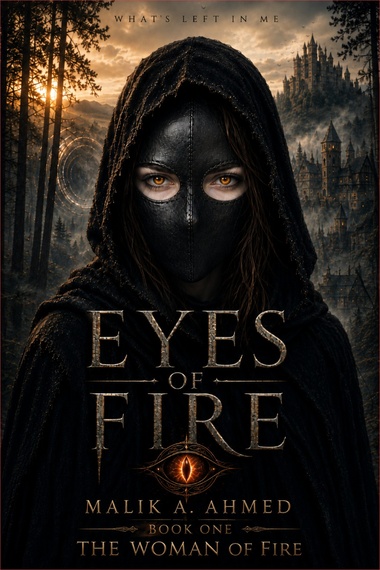
Victoria Stevens is twenty-one years old when the people she trusts most sell her for five billion dollars.
Taken into a secret facility hidden beneath the Nevada desert, Victoria becomes the subject of experiments that were never meant to be known. Her body is altered. Her face is disfigured. Her biology is changed in ways no one fully understands. And in one of the most horrifying procedures, her mouth is permanently sealed, leaving her completely unable to speak.
Her parents approved every procedure.
They called it a sacrifice.
Victoria eventually realizes the agonizing truth: she was never their daughter. She was their investment.
Yet the experiments fail to destroy everything inside her. They leave behind razor-sharp instincts, an extraordinary memory, and a mind capable of recognizing lethal patterns others miss.
Trapped in a living nightmare, mute and unrecognizable, Victoria must survive the horrors of the facility and uncover the truth behind her family’s betrayal—before she is erased forever.
Some women inherit a family name.
Victoria inherited a war.
About the book
What is the book about?
Victoria Stevens is twenty-one when her own parents sell her for five billion dollars into a clandestine subterranean facility beneath the Nevada desert. After agonizing, irreversible biological procedures—including having her face disfigured and her mouth permanently sealed—a catastrophic experiment fractures reality, sending her back in time to the year 1400. Mute, masked, and gifted with deadly pattern recognition and combat instincts, she earns the moniker “The Woman with the Eyes of Fire” while plotting to erase her family’s bloodline before they can ever exist.
When did you start writing the book?
I began writing the initial concept in late 2025.
How long did it take you to write it?
Bringing Victoria’s story to life took roughly eight to ten months of intense drafting and revision, particularly balancing the sterile horror of modern bio-engineering with the raw, brutal atmosphere of 15th-century survival.
Where did you get the idea from?
The inspiration was visceral—Victoria Stevens literally visited me in a dream. She appeared with her mouth smoothly sealed over by her own skin, not stitched with thread, but completely closed over, and she was crying. It was such a haunting, unforgettable image that burned into my mind; I knew immediately that I had to tell her story. That nightmare became the foundational spark for Victoria’s journey and the entire Eyes of Fire series.
Were there any parts of the book where you struggled? What came easily?
Writing a completely mute protagonist came surprisingly naturally—it forces you to lean heavily into micro-expressions, combat choreography, sensory perception, and internal tension. The true challenge lay in navigating the paradoxes and moral weight of time travel: ensuring Victoria’s attempts to rewrite ancestry felt grounded in consequence rather than clean fantasy.
Are your characters entirely fictitious or have you borrowed from real world people you know?
The characters are entirely fictitious, but Victoria’s psychological arc reflects universal themes: the agony of realizing trust was manufactured, the resilience required to rebuild a shattered self, and the danger of letting vengeance consume what humanity remains.
We all know how important it is for writers to read. Are there any particular authors that have influenced how you write and, if so, how have they influenced you?
I draw heavy inspiration from authors who command psychological dread, rapid pacing, and unforgiving speculative worlds. Works that treat survival and isolation under systemic cruelty as active narrative drivers have shaped my focus on razor-sharp, atmospheric storytelling.
Do you have a target reader?
Readers who crave dark, high-stakes science fiction, time-travel thrillers, and revenge narratives featuring relentless, morally tested anti-heroes.
About Writing
Do you have a writing process? If so can you please describe it?
My workflow is mobile-first and deeply structured. I draft and iterate directly within terminal environments and minimalist text editors on Android, which eliminates distractions and keeps me focused on rhythm and sentence structure. I work in focused, daily sprints, prioritizing momentum first and rigorous structural trimming second.
Do you outline? If so, do you do so extensively or just chapter headings and a couple of sentences?
Extensively. For high-stakes thrillers, tight cause-and-effect is mandatory. I outline scene beats, character motivations, and narrative clues well before drafting so that every twist feels earned rather than improvised.
Do you edit as you go or wait until you’ve finished?
I do light structural passes as chapters close, but I reserve full line edits, rhythm polish, and continuity tightening until the full draft is assembled.
Did you hire a professional editor?
I rely on a multi-pass developmental and line-editing routine, utilizing extensive peer beta readers and structural revisions before publication.
Do you listen to music while you write? If yes, what gets the fingers tapping?
Dark ambient tracks, cinematic film scores, and heavy instrumental synthwave. Anything with a driving, atmospheric rhythm that keeps the adrenaline high without lyrical distraction.
About Publishing
Did you submit your work to Agents? What made you decide to go Indie, whether self-publishing or with an indie publisher? Was it a particular event or a gradual process?
I chose the indie route deliberately to retain full creative control over my release velocity, cover design, marketing architecture, and serial intellectual property. Traditional cycles move slowly; indie publishing allows an author to build a universe and engage directly with readers without gatekeeping.
Did you get your book cover professionally done or did you do it yourself?
I designed the aesthetic direction and branding myself, focusing on minimalist symbolism, typography, and cinematic color palettes to stand out clearly in digital storefronts.
Do you have a marketing plan for the book or are you just winging it?
Structured planning all the way. I focus heavily on discoverability architecture—author knowledge graphs, metadata optimization, targeted digital advertising, cross-platform entity linking, and direct reader outreach.
Any advice that you would like to give to other newbies considering becoming Indie authors?
Treat your craft like an art, but your publishing like an engineering problem. Focus on mastering tension on the page, and don’t neglect metadata, clean typography, and distribution infrastructure. Consistency beats waiting for permission.
About You
What would you like readers to know about you?
That I write across science fiction, thrillers, fantasy, and psychological mystery with a goal to craft immersive, high-stakes narratives that linger long after the final chapter.
What are you working on now?
I am currently writing a standalone psychological thriller novel. Alongside planning the future expansion of the Eyes of Fire universe, this project allows me to craft a focused, self-contained story designed to keep readers on edge from start to finish.
End of Interview:
For more from Malik A Ahmed visit his website and follow him on Facebook, Instagram, and Twitter.
Get your copy of The Woman of Fire from Amazon US or Amazon UK.