My reader is anyone exhausted by living at half past almost: someone who knows something is not working but keeps participating in it. This book is for the person who is finished collecting insight and ready to look at what their life keeps proving.
Allison Jacob – 14 November 2026
The Back Flap
You are the problem.
Read this and prove me otherwise.
It will expose the places you protect instead of change.
Comfort will never bring you clarity.
It only makes the pattern easier to live with.
Blame is convenient.
Circumstances make excellent cover stories.
Knowing what you’re doing doesn’t stop you from doing it.
The pattern ends when you stop feeding it.
Some pages will feel familiar.
Others will feel uncomfortably precise.
That isn’t judgment. It’s recognition.
If you’re willing to face your patterns, keep reading.
Because once you see it clearly,
you don’t get to unsee it.
About the Book
What is the book about?
Half Past Almost is a forensic audit of the choices, patterns, and systems I built to keep my own bullshit alive. It began with a literal pile of paperwork I kept avoiding and grew into eleven principles for tracing the evidence back to myself. It is not self-help. Self-help sits ten aisles over. This is help your fucking self.
When did you start writing the book?
I started writing it in March 2025.
How long did it take you to write it?
About nineteen months. While finishing it, I also put a serious dent in several of the other books in the seven-book series.
Where did you get the idea from?
I got sick of the pile: bills, insurance notices, mortgage documents, and every other adult task I had avoided, all beautifully organized so it looked handled. The first item I dealt with was an insurance claim that ended with me owing thirty-six dollars. One piece of paper became a system. One system became eleven principles. One book became seven.
Were there any parts of the book where you struggled?
The hardest part was holding myself accountable without making somebody else the villain. It is easy to write a clean story where everything happened to you; it is harder to keep your own receipts in the room. I also had to decide what belonged to the reader, because vulnerability is not the same as emptying every drawer in public.
What came easily?
Pattern recognition and humor came easily. Once the eleven principles appeared, the book had a structure. I still had to tell the truth, but at least I knew where I was standing.
Are your characters entirely fictitious or have you borrowed from real world people you know?
This is nonfiction, so the experiences are real. When other people appear, they are there because of what the experience exposed in me, not so I can prosecute them on the page. What I can own is my behavior, my choices, and what I did next.
We all know how important it is for writers to read. Are there any particular authors that have influenced how you write and, if so, how have they influenced you?
Augusten Burroughs inspired me to keep writing exactly as I am. I believe in people and I don’t know how to operate by performance anymore. Often times I’m told that others feel seen by me and I always reply: “That’s because you allowed me to.”
Do you have a target reader?
My reader is anyone exhausted by living at half past almost: someone who knows something is not working but keeps participating in it. This book is for the person who is finished collecting insight and ready to look at what their life keeps proving.
About Writing
Do you have a writing process? If so can you please describe it?
I start with the thing I cannot stop circling, usually a scene, a sentence, or something I have been trying too hard to explain. I write the raw version, then ask what actually happened, what I did next, and what kept repeating. Once I see the pattern, I test the language until it sounds like something I would actually say. If it sounds wise but not true, it goes.
Do you outline? If so, do you do so extensively or just chapter headings and a couple of sentences?
I didn’t start with a traditional outline. I started with pieces. Once the Blueprint emerged, the eleven principles became the spine, and I organized the scenes under the principle they served. I don’t force a scene into a chapter because a spreadsheet says it belongs there.
Do you edit as you go or wait until you’ve finished?
Both. I edit sentences as I go because rhythm matters to me, then do larger passes for structure and repetition. I can polish one paragraph forever, so at some point I have to make myself move.
Did you hire a professional editor?
No. I edited it myself, over and over, at both the sentence and structural level.
Do you listen to music while you write? If yes, what gets the fingers tapping?
No. I don’t listen to music while I write.
About Publishing
Did you submit your work to Agents?
No. I didn’t submit it to literary agents.
What made you decide to go Indie, whether self-publishing or with an indie publisher? Was it a particular event or a gradual process?
It was gradual. I’ve spent years in publishing, production, and brand development, and I didn’t want to sand down the language or wait for permission. Going indie gave me control of the voice, the look, the timing, and the reader experience. It also made every decision mine to own, which is fairly on-brand for the book.
Did you get your book cover professionally done or did you do it yourself?
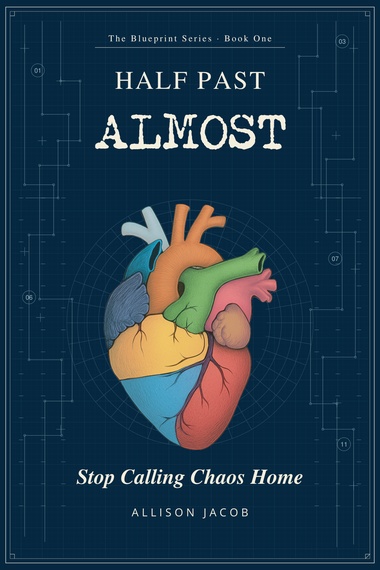
Coulter Dotson created the original anatomical heart artwork. I helped shape the cover because the heart and blueprint imagery are part of the whole series, not decoration added at the end.
Do you have a marketing plan for the book or are you just winging it?
I have a plan, but no giant machine behind me. The digital edition is on Payhip, and ClarityIsYours.com gives it one clean home. I’m building through interviews like this one, social content, word of mouth, and a print edition next. I’d rather build slowly around the right readers than spend money making noise.
Any advice that you would like to give to other newbies considering becoming Indie authors?
Finish the book before you spend a fortune trying to look like an author. Indie freedom means the cover, editing, formatting, distribution, and every bad decision are yours too. Pay for help where it matters, keep control where it matters, and do not confuse being busy around the book with finishing the damn book.
About You
Where did you grow up?
I grew up in Knoxville, Tennessee.
Where do you live now?
I live in Nashville, Tennessee now.
What would you like readers to know about you?
Before becoming a yacht chef, I was a food-and-wine magazine publisher, wedding magazine publisher, trade-show producer, mentor, and gambler. I never attended culinary school, and I built AllisonJacob.com myself, which I think is kinda cool. I don’t believe people need fixing. I believe the way back begins when we stop getting in our own fucking way.
What are you working on now?
I’m preparing the print edition of Half Past Almost, and I’m already well into several of the other books in The Blueprint Series. The full series has seven books, so apparently one accidental book wasn’t enough.
End of Interview:
For more from Allison Jacob visit her website and follow her on Instagram.
Get your copy of Half Past Almost from Payjhip.