I hope readers come away understanding that what happened to us may always be part of our story, but it does not have to determine how the story ends.
Deborah Samuel – 9 November 2026
The Back Flap
Grace Through Fire: A Memoir of Murder, Tragedy, and Resilience is a raw and redemptive memoir about surviving generational trauma, devastating loss, caregiving, and ultimately learning how to rescue yourself.
When my elderly mother shot my abusive father in their Arkansas home, my already complicated life was thrown into a storm of murder trials, media attention, grief, family responsibility, and emotional upheaval. At the same time, I was caring for my wife following a life-altering accident while confronting my own relationship with alcohol and the accumulated trauma of my past.
Eventually, I faced a difficult truth: I could not save everyone around me. I had to begin saving myself.
Grace Through Fire follows that journey from survival to sobriety, spiritual awakening, forgiveness, reinvention, and ultimately freedom. It is a story about what happens when we stop allowing our past to determine our future—and discover that it is never too late to begin again.
About the Book
What is the book about?
At its heart, Grace Through Fire is about what happens after life brings you to your knees.
The events in the book are dramatic—my elderly mother shooting my abusive father, murder trials, my wife’s life-altering accident, family trauma, caregiving, loss, and my own relationship with alcohol—but I don’t believe those events are ultimately what the book is about.
It is about the moment I finally understood that I could not keep trying to save everyone around me. I had to rescue myself.
The book follows my journey through survival, sobriety, forgiveness, spiritual awakening, and reinvention. I hope readers come away understanding that what happened to us may always be part of our story, but it does not have to determine how the story ends.
When did you start writing the book?
In many ways, I started writing Grace Through Fire long before I knew I was writing a book.
I kept journals for about 14 years. Writing was where I put the things I was experiencing and couldn’t always make sense of at the time. Eventually, I started an online blog based on some of those journals. People began reading my stories and, to my surprise, wanted to know more.
That was an important moment for me. I began to realize that experiences I had considered intensely personal might resonate with other people. Eventually, those 14 years of journals became the raw material for Grace Through Fire.
How long did it take you to write it?
Once I seriously began turning those thousands of journal pages into a book, it took about three years.
I worked closely with editor Amely Greeven, who became an absolute angel and companion throughout the process. She helped me sift through thousands of pages of thoughts, memories, scenes, and stories and organize them into chapters that would make sense to someone who had not lived inside my head for 14 years.
There is a tremendous difference between keeping a journal and writing a memoir. A journal only has to make sense to you. A memoir has to take a reader by the hand and lead them through the story.
Where did you get the idea from?
The idea really came from those thousands of journal pages—and from my sister Laura.
I had been writing for years as a way of processing what was happening in my life. Eventually Laura said to me, “Deb, you have to write the damn book.”
She was right.
I didn’t wake up one morning and decide I wanted to become an author and then go searching for something to write about. The story was already there.
The book came first. Becoming an author came later.
Were there any parts of the book where you struggled?
Absolutely. One of my biggest struggles was deciding what had to come out.
There were so many stories I wanted to include. When you have lived through these experiences and carried them for years, every story can feel important. But I had to learn that something could be meaningful to me and still not necessarily belong in this particular book.
Cutting those stories was difficult, but I haven’t thrown them away. Some may find their way into my second or third book. I now think of them less as stories that were cut and more as stories waiting for their proper home.
What came easily?
Writing about my students brought me tremendous joy.
During some of the hardest periods of my personal life, I still had this wonderfully cool job to show up for every day. My students gave me purpose, laughter, challenges, and a reason to get out of my own head.
I was supposed to be their teacher, but looking back, I realize they were helping me survive some very difficult chapters of my own life.
Those sections were fun to revisit because they reminded me that even when one part of our life feels incredibly dark, another part can still contain enormous light.
Are your characters entirely fictitious or have you borrowed from real world people you know?
This is memoir, so these are real people and real events.
That carries an enormous responsibility. When you write memoir, you are telling your truth, but inevitably your story intersects with other people’s stories.
I tried to write honestly without writing vindictively. I wasn’t interested in settling scores. I wanted to understand what happened, how it shaped me, what I carried forward from it, and eventually what I needed to release.
That distinction became very important to me.
We all know how important it is for writers to read. Are there any particular authors that have influenced how you write and, if so, how have they influenced you?
Dr. Lois P. Frankel, Brené Brown, and Napoleon Hill have all influenced me in different ways.
Lois helped me understand how women sometimes unintentionally diminish their own power. Brené Brown gave me a vocabulary for vulnerability, courage, shame, and resilience. Napoleon Hill challenged the way I thought about success, money, abundance, and the beliefs we carry about what is possible.
What I admire most are writers who leave me thinking differently about my own life. That is what I hope to do as a writer as well. I don’t want to tell readers what lesson they are supposed to learn from my story. I would rather tell the story honestly and allow them to discover the lesson that belongs to them.
Do you have a target reader?
Yes, although my understanding of that reader has expanded tremendously.
I initially thought Grace Through Fire would primarily resonate with people who had experienced trauma, grief, family dysfunction, caregiving, addiction, or major life transitions.
Then early readers began sharing their own stories with me. Some were older readers who had carried family secrets, violence, shame, grief, or painful experiences quietly for decades. They would tell me things they had rarely spoken about before.
That taught me something important: we never really know what another person has survived.
My target reader is ultimately anyone who has wondered whether it is too late to change their life, forgive themselves, put down something they have carried for too long, or begin again.
About Writing
Do you have a writing process? If so can you please describe it?
Pen and paper first. Computer second.
Writing by hand seems to bypass the part of my brain that wants everything to be polished and perfect. I scribble, cross things out, draw arrows, write in margins, and let the thoughts come.
Once I find the emotional center of what I am trying to say, I move to the computer. That is where the storyteller gradually becomes the editor.
Do you outline? If so, do you do so extensively or just chapter headings and a couple of sentences?
Yes. Grace Through Fire began as a very large outline broken into scenes from my life.
With thousands of pages of journals covering so many years, I needed a structure that allowed me to step back and see my life as a story rather than simply a collection of memories.
From there, we could identify which scenes actually moved the narrative forward and how they belonged together.
Do you edit as you go or wait until you’ve finished?
Both—and apparently I edit forever!
I edited individual chapters as I went and then did the big edits once the manuscript came together. Then we edited again. And again. And just when I thought there could not possibly be another mistake hiding in that manuscript, another set of eyes would find something.
I was amazed by the last-minute catches just before final print. It was nerve-racking, but it taught me why fresh eyes are invaluable. Eventually, your brain starts seeing what it expects to see instead of what is actually on the page.
Did you hire a professional editor?
Yes, several professionals helped me throughout the process.
Amely Greeven was my primary editor and my three-year companion on this journey. She helped me transform thousands of pages of journals, memories, and scenes into a coherent memoir.
Near the end, my dear friend and flying buddy Derek Westen became what I affectionately call my “editorial angel.” After a long career in law, Derek has a laser-sharp eye for language, grammar, and details the rest of us somehow managed to miss.
Every book needs a Derek.
Do you listen to music while you write? If yes, what gets the fingers tapping?
Absolutely. I am deeply influenced by powerful film scores and emotionally charged movie music.
Music helps me see a scene. When I needed to recreate a difficult moment while writing Grace Through Fire, music could help me step emotionally back into that time.
I often thought about scenes from Cast Away—the isolation, desperation, survival, and determination—and the original Top Gun, with its intensity, speed, risk, and emotion.
Sometimes writing about trauma felt a little like climbing into a cockpit: commit, trust your instincts, hold on, and keep moving forward even when everything feels out of control.
Once I can see the scene, I can usually find the words.
About Publishing
Did you submit your work to Agents?
No. I went directly to She Writes Press.
I knew I wanted more control over my project, and I was very drawn to what publisher Brooke Warner stood for and her philosophy about creating opportunities for women writers. She green-lighted Grace Through Fire from the beginning, and I felt I had found the right home for the book.
What made you decide to go Indie, whether self-publishing or with an indie publisher? Was it a particular event or a gradual process?
For me, independent publishing wasn’t a fallback after trying another route. It was a deliberate choice.
I knew early that She Writes Press was the path I wanted to pursue. I loved Brooke Warner’s philosophy, her advocacy for women writers, and a publishing model that allowed me to surround myself with experienced professionals while retaining a meaningful level of control over such a deeply personal project.
When you are handing someone a story this intimate, trusting the people helping you bring it into the world matters enormously.
Did you get your book cover professionally done or did you do it yourself?
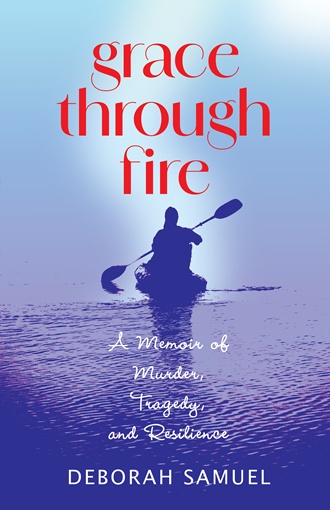
The cover was professionally designed through She Writes Press, but I was very involved in the creative direction.
I sent them photographs from my life, including images involving my kayak, and shared ideas about what I wanted the cover to communicate emotionally. Their designers came back with two concepts that I loved almost immediately.
Then I did what any decisive author does when presented with two covers she loves—I asked some of my closest family members what they thought!
Together, we selected the cover that ultimately became Grace Through Fire. It felt right, and I still love it.
Do you have a marketing plan for the book or are you just winging it?
Oh, there is definitely a plan!
I have invested significantly in giving Grace Through Fire the best opportunity to find the readers who may be impacted by this story. I have a professional publicity team, interviews and podcasts, bookstore and author events, speaking engagements, a book tour, and international events planned.
I also bring an entrepreneur’s mindset to publishing. Writing the book and helping people discover the book are two completely different jobs. I don’t expect that simply because I wrote something meaningful, readers will magically know it exists.
I want to do everything I reasonably can to help Grace Through Fire find the people who may need it.
Any advice that you would like to give to other newbies considering becoming Indie authors?
Publishing a book is hard.
You need to be in love with your project and have a burning desire to see it through, because there will be moments when the process tests that commitment. Writing “The End” is nowhere near the end. There is editing, more editing, design, production, publicity, marketing, deadlines, decisions—and apparently another round of editing!
I came into this as a first-time author, and I now have enormous respect for the editors, designers, publishers, publicists, booksellers, and everyone else who helps turn a manuscript into an actual book.
My advice is to surround yourself with people who know things you don’t know. Listen to them. Stay curious. Be willing to invest in your work. Most importantly, know why you are doing it.
If your reason is strong enough, you’ll keep going when the process gets hard.
About You
Where did you grow up?
I grew up in Rogers, Arkansas. My roots in Arkansas are an important part of who I am and an important part of Grace Through Fire. It is where so much of my story began.
Where do you live now?
I live in Santa Barbara, California, with my wife, Kelsey, and our beloved black cat aboard our 1973 Grand Banks yacht, Summer Solstice, in Santa Barbara Harbor.
For about 25 years, I had a photograph of Santa Barbara Harbor pinned to the corkboard in my office. I would look at it and imagine living there someday.
Today, I wake up inside that photograph.
What would you like readers to know about you?
I have reinvented myself more times than I ever could have imagined.
I spent 20 years as a teacher and have also been a FedEx driver, home builder, airplane mechanic, pilot, real estate professional, entrepreneur, and now author and speaker.
At first glance, those lives may seem unrelated. To me, they are connected by one idea: transition.
Today, much of my professional work involves helping people navigate major transitions. Grace Through Fire tells the story of an enormous transition of my own.
If there is one thing my life has taught me, it is this: reinvention does not have an expiration date.
What are you working on now?
I already have ideas and material developing for two more books, including some of the stories that simply couldn’t fit into Grace Through Fire.
I am also expanding my work as a speaker. After 20 years as an educator, I realize that speaking is really another form of teaching—only now the classroom may be an auditorium.
At the same time, I am returning to another great love: flying. I am working on getting my pilot credentials current again and hope to purchase an airplane within the next year.
Apparently, even after writing a memoir, I am still figuring out what I want to be when I grow up.
End of Interview:
Get your copy of Grace Through Fire from Amazon US.