I grew up on the Gulf coast and spent years crossing the country, and somewhere in there I noticed a pattern I couldn’t unsee: every time I came home from a road trip, another one of my favorite haunts was gone. Shuttered. Sold. Converted into a chain with a drive-thru and a loyalty app. Or bulldozed flat for another tower of condos nobody who grew up there could ever afford.
L.B. Phillips – 3 October 2026
The Back Flap
Some places are worth the long way around.
Miles Donovan notices things. It’s a harmless habit — until a stranger presses a fifteen-year-old postcard into his hand and points him toward the vanishing Florida the rest of the world keeps paving over: the fish camps and tiki bars, the hand-painted motels and one-of-a-kind roadside wonders that a faceless corporation called Meridian is quietly erasing, one beloved landmark at a time.
Armed with a faded gray cap, a road-worn Jeep, and a crew of the gloriously stubborn, Miles sets out to save what’s left — and discovers that the map he’s really following leads straight back to the people and places that made him.
Warm, funny, and big-hearted, The Long Way is a Gulf Coast road-trip mystery in the affectionate, only-in-Florida spirit of Carl Hiaasen and Tim Dorsey — a real mystery at its heart, with a soul and a sense of humor. Book One of The Department of Small Wonders.
About the book
What is the book about?
At heart it’s a warm, funny Gulf Coast road-trip mystery. Miles Donovan is a man who notices things — which turns out to be the single most dangerous habit in America. A stranger hands him a fifteen-year-old postcard, and Miles goes looking for the Old Florida that keeps quietly slipping away: the oddball, irreplaceable places a faceless corporation called Meridian is wiping off the map, one landmark at a time. What starts as a rescue mission for a few beloved spots becomes something bigger and far more personal — the road keeps leading him back to everything, and everyone, he thought he’d left behind. It’s Book One of the Department of Small Wonders.
When did you start writing the book?
Believe it or not, in 1997. I wrote sixteen versions of it between 1997 and 2002 — and then I set it down, because I knew I wasn’t ready to write it the way it deserved.
How long did it take you to write it?
In one sense, about two years — I came back to it in the summer of 2024 and saw it through to a 2026 release. In the truer sense, twenty-seven years. I’d walked away after those early drafts, and I only returned once I’d finished college, read everything I could get my hands on, and driven through thirty-eight states. I didn’t believe I was equipped to write a great book until I’d read enough great ones and seen enough of the country to have something honest to say.
Where did you get the idea from?
From heartbreak, honestly — the slow kind that sneaks up on you. I grew up on the Gulf coast and spent years crossing the country, and somewhere in there I noticed a pattern I couldn’t unsee: every time I came home from a road trip, another one of my favorite haunts was gone. Shuttered. Sold. Converted into a chain with a drive-thru and a loyalty app. Or bulldozed flat for another tower of condos nobody who grew up there could ever afford. A corner diner one year, an old drive-in the next, the marina where I learned the water after that — each one erased quietly between visits, as if it had never mattered to anyone. Nobody held a vote. It just happened, one “permanently closed” at a time. That part is deeply personal for me, and the book is what I did about it: I put a man in the doorway of those places — even a fictional one — who refuses to drive past.
Were there any parts of the book where you struggled?
The ending, and the readiness. Sixteen drafts in my twenties taught me I had the voice but not yet the wisdom — I could make you laugh, but I couldn’t yet make you feel the thing under the laugh. Coming back decades later, the struggle was earning the emotion honestly, so the funny parts and the true parts belonged to the same book.
What came easily?
The voice, and the Florida of it — the characters who talk sideways, the rooster who holds up traffic, the argument you have with your best friend at six in the morning. Those poured out. Florida writes half your dialogue for you if you’re paying attention.
Are your characters entirely fictitious or have you borrowed from real world people you know?
The places are real (or were). The people are invented — but they’re honest composites, stitched together from a lifetime of dock hands, diner regulars, and beautiful Gulf-coast eccentrics I’ve known. Nobody’s a photograph; everybody’s a little bit true.
We all know how important it is for writers to read. Are there any particular authors that have influenced how you write and, if so, how have they influenced you?
More than I can list, but here’s the core crew. Tim Dorsey taught me comic momentum and the joy of a gloriously unhinged Florida. Carl Hiaasen taught me that the best comedy has real moral outrage humming underneath it — greed and bulldozers make excellent villains. Edgar Allan Poe taught me atmosphere and the architecture of a mystery. Stephen King taught me interior life — how to drop an ordinary person in over their head and make you live inside them. John Grisham taught me propulsion, the turn-the-page engine that respects a reader’s time. And I’ve read every one of Jimmy Buffett’s books — his are the ones that taught me the tone I most wanted: the grin that means it, the salt and the soul in the same sentence. Honestly, I didn’t feel ready to write a good book until I’d read a mountain of them.
Do you have a target reader?
Anyone who misses the real, un-franchised version of a place they love. If you grin at Hiaasen and Dorsey, take the scenic route on purpose, own more than one Jimmy Buffett record, or have ever mourned a torn-down diner — this book was written for you.
About Writing
Do you have a writing process? If so can you please describe it?
I do — though “process” makes it sound tidier than it is. Mine is closer to obsessive, iterative discovery. I’m not an outline-then-draft-then-revise writer; I’m a vision → collision → recognition → refinement writer.
It starts with a feeling, not a plot. I usually know what I want a reader to feel long before I know how I’ll get them there — nostalgia, curiosity, a laugh, a little ache, that sudden urge to get in the Jeep and just go. Structure comes later. What comes first is fragments, which I collect obsessively: forgotten signs, roadside businesses, strange people, a song, a smell, a piece of local history, the exact wrong-in-the-best-way thing somebody says. I don’t research only what a story needs — more often I fall for something first and then go find the story that deserves it.
From there I write through association. One interesting thing pulls me toward another, down a rabbit hole and back, until things that had no business connecting suddenly do — wait, what if this ties to that? I generate far more than I’ll ever use; I’d rather have twenty possibilities and kill seventeen than manufacture the perfect three up front. Abundance first, selection later.
I recognize the right answer faster than I accept the first one. When something’s off, I usually feel it immediately, even before I can say why — like I’ve lost the original signal — and I’ll keep pushing until I find it again. Then I revise by amplifying and subtracting at the same time: I’ll want a scene funnier, stranger, warmer, more Dorsey, more Buffett — and realize the fix is to cut half of what’s there. I’m not after more stuff; I’m after concentration. Fewer things, each carrying more.
Voice is the final test. Something can be technically clean and still be wrong if it doesn’t sound like me; I’ll take a little structural weirdness over anything polished and lifeless. And over time the recurring things — the Jeep, the notebooks, the roads and meals and disappearing places — stop being scenery and become a private vocabulary, where certain objects mean a little more every time they come back.
Really, my process is curation disguised as writing. I collect evidence of things worth noticing, then move the pieces around until they start telling a story. Maybe that’s why place matters so much to me — I’m not inventing worlds so much as rescuing pieces of the real one and giving them somewhere to live. In one sentence: I chase curiosity until it becomes meaning, overwrite until I find the heartbeat, then cut and sharpen until a reader feels the same thing that made me stop and look in the first place.
Do you outline? If so, do you do so extensively or just chapter headings and a couple of sentences?
Barely, and never up front. What I have early is more a string of postcards than a blueprint — the big stops on the map and the emotional turn I’m driving toward — and the real shape only shows up once the fragments start connecting. I leave wide room for the detours, because the detours are usually the best part of any road trip and any book.
Do you edit as you go or wait until you’ve finished?
I overwrite first, then carve. If I stop to polish early, I never make it out of the parking lot — so I get it all down, far too much on purpose, and the real work happens in the pass afterward, trimming until only what earns its place is still standing. Sixteen early versions will teach you the difference between fussing and finishing.
Did you hire a professional editor?
No — I leaned on a small circle of sharp, honest early readers and a lot of careful self-editing passes. Two decades of setting the book down and picking it back up turned out to be its own kind of editing.
Do you listen to music while you write? If yes, what gets the fingers tapping?
Always — but never one playlist on shuffle. I score the scene. Once I know how I want a scene to feel, I go find the song that already feels that way and let it fill the room while I write — so a sunlit, top-down stretch might run on Buffett or Marley; a lonely, late-night one on The Cure or Noah Kahan; something aching and building on Mumford & Sons; something tender on Elvis; something restless on Pearl Jam; something orderly and clarifying on Bach. I’ve always worked this way and I couldn’t do it any other. I think you can feel it on the page — the music ends up in the prose even when the song never gets named. (And yes, this book lives mostly at the warm, salt-air end of that dial — I launched it on September 1, Buffett’s day, on purpose.)
About Publishing
Did you submit your work to Agents?
No. I decided early this book wanted to go indie, so I didn’t spend the season chasing agents — I spent it making the book right.
What made you decide to go Indie, whether self-publishing or with an indie publisher?
Control of the vision. The Long Way is a very specific love letter to a disappearing Florida, right down to the fish-camp signage and the songs on the radio. Going indie meant nobody was going to sand the regional edges off it — and those edges are the whole point.
Was it a particular event or a gradual process?
Gradual — about as gradual as it gets. Twenty-seven years of gradual. But when I finally saw the whole series — the map, the crew, the places worth saving — I stopped waiting for permission and built it.
Did you get your book cover professionally done or did you do it yourself?
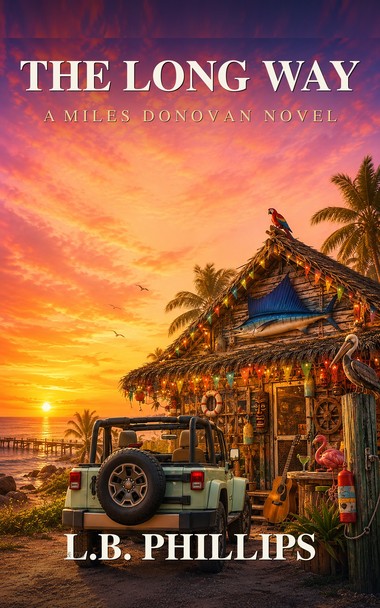
I did it myself — directing AI tools until it matched the picture in my head: the tiki bar at golden hour, the Jeep, the parrot on the roof. I wanted a cover that felt like the book — warm, a little wild, and unmistakably Gulf coast.
Do you have a marketing plan for the book or are you just winging it?
A real one, thankfully. Early reviewer copies, regional and indie bookstores, launch-week outreach, and leaning hard into what the book is really about: the overlooked places people love and don’t want to lose. I’d rather earn readers one genuine conversation at a time than shout into the void.
Any advice that you would like to give to other newbies considering becoming Indie authors?
Write the book only you could have written — the personal, gloriously specific, weird-in-the-best-way one — and never polish away the little fingerprints that make the voice unmistakably yours. Then treat publishing as the beginning, not the finish line: be relentless, creative, and shamelessly resourceful about getting the book in front of people. Nobody will ever believe in your book harder than you do, so it’s on you to give them a very good reason to discover it.
About You
Where did you grow up?
Clearwater, on Florida’s Gulf coast — salt air, summer thunderstorms, and every only-in-Florida character you could ask for. It’s in the book’s DNA.
Where do you live now?
Knoxville, Tennessee. I grew up in Clearwater, spent years in the Tampa Bay area and then Orlando, and made the move up to Knoxville in 2024 — close enough to the Smokies to hike, and far enough from the Gulf to miss it, which turns out to be great fuel for writing about it.
What would you like readers to know about you?
I came to fiction the long way. I’m a Clearwater kid by way of Tampa Bay, Orlando, and now Knoxville; I spent years in newspapers — I was Publisher and Editor of The Pinellas Informer — started this book in 1997, walked away from it, grew up, read everything, drove everywhere, and came back to finish it right. I write the kind of book I want to read: funny, warm, a little wise, and rooting for the underdog places and people.
What are you working on now?
Book Two, The Last Great Road Trip — the next stop for the Department of Small Wonders. Same crew, same heart, a longer stretch of highway. The map, as one character puts it, is national now.
End of Interview:
For more from L.B. Phillips, follow him on Facebook.
Get your copy of The Long Way from Amazon US or Amazon UK.