The concepts around decision-making also developed fairly easily. As I dug deeper into neuroscience and psychology, I became fascinated by the idea that our brains often have competing constituencies pulling us in different directions. Much of the book ultimately became about creating greater internal alignment between those competing forces.
Rich Harris – 1 October 2026
The Back Flap
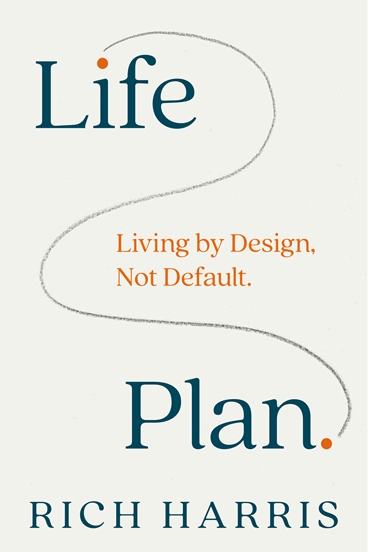
In Life Plan: Living by Design, Not Default, Rich Harris provides a practical framework for living with greater clarity, balance, and intention. Drawing on neuroscience, psychology, and a written annual life-planning practice he has followed for nearly three decades, Harris explains why change is hard, how subconscious patterns shape our behavior and decisions, and what it takes to create lasting alignment between who you are and how you live. More than motivational sound bites or traditional self-help platitudes, Life Plan offers a grounded, thoughtful guide to designing a life that reflects what matters most to you.
About the book
What is the book about?
Life Plan is about learning to live more intentionally while understanding why that can be so difficult in the first place. We sometimes assume lasting change comes down to motivation or discipline, but the science behind change and decision-making tells a much more nuanced story.
The book combines neuroscience, psychology, personal stories, and nearly three decades of my own annual life-planning practice to explore how our brains are wired, why subconscious patterns so often shape our decisions, and how we can better align our daily choices with what actually matters to us. My hope is that readers come away inspired, with a practical framework they can return to year after year as they design a life that feels more purposeful, balanced, and authentic.
When did you start writing the book?
I started outlining the book and developing many of the core concepts in late 2020 after leaving my career in commercial real estate. It also happened to be during the height of the COVID pandemic, which gave me more time and space to finally begin writing a book that had been on my mind for years.
How long did it take you to write it?
Too long! Ha! Writing a book was far more difficult than I expected. It was a humbling process trying to organize and communicate ideas that are much easier to explain in conversation than in a structured manuscript. From the initial outline to the finished book, it took about five years.
Where did you get the idea from?
The idea grew out of my own life over time. I’ve completed a 100+ page written life plan every year since 1999, which unsurprisingly led me to study neuroscience, psychology, motivation, and human behavior. Along the way, I was also applying many of those ideas in business, leadership, and coaching. Eventually, I realized there was an opportunity to share what I’d learned by connecting the science behind intentional living with a practical framework people could apply in their own lives.
Were there any parts of the book where you struggled?
Yes, of course! A friend who had written a doctoral thesis gave me some great advice early on. He suggested having other projects to work on for the days when the writing wasn’t flowing. That turned out to be a big part of my approach on the days when writer’s block was present.
Truth be told, I wrote about 70 pages of the book and then pivoted to writing exclusively about one concept in the book, only to return to the original idea a few months later. Writing a book is real process, and you learn a lot about yourself. Another friend joked that I’d gone from executing business to performing art. I thought that captured the experience perfectly.
What came easily?
Many of the ideas around goal setting and the compounding returns that come from revisiting your priorities year after year came more naturally because I’d been living that life-planning practice for decades before I ever started writing the book.
The concepts around decision-making also developed fairly easily. As I dug deeper into neuroscience and psychology, I became fascinated by the idea that our brains often have competing constituencies pulling us in different directions. Much of the book ultimately became about creating greater internal alignment between those competing forces.
Are your characters entirely fictitious or have you borrowed from real world people you know?
Life Plan is a work of nonfiction, so the stories are drawn from my own experiences. In a few cases, I’ve changed names or identifying details to respect people’s privacy, but the lessons and experiences themselves are authentic.
We all know how important it is for writers to read. Are there any particular authors that have influenced how you write and, if so, how have they influenced you?
I have a long list of authors who have influenced my thinking over the years, and I’m incredibly grateful for their work. While I wouldn’t say they influenced my writing style, they certainly shaped the ideas behind the book. Jonathan Haidt, Daniel Kahneman, Charles Duhigg, David Eagleman, Sonja Lyubomirsky, Wayne Dyer, and Joe Dispenza all influenced different aspects of how I think about human behavior, decision-making, habits, and personal growth.
Do you have a target reader?
I wrote the book for a broad audience, but I think it will resonate most with people who want to live more intentionally. In particular, I think it’s valuable for high achievers and those looking to better align their longer-term objectives with their everyday actions. Ultimately, the book is about becoming aware of, and closing, that gap.
About Writing
Do you have a writing process? If so can you please describe it?
I probably didn’t have the most refined process when I started my writing journey, but I was focused on being patient with myself given the dramatic career change I had made. I did spend a great deal of time developing the outline and refining the specific concepts I wanted to include. One of the biggest early challenges was determining the order in which to present them for maximum impact. I also learned that mornings were by far my most productive writing time.
Do you outline? If so, do you do so extensively or just chapter headings and a couple of sentences?
Yes, I had a very extensive outline, and I often returned to it whenever I felt I was drifting from the core concept of the chapter, which is easy to do when you’re passionate about a subject. I also developed a second outline that distilled each chapter into a single sentence. It wasn’t easy, but it forced me to clarify the central idea of each chapter while keeping the overall progression of the book logical and intentional.
Do you edit as you go or wait until you’ve finished?
I edited in batches throughout the writing process. I tried to stay in the creative flow when it was there, and then shift into an editing mindset when the writing wasn’t coming as naturally. I think that approach resulted in a more refined manuscript by the time it reached my editors, although their contributions greatly improved the finished product.
Did you hire a professional editor?
Yes. I hired professional editors at every stage of the process, from content editing to copy editing. Because of the publishing path I ultimately took, I ended up working with multiple editors along the way. It wasn’t exactly the plan, but I can rest assured the book has been thoroughly edited!
Do you listen to music while you write? If yes, what gets the fingers tapping?
What a great question! Initially, I preferred quiet, but then toward the end I got into the habit of listening to instrumental music as I wrote. Two of my favorites were Indigo Road by Joey Fehrenbach and Sirocco by Ulrich Schnauss. I think I may have worn those two songs out! 😆
About Publishing
Did you submit your work to Agents?
I didn’t. I spent a lot of time talking with authors and others in the publishing world, and the overwhelming advice was to self-publish. For me, it offered the right balance of creative control, speed to market, and long-term flexibility. Once I settled on that path, I felt confident it was the right decision.
What made you decide to go Indie, whether self-publishing or with an indie publisher? Was it a particular event or a gradual process?
It was a gradual process rather than a single event. As I learned more about the publishing landscape, self-publishing increasingly felt like the right path for me.
Did you get your book cover professionally done or did you do it yourself?
Professionally. I have a graphic design background, but I also know the value of expertise. The cover was professionally designed, and I’m thrilled with how it turned out.
Do you have a marketing plan for the book or are you just winging it?
Haha, I’m pretty plan-oriented, so I definitely have a plan, although I’d be lying if I said I have it all figured out. I’ve approached the marketing the same way I approached writing the book: learning from people who have done it before, being intentional, and adjusting my approach as I discover what works best.
Any advice that you would like to give to other newbies considering becoming Indie authors?
First, I’d encourage anyone considering the journey to go for it. Second, love yourself well through the process. Pay attention to what works for you, whether that’s your most productive time to write, outlining, listening to music, feedback from a small group of readers, or working with a great content editor. Everyone’s process is a little different. Above all, remember it’s a marathon, not a sprint, so try to enjoy the journey and learn as much as you can about your topic or yourself along the way.
About You
Where did you grow up?
I grew up in the small town of Honeoye in upstate New York. It’s in the Finger Lakes region and sits on the shores of Honeoye Lake, one of the Finger Lakes. It’s a beautiful part of the country, with lots of lakes, rolling hills, and valleys that I still love to visit today.
Where do you live now?
I live in Chapel Hill, North Carolina.
What would you like readers to know about you?
I’d like readers to know that curiosity has always been one of the driving forces in my life. I don’t pretend to have life figured out, but I genuinely enjoy asking meaningful questions and learning from the people around me. I hope readers see the book as an invitation to explore those same questions in their own lives.
What are you working on now?
Right now, the book launch is obviously taking up a lot of my time and attention. The adventure continues! Beyond that, I’m continuing to build Life Plan through speaking, consulting, and coaching, while also helping lead Realcore Applications, a software company serving the commercial real estate industry.
End of Interview:
For more from Rich Harris visit his website.
Get your copy of Life Plan from Amazon US or Amazon UK.