The characters are entirely fictitious. However, my work as a psychiatrist gave me rich material for creating characters who struggle with schizophrenia, bipolar disorder, and other conditions.
Jess Wright – 8 September 2026
The Back Flap
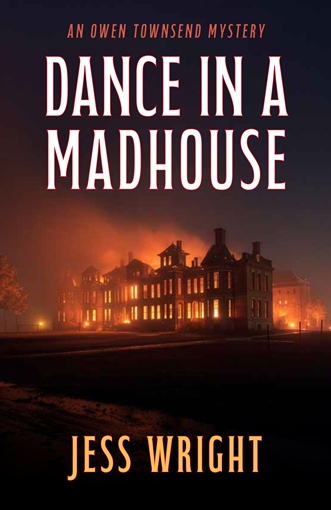
A young doctor contracts typhoid fever in 1905 and has a sudden downfall—delirium, an act of violence, and commitment to an asylum. Is Owen sane—a victim of a toxin that has cleared his system? Or is he as psychotic as his psychiatrist claims? The only thing certain is that he is in a wasteland where more harm than healing occurs.
Owen soon learns that there are people who want him incarcerated forever or dead. There are fires. Attacks that defy logic. Terror instead of treatment. To survive, he must navigate the labyrinth of the madhouse and convince Brumbaugh, a shrewd police inspector, to join his cause. Celeste, an enigmatic young opera singer who transfixes him after he saves her from suicide, might have the clues he needs. But Owen needs to decipher riddles from her tortured past to find a way toward freedom.
Set at the dawn of modern psychiatric treatment, Dance in a Madhouse, is a thrilling testament to courage and resilience. Can Owen and Celeste’s determination overcome the odds against them? Are redemption and healing possible? The dances will tell.
About the book
When did you start writing the book?
In 2021.
How long did it take you to write it?
About 18 months.
Where did you get the idea from?
My ideas for this book were primed by Margo Taft Stever, a poet, who told me the story of Peter Taft, her great-grandfather. Peter was a brilliant man. However, he had the misfortune to be hospitalized in a sanitorium after contracting typhoid fever and having a brief delirium. Although it is impossible to know the reasons Peter was kept in an asylum, his stepbrother, William Howard Taft, would become president of the United States in 1909. The letters Peter wrote to his family from the sanatorium are heart-rending. He begged to see his wife and small child. Yet his doctor, W. S. Chipley, prescribed isolation. In reading Peter’s letters, I could find no sign of psychosis or any other mental illness.
Had Peter been misdiagnosed? Was he a victim of typhoid fever and its primitive treatment methods like Owen Townsend? Was he incarcerated in the sanatorium because he had a famous family who wanted him put away? There are no clear answers to these questions, but Margo Taft Stever believes her great-grandfather wasn’t mentally ill. In her book, The Cracked Piano, she transforms some of Peter’s letters into poems. One of them touches on an event that was commonplace in asylums at that time. Spectators were invited to watch “lunatic balls” where patients danced to an orchestra. The combined words of Peter Taft and Margo Taft Stever tell of the stigma the patients felt. “Behind a glass wall, well-dressed spectators, riveted, sit amused. Looking at them looking, the patients know they are through.” (From “The Lunatic Ball,” Cracked Piano, Poems by Margo Taft Stever, Cavankerry Press, 2019.)
Were there any parts of the book where you struggled?
Yes. Many. The love scenes between Owen and the emotionally scarred patient, Celeste, were the most difficult to write.
What came easily?
Scenes between Owen and his psychiatrist, Dr. Fletcher, the superintendent of the asylum, flowed more easily. My years of experience as a practicing psychiatrist helped me give authenticity to these scenes.
Are your characters entirely fictitious or have you borrowed from real world people you know?
The characters are entirely fictitious. However, my work as a psychiatrist gave me rich material for creating characters who struggle with schizophrenia, bipolar disorder, and other conditions.
We all know how important it is for writers to read. Are there any particular authors that have influenced how you write and, if so, how have they influenced you?
My favorite novels are richly layered and dig deep into character development. Elizabeth Shrout, Amor Towles, Ann Patchett, Mark Helprin, and Robertson Davies are well represented in my library. Daniel Mason, a psychiatrist and novelist, has written wonderful novels. In the realm of mystery, I think Anthony Horowitz is at the top of the heap. He fascinates with his complex, brilliant plots. These standout authors inspire me to develop intriguing stories that show the inner world of the people who inhabit them.
Do you have a target reader?
People who love historical fiction, mysteries, and absorbing tales.
About Writing
Do you have a writing process? If so can you please describe it?
I am working half-time as a professor of psychiatry and devote much of the remainder of my workdays to writing fiction. I have a schedule and stick to it for the most part. I’m fortunate to have a quiet study where I can concentrate well; but I also write in airplanes, hotel rooms, and on retreats where I get away to write intensively and think about writing. I don’t need props to get me going. However, I enjoy sipping on some excellent coffee or tea (decaf always) when I write.
Do you outline? If so, do you do so extensively or just chapter headings and a couple of sentences?
Having started my writing career producing medical texts, scientific articles, and self-help books, I was accustomed to developing extensive outlines. I’ve carried over the outlining process to fiction writing and find that it helps me keep on track. Typically, I outline one to three paragraphs of proposed content for each chapter. My fiction writing is more creative than my medical writing, and I alter outlines as the story unfolds, sometimes in unanticipated ways.
Do you edit as you go or wait until you’ve finished?
I edit each chapter with at least three run-throughs before going on to the next chapter. After completing a draft of the entire book, I start editing again from Chapter 1 onward.
Did you hire a professional editor?
I have a fiction writing coach and a professional editor. Both assist me as I am working on chapters. The books are edited again by the publisher.
Do you listen to music while you write? If yes, what gets the fingers tapping?
I don’t listen to music. I prefer quiet and the bird song that I can hear from my study overlooking my garden.
About Publishing
Did you submit your work to Agents?
Yes. Jacques DeSpoelberch, my agent for, Dance in a Madhouse, died before I secured a contract for publishing it. Jacques was a strong advocate for the book and helped shape it for publication.
What made you decide to go Indie, whether self-publishing or with an indie publisher? Was it a particular event or a gradual process?
I chose an Indie publisher with a strong reputation for high integrity and quality publications after working with two agents. I was unwilling to spend more time to secure a traditional publishing contract.
Did you get your book cover professionally done or did you do it yourself?
The book cover was designed by the publisher’s team at the Stable Book Group.
Do you have a marketing plan for the book or are you just winging it?
I have a publicity firm, BookSparks, and also have developed a marketing plan including online advertisements.
Any advice that you would like to give to other newbies considering becoming Indie authors?
Get help from people who know the business.
About You
Where did you grow up?
Hollidaysburg, PA, a small town in the mountains close to State College, PA.
Where do you live now?
Louisville, KY
What would you like readers to know about you?
I am a professor of psychiatry at the University of Louisville where I treat patients, teach, and do research. I’ve written eight medical books and am the principal author of a computer program for depression that has been proven effective in many research studies. My ventures into fiction writing are a gratifying way to expand my reach. I’m an avid gardener, fly-fisherman, and choral singer.
What are you working on now?
A memoir.
End of Interview:
Get your copy of Dance in a Madhouse from Amazon US or Amazon UK.