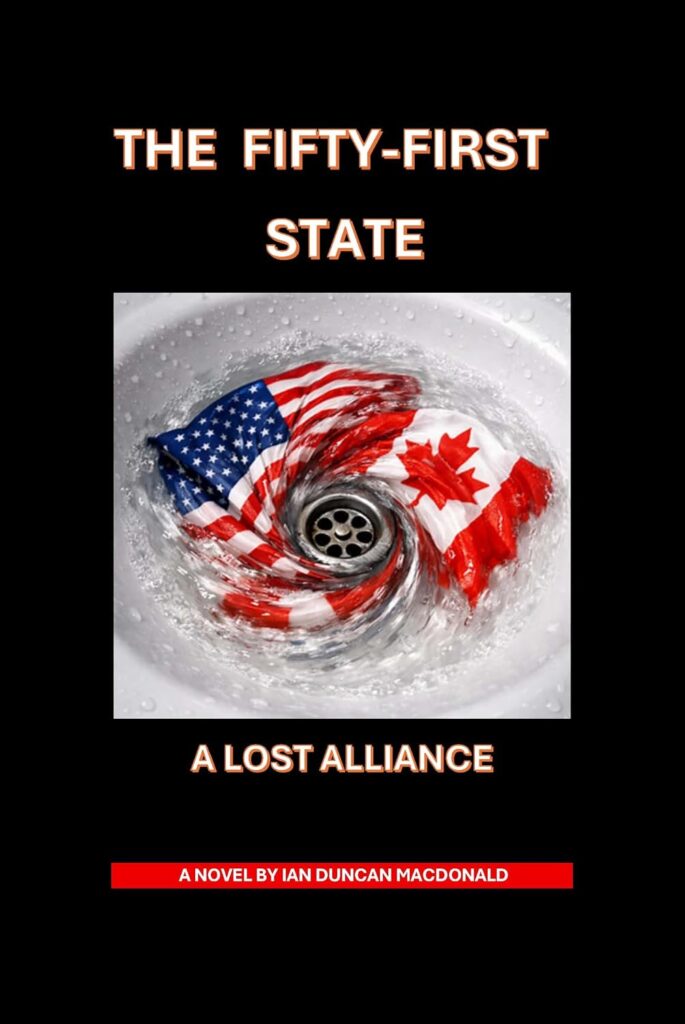
The book is about power, manipulation and arrogance. The initiating catalyst is a record-breaking drought that is destroying the economy of the American Southwest. It is a presidential election year and 80,000,000 voters in the Southwest are demanding a permanent solution to the chronic drought problem.
Ian Duncan MacDonald – 6 September 2026
The Back Flap
It is now difficult for Canada to see the US government as a trusted friend.
Ever since the American Revolution in 1776 the United States has coveted annexing Canada. Colonists then loyal to the British crown left the newly founded thirteen states and moved to the safely of Canada. A few years later, in 1812, they fought a war to repulse an attempted invasion by the United States of America.
Annexation interests are constantly fanned into a flame by US politicians whenever the American Southwest states (California, Arizona, Nevada and New Mexico) suffer prolonged droughts. US politicians looking for opportunities to win the votes of the 80,000,000 constituents in the Southwest like to tempt voters with a permanent solution to an ever-shrinking supply of fresh water. The politicians propose redirecting Great Lakes water to the Southwest.
The Great Lakes are the largest pool of fresh water in the world. The Politicians ignore the complication that this water is shared with Canada and is not theirs to be just taken. They also ignore the reality that it would take years plus billions of dollars to build the eight hundred of miles of canals and pipelines to deliver this solution to the Southwest.
This novel is set in an election year. The Southwest is suffering through its worst ever drought. To win Southwest votes the president proposes to show that this time the federal government is serious about solving the US drought problem. He is going to immediately implement the long-proposed plan of directing water from the Great Lakes to the Southwest. This requires the invasion of Canada’s Province of Ontario by the United States.
Dr. Rob Lyons, a respected State Department analyst is immediately sent to secretly meet separatist politicians in Quebec and Western Canada. He is armed with incentives to buy their agreement to stand aside while a vastly superior American armed force will invade Ontario. The province of Ontario is the only province bordering the Great lakes. The lakes stretch for a thousand miles along the northern border of seven US states.
A greedy Washington lobbyist acquires and sells a copy of the secret invasion plan to the Canadian embassy. The ambassador flies with it to Ottawa.
The threat results in the Royal Canadian Mounted Police, Canada’s national police force, seeking Rob Lyons and his beautiful assistant. They follow them across thousands of miles of Canada’s frozen north in the depth of Winter.
About the book
What is the book about?
The book is about power, manipulation and arrogance. The initiating catalyst is a record-breaking drought that is destroying the economy of the American Southwest. It is a presidential election year and 80,000,000 voters in the Southwest are demanding a permanent solution to the chronic drought problem.
The solution lies on the USA’s Northern border with Canada. To redirect the waters from the Great Lakes to the parched Southwest requires invading the Canadian province of Ontario. It borders the Northern shore of all the Great Lakes while 7 US states are on the South shore of the Great Lakes.
A State Department agent is sent under cover to Canada to meet with powerful separatist groups in Alberta and Quebec. He gives them a message that in return for their co-operation, America will establish their provinces as independent republics.
A lobbyist in Washington learns of this planned secret invasion and sells the information to the Canadian government. The state department agent is then hunted as he travels from Quebec to Alberta.
Aboriginal, (native Indian) rights are a subplot with their plan to assassinate the President. Romantic relationships are also explored,
The complication of how Ontario could be joined to the United States without disrupting the balance between Democrats and Republicans power positions is resolved. …
When did you start writing the book?
I wrote the novel in 2018 and published it as Using Drought USA. It was a sequel to an earlier novel called Duel. When the current friction between Canada and the USA surfaced, I realized that the book could be relaunched with a new more interesting title. Since I am the “publisher”, I had the freedom to do this.
How long did it take you to write it?
I become obsessed with completing my books. This is the 10th book I have written since 2017. I can complete about 3,000 words a day. It takes me about 4 months to write a book.
Where did you get the idea from?
The Southwest was going through a severe drought. Many ideas were circulating on how to bring water to the Southwest. Diverting water from the Great Lakes is not a new idea. At the same time China had completed a similar massive water diversion.
Were there any parts of the book where you struggled?
I do not struggle with my writing. In my nocturnal dream like state, my mind freely considers all possibilities and works out the most interesting solution to the problems I will encounter in writing the next day.
What came easily?
What comes easily is writing about power relationships because. I was a senior executive in companies employing thousands of people.
I am also familiar with all the locations in the book. My job and my curiosity have taken me all over the world.
I have also been involved in lobbying governments and understand how they work.
Are your characters entirely fictitious or have you borrowed from real world people you know?
The characters in the book are fictitious, but they are modeled on bits and pieces of the interesting people that I have encountered over many decades.
We all know how important it is for writers to read. Are there any particular authors that have influenced how you write and, if so, how have they influenced you?
I have always read a great deal but when asked this question, the books by Ian Fleming and John Grisham come to mind.
Do you have a target reader?
When I wrote my 7 investment books I had in mind that I was writing for an 80-year-old widow who was being ripped off by professional investment advisors. She knew little about business and investing.
With novels I am writing the kind of book I like to read. I am as curious as my readers as to what my mind is going to reveal next. To me it is like doing a jigsaw puzzle. You put all these random pieces together to form a complete, credible picture. What solution and plots is my subconscious mind going to conjure each night.
in business I designed many new products in this dream like state. They were so real and clear to me that I had to remind myself that they did not yet exist. My job was always one of solving problems and responding to unexpected threats. My writing novels are just another series of problems to be solved in a logical believable way.
About Writing
Do you have a writing process? If so can you please describe it?
I have a fuzzy view of the characters and the beginning and the end of the book in my head. I go to bed each night and my subconscious mind reviews all the possible options for the next day’s writing. I get up sit down at my desk and start writing for several hours, I may pause to do some research as I want my fiction to sound “real”.
Do you outline? If so, do you do so extensively or just chapter headings and a couple of sentences?
A fuzzy outline is in my head.
Did you hire a professional editor?
I do not use an editor. I was warned by someone I respect that introducing an editor into my writing would destroy my unique style. In my first job as a commercial credit reporter with Dun & Bradstreet, I had an editor. I remember going to him and asking him for help in describing what I wanted to write about. He asked me what I wanted to say. I told him. He said to write what I had just told him. It was a high-pressure, high-volume writing job. Businesses were waiting for my reports to make risk decisions.
I had a brother who was a university English professor. For decades he discussed the novels of writers but never wrote a novel himself. He wrote scholarly papers for literary publications in such a compressed manner that it was almost impossible for others to comprehend what he was writing about. For example, one of his papers was, “Moby Dick as a reaction against Emersonian transcendentalism”.
I write because I like to write. It is an intellectual challenge to communicate ideas clearly to others. I am not trying to impress anyone or get rich from my writing. Is it possible that editors and publishers are just parasites feeding off the creativity of authors who they see as producing products that they can market like bars of soap?
Do you listen to music while you write? If yes, what gets the fingers tapping?
I find music distracting when I am writing, I want nothing interfering with the connection between my conscious mind and my subconscious narratives.
About Publishing
Did you submit your work to Agents?
When I wrote my first book. I approached agents. It became obvious that since I was 70 years old that getting a publisher interested in the first book by an unknown old person was close to impossible.
What made you decide to go Indie, whether self-publishing or with an indie publisher? Was it a particular event or a gradual process?
I quickly learned that it would take a year or more before a publisher would be able to produce a printed book. At my advanced age would I live long enough to see that book?
Publishers have their way of doing things. It is a business for them, and their objective is to maximize their profits. I did not really care about their profits nor was I looking to get rich from the royalties they might pay me.
When I learned at Amazon I could have my finished book in my hands within a week, I jumped to self-publishing. My total expenditure would be paying $6.95 for an author copy of the printed book. I had already invested the time and effort into the manuscript.
Did you get your book cover professionally done or did you do it yourself?
I do the artwork for my own covers. At Fine Art America I have over 2,300 paintings, drawings, digital art and photographs available. I have been an artist since I was small child. Like my books, I work out my paintings and covers while in bed sleeping.
Do you have a marketing plan for the book or are you just winging it?
I was a very successful salesman. My plan is to make as many possibly interested people aware of whatever book I am promoting. I do this in many ways. For the investment books I have a weekly Safe Dividend Investing podcast that has been heard by hundreds of thousands.
I also respond to questions in certain investment websites which are visited by millions. The unusual thing is I have been financially independent for 20 years. Whether someone does or does not buy my book is almost irrelevant. With novels I write about my books in various social media.
Any advice that you would like to give to other newbies considering becoming Indie authors?
You are free to write and publish whatever you wish. Just write because you enjoy the intellectual challenge. If people enjoy your writing great. If they do not enjoy your writing that is their prerogative. If you are writing to get rich, there are dozens of ways for a smart, creative person to become wealthy that are much easier than writing.
About You
Where did you grow up?
I grew up in the northern mining city of 200,000 people. My father was a miner who loved books and playing bridge. I paid for my university education working in those nickel mines.
What would you like readers to know about you?
My life is an open book, and a quick internet search lays it bare. My objective is to show you how to achieve financial and creative freedom.
What are you working on now?
I am several chapters into a sequel to my novel Beware the Abandoned. People have written to me telling me they want to know how John Cross stays ahead of the FBI and the mob who are searching for him. I also write the scripts for my weekly Safe Dividend Investing podcast every week. There are now 284 episodes available. I find it interesting how I can come up with something new each week that attracts listeners. I also have a large painting that I am not happy with that I want to “fix”.
There are not enough hours in a day to explore all that I want to do. However, I do recognize that I am free to work when I feel like working.
End of Interview:
For more from Ian Duncan MacDonald check out his website.
Get your copy of The Fifty-First State from Amazon US, Amazon UK, or Amazon Canada.