I think anyone who enjoys suspense with substance will enjoy The Shelter.
Khaled Ashraf – 21 August 2026
The Back Flap
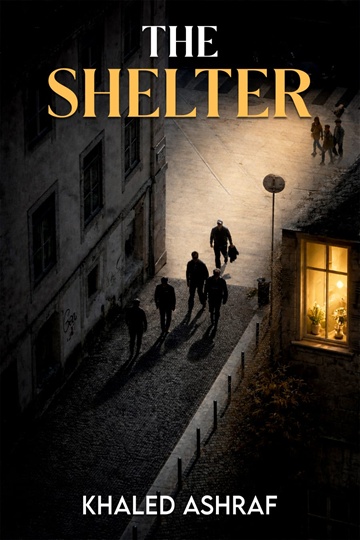
Elliot Harris is a father who believes that showing up should be enough. He wakes before dawn, counts his steps, and measures his energy against the demands of the day. Living with an autoimmune condition that does not show on his face, he negotiates every stair, every hallway, and every appointment with careful precision. From the outside, he appears steady. Responsible. Reliable.
But steadiness is not the same as stability.
When Elliot walks across the city to pick up his eight-year-old son instead of attending a required compliance workshop at a transitional housing program called The Shelter, the consequences unfold quietly. His bed is “paused.” School officials begin requesting documentation. Communication is redirected. Work expectations tighten. Words like reliability, consistency, and eligibility begin appearing in files he cannot see. No one calls it punishment. They call it support.
As institutions speak the language of care while tightening the terms of belonging, Elliot finds himself slowly rerouted from the center of his son Marcus’s life. He is not removed. He is not condemned. He is simply adjusted, placed on emergency contact lists instead of primary communication, asked for verification instead of trust, required to prove presence instead of being assumed.
The Shelter is a piercing and deeply humane novel about fatherhood under pressure, illness without visibility, and the quiet administrative language that reshapes lives without ever raising its voice. It explores what happens when care becomes conditional, when stability is defined by paperwork, and when a man begins to realize that being present is not the same as being counted.
With restraint and moral clarity, Khaled Ashraf tells the story of a father navigating systems that promise protection while narrowing his place within them. The Shelter is a powerful meditation on modern institutions, quiet erasure, and the fragile space between responsibility and removal.
About the Book
What is the book about?
The Shelter asks a simple question: What happens when the world you’ve always depended on suddenly isn’t there anymore? It’s a story about survival, trust, fear, hope, and the choices people make when they’re pushed far outside their comfort zones. I wanted to write something that kept people turning the pages, but I also wanted readers to pause every now and then and ask themselves, “What would I have done?” If people finish the book still thinking about it a few days later, I’ll consider that a success.
When did you start writing the book?
The truth is, I started writing it long before I ever opened a laptop. The story lived in my head for a while. I’d play out different scenes while driving, walking, or trying to fall asleep. Eventually I realized I wasn’t going to stop thinking about it until I put it on paper.
How long did it take you to write it?
Long enough to realize writing a book is a lot harder than reading one. There were days when the words came easily, and there were days when I wondered if I’d ever finish. Looking back, I’m glad I stayed with it because the story became better every time I came back to it.
Where did you get the idea from?
I’ve always been fascinated by one question: Why do people make the decisions they make? Two people can face the exact same situation and walk away with completely different choices. That has always interested me. The Shelter gave me a chance to explore that question through a story instead of a debate.
Were there any parts of the book where you struggled?
Knowing when to stop. As writers, we can always think of one more sentence, one more scene, or one more chapter. At some point, you have to trust the story and let it belong to the reader.
What came easily?
The conversations. I love dialogue because that’s where personalities show up. A good conversation can tell you more about a character than three pages of description.
Are your characters entirely fictitious or have you borrowed from real world people you know?
Every character is fictional, but every writer borrows little pieces from real life. Maybe it’s someone’s sense of humor, the way they handle pressure, or a conversation that stuck with me years ago. None of the characters are copies of real people, but life definitely leaves fingerprints on fiction.
We all know how important it is for writers to read. Are there any particular authors that have influenced how you write and, if so, how have they influenced you?
I’m drawn to writers who make me think. I enjoy stories that respect the reader and don’t explain every little detail. Some books entertain you for a weekend. Others stay with you for years because they change the way you look at people. Those are the kinds of books I admire.
Do you have a target reader?
I think anyone who enjoys suspense with substance will enjoy The Shelter. If you’re the kind of reader who likes talking about a book after you’ve finished it, then you’re probably the audience I had in mind.
About Writing
Do you have a writing process? If so can you please describe it?
I usually start with a question instead of a plot. Once I find a question I can’t stop thinking about, the story starts growing around it. I spend a lot of time thinking before I ever start typing. Once I finally sit down, I already have a pretty good idea of where I want to go.
Do you outline? If so, do you do so extensively or just chapter headings and a couple of sentences?
I like having a roadmap, but I don’t want a GPS telling me every turn. I know the beginning, I know the ending, and I know a few important stops along the way. Everything else is part of the adventure.
Do you edit as you go or wait until you’ve finished?
A little of both. If something really isn’t working, I’ll fix it before moving on. But I also know perfection can become procrastination. Sometimes you just have to keep writing.
Did you hire a professional editor?
Absolutely. Fresh eyes make every book better. No matter how many times you’ve read your own work, someone else will always notice things you’ve missed.
Do you listen to music while you write? If yes, what gets the fingers tapping?
Sometimes. Usually instrumental music or movie scores. Lyrics have a way of pulling my attention away from the page, so I like music that creates a mood without demanding my attention.
About Publishing
Did you submit your work to Agents?
I explored different paths before deciding how I wanted to publish. Every writer’s journey is different, and I think it’s important to find the path that fits your goals instead of someone else’s.
What made you decide to go Indie, whether self-publishing or with an indie publisher? Was it a particular event or a gradual process?
It was definitely a gradual decision. Independent publishing lets writers take ownership of the entire process. It’s more responsibility, but it’s also incredibly rewarding to see your vision come to life from beginning to end.
Did you get your book cover professionally done or did you do it yourself?
Professionally. I know enough to know what I don’t know, and book cover design is definitely one of those things.
Do you have a marketing plan for the book or are you just winging it?
I’m trying to focus less on “selling” a book and more on having conversations. Books have always spread from one reader telling another reader, “You should read this.” If that happens, everything else tends to take care of itself.
Any advice that you would like to give to other newbies considering becoming Indie authors?
Don’t compare your first chapter to someone else’s tenth book. Finish the manuscript. Keep learning. Be open to feedback. Most importantly, don’t quit just because the process takes longer than you expected.
About You
Where did you grow up?
I grew up in Pennsylvania, and it’s still home. Looking back, I didn’t appreciate how much the people and places around me would shape the way I think, but they absolutely did.
Where do you live now?
I still live in Pennsylvania with my family, and it’s where I do most of my writing.
What would you like readers to know about you?
I’m naturally curious. I enjoy asking questions, reading about ideas, and having conversations that don’t always end with neat, easy answers. Writing is another way for me to explore those questions. I don’t expect every reader to agree with me, but I hope they enjoy the conversation.
What are you working on now?
Right now I’m doing what most writers are doing: writing, rewriting, taking notes at random times of the day, and trying to stay one step ahead of the next idea that insists on becoming a story. I’m excited about what’s coming next, and I hope readers will enjoy taking that journey with me.
End of Interview:
Get your copy of The Shelter from Amazon US or Amazon UK.