The common thread in all my novels is women whose stories have been forgotten or are misrepresented.
Laurel Corona – 19 August 2026
The Back Flap
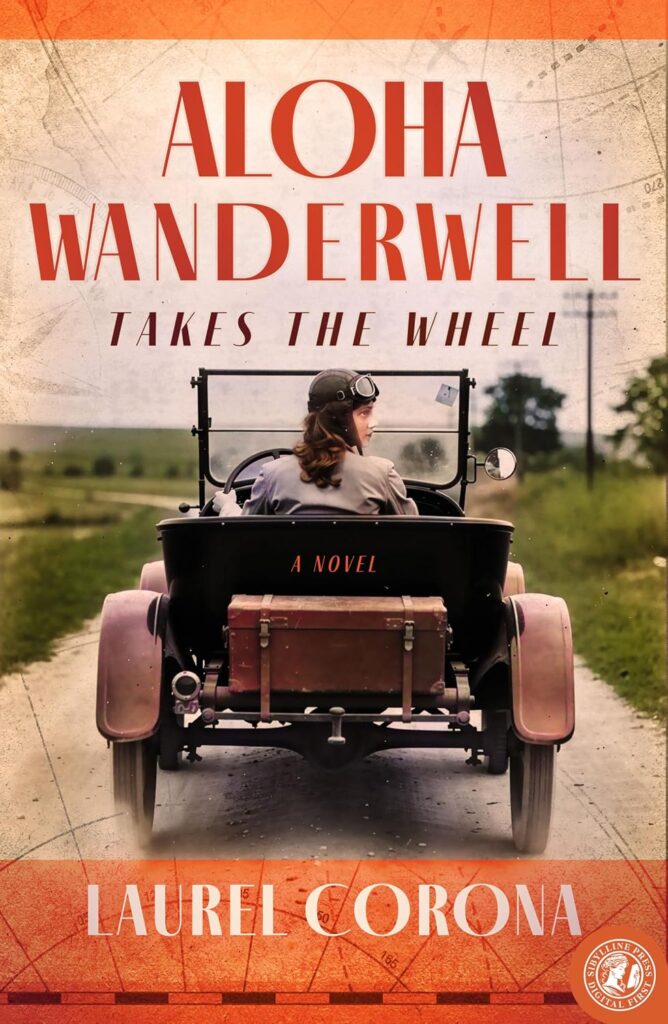
In the 1920s and 1930s, Aloha Wanderwell drove Model Ts across five continents, winning fame as the most traveled woman in the world.
Sixteen-year-old Idris Hall ran away from her boarding achool in 1924, changed her name, and joined the daring around-the-world expedition of charismatic Walter “Cap” Wanderwell, beginning a decade-long adventure that would take her across five continents behind the wheel of a Model T, in an era where roads were often no more than grooves in the dirt, and few if any people had seen a car or a European face.
Who was Aloha Wanderwell? How did she find the determination and courage to survive threats like stampeding elephants in Africa, a blizzard obliterating the road in Ukraine, and armed militants in China? Who was Walter Wanderwell? Rogue, philanderer, con man, and perhaps a German spy—he was all of this, as well as the love of Aloha’s life. Through the grit of their travel and the giddy heights of their international fame, Aloha grows from a starstruck teen to a woman confident of everything except the man who cannot love her the way she needs.
About the book
What is the book about?
It’s a coming-of-age adventure about the first woman to drive around the world, who did it as a teenager in the 1920s.
When did you start writing the book?
I started thinking about writing it in 2021, but couldn’t find the best way to tell the story for a year or so.
How long did it take you to write it?
It took a year to crank out a decent draft, then the next two years I left it alone for months at a time while I did other things. I followed that same pattern for revisions large and small, until I arrived at the point where I could say “this is the best book I can write.” So the answer is anywhere from one to three years depending on how you look at it, and then the publishing process adds a year or more onto that.
Where did you get the idea from?
The common thread in all my novels is women whose stories have been forgotten or are misrepresented. A friend I met shortly after I moved to Victoria BC lent me a little book about interesting women in Vancouver Island history, and one of the profiles was of Aloha. I was hooked in minutes!
Were there any parts of the book where you struggled?
The hardest part for me was trying to capture the adolescent angst that was part of the story. Aloha’s not just an intrepid world traveler. She’s a teenage girl. She’s immature and emotionally vulnerable, and I wanted to capture that without letting adolescent behavior and thoughts become annoying and distract from the fact that she was a tough cookie who discovers her own strength, sets her own boundaries, and deals with everything without flinching.
What came easily?
I love writing dialogue. In a first draft I get to know my characters through hearing how they talk and what they say. At some point I feel as if I am writing down what they are saying rather than making it up. When I reach the point where I am saying “Slow down! I can’t type that fast!” my characters have become authentic people who are in charge of the story from that point forward. It’s a great feeling to become their scribe more than their creator.
Are your characters entirely fictitious or have you borrowed from real world people you know?
In my other books, the point of view characters are fictitious and the historical ones, like Vivaldi, Isabella of Castille, and Emilie du Châtelet are woven into their stories. This is the first book where the main character is a real person and this presented challenges for me because I wasn’t going to control the plot in the way I usually can. But that said, I do think it is true that there’s some autobiography in any work of fiction, and a little bit of free therapy for authors in having characters deal with challenges that are reminiscent of situations they have faced. More often than not, my heroines handle tough situations and difficult people the way I wish I had, and there is some catharsis in that.
We all know how important it is for writers to read. Are there any particular authors that have influenced how you write and, if so, how have they influenced you?
I will read anything Ann Patchett or Geraldine Brooks writes. Kristen Hannah is another favorite. I learn about pacing of plots and character development from them. I greatly admire Barbara Kingsolver, especially The Poisonwood Bible, which gave me the idea to have several first-person narrators, but not allow the character at the core of the conflict (in Poisonwood Bible the father, and in my book Walter Wanderwell) to speak for himself, so that his story is only told through the eyes of others.
I mostly listen to audiobooks these days, because I use up my ability to process words visually through the hours I spend writing. I listen to a lot of best sellers this way, but I must admit that I get a lot of pleasure from “ear candy” like thrillers, murder mysteries, and anything non-challenging to the brain.
Do you have a target reader?
I try to write books a woman would feel comfortable giving to her mother as well as her daughter. I guess that means my target audience is women ranging from teens to great grandmothers, but that said, I have had a lot of men tell me they enjoy my books, sometimes more than they expected to.
About Writing
Do you have a writing process? If so can you please describe it?
I have a lot of ideas for historical novels because there are so many women worthy of having their story told, but most of these ideas I enjoy for a little while and then abandon them. When someone commands my attention the way Aloha did, I can’t wait to start writing, and I don’t think I have ever suffered from writer’s block once I am under the spell.
At this point in my life, I don’t have anyone demanding my time, and most days I am free to write as much as I want. My problem is maintaining balance in my life so I don’t get up midafternoon a little wobbly from a day of sitting that probably started about 6am, still in my jammies, with fuzzy teeth and a grumbling stomach. I have this practice that I call Five Categories of Time. I make a commitment to spend one hour of my day exercising, one hour in self care, one hour of work, one hour of human interaction, and one hour just having fun. As long as I do all that by the time I go to bed, I can spend the rest of the day on whatever I want. When I’m writing a book, I’ll usually spend the rest of the day doing that, but the other four hours have kept me healthy and sane through six books now.
Do you outline? If so, do you do so extensively or just chapter headings and a couple of sentences?
When I decided to write my first novel, The Four Seasons, I did a chapter-by chapter outline focusing on where I needed the story to be by the end of each chapter. Then, as I got into the story, I saw the way the characters wanted their story to go, and I got out of their way. When I finished the first draft I looked again at my outline and was shocked. I was going to write that? I learned from that to have a much looser idea of how my books will evolve.
That said, though, in historical fiction, much of the plot has to revolve around getting the fictional protagonists where they need to be to ground the story in its historical setting. I need to get them to a cloister in Venice, or to Helen of Troy’s court at Sparta, or into Henry the Navigator’s inner circle, and I think a lot of readers probably don’t realize how many plot points are designed around what will get the characters in the right place at the right time.
One thing that light outlining is good for is determining whether you have a story that is likely to come out to roughly 100,000 words when all is said and done because that’s the sweet spot for publishers. I realized in one of my books that a subplot I was interested in would take up too much word count, and in another I realized I could add something without making the book longer than publishers like to see. So yes, some outlining is valuable, but I do very little of it.
Do you edit as you go or wait until you’ve finished?
So many people ask authors how many drafts it took to finalize a book. I guess that used to be the case when writers pounded text out into a typewriter or wrote it longhand. Now, there really isn’t an answer to that question, because I don’t know anyone who doesn’t edit as they go.
I have a theory that the reason some books start out so well and then fizzle out is because the further you get into writing a book the fewer times you will revise the later text. I remember one time hearing someone say how high a percentage of car accidents happen within a few miles of home. That doesn’t mean that is the most risky part, because every time we get in our cars we cover that distance twice, coming and going, maybe even daily, whereas we may be on a stretch further from home only occasionally. More accidents happen in the home than elsewhere not because our homes are inherently dangerous but because we are there most of the time. There’s a bit of an analogy here with editing. Problems with the first fifty pages will get the most attention because we will keep going back again and again to the beginning. The next hundred pages will get less, but more than the last hundred, which we may edit and revise only a few times. I can’t count the number of times I have read weak final chapters of a book and thought to myself, “I know what happened.”
Do you listen to music while you write? If yes, what gets the fingers tapping?
I need absolute silence to concentrate. I’m one of those people who will turn off the car radio if I’m trying to find an address. With The Four Seasons I listened to Vivaldi non-stop, but since then I have avoided any outside stimulation while I’m writing. I’ve heard this may have something to do with getting older, but I think it’s just not wanting any distractions.
About Publishing
Did you submit your work to Agents?
I have always had an agent, but with Aloha Wanderwell Takes the Wheel, my agent didn’t really have the fire to sell the book. Fortunately, going indie means you don’t need an agent, and I have been much happier.
What made you decide to go Indie, whether self-publishing or with an indie publisher? Was it a particular event or a gradual process?
When I first started publishing back in 2008, authors had to have an agent. The only other means of publication were vanity presses, so of course I got an agent—three over the course of my first five books. When hybrid models like She Writes and marketing co-op models like Sibylline came onto the scene, at first they had to overcome the prejudice attached to books that weren’t conventionally published. Now, that it’s obvious that they are fully legitimate and are producing award winning books, I think that issue has been put firmly in the past.
Do you have a marketing plan for the book or are you just winging it?
I didn’t realize when my first novel came out from a major publisher that having a publicist meant I would get a fraction of a junior staffer’s time for a few weeks. As a result, the book didn’t get the push it needed for big commercial success. This time I decided I was going to do everything in my power to make Aloha succeed. That involved carrying out my own marketing plan to get the book into bookstores and libraries and submit it for prizes. It also involved contracting with Books Forward for publicity. I think it’s going well. I expect all these efforts will play out over the next six months or so, and whatever happens I will know that this time I did everything I could.
Any advice that you would like to give to other newbies considering becoming Indie authors?
Yes. Whatever publisher you go with, remember that no one else is going to make your book stand out. You have to do the work. Do everything you can think of because it could make all the difference not just for the present book, but for your career as an author. Good sales get you more opportunities for future books. Poor sales are going to do just the opposite.
About You
Where did you grow up?
I am a native of Southern California. I was born in the Los Angeles area and spent almost all my life in San Diego.
Where do you live now?
As of 2020, I live in Victoria, British Columbia
What would you like readers to know about you?
I have a great retirement gig as a lecturer for several luxury cruise lines and spend about half the year traveling the world. The rest of the time I enjoy living on beautiful Vancouver Island, with all its opportunities to enjoy nature and a beautiful city.
What are you working on now?
I have another book, The Intuitive, coming out from Sibylline Press in May 2027. The story is set in New York in the early 1900s and the main character, Zorah, is a socialite whose husband and son have been killed in an accident. To deal with her grief she begins working as an “intuitive” at Ellis island. This program, sponsored by a grant from the US government, selected women for what were believed to be their extraordinary intuitive abilities and had them observe newly arrived immigrants and mark with chalk those they suspected of mental deficiencies. If these people were unable to pass culturally biased intelligence tests, they were sent home. It’s really a disgraceful story in American history, and Zorah, soon becomes so troubled by the ethics of what she has done that she decides to atone by becoming involved with the lives of one family she harmed. As a result, Zorah awakens to realities her racist, xenophobic and anti-Semitic social circles are willfully blind to, and looking for a higher purpose for her life, she gets involved with suffrage, birth control and other social issues affecting women at the time. It’s a walk through feminist history of the era, but what I love most about the story is how Zorah is able, through opening her heart and mind, to once again fill her home with love.
End of Interview:
Get your copy of Aloha Wanderwell Takes the Wheel from Amazon US or Amazon UK.