Everyone was a teenager once and can relate.
Patrick d’Entremont – 11 July 2026
The Back Flap
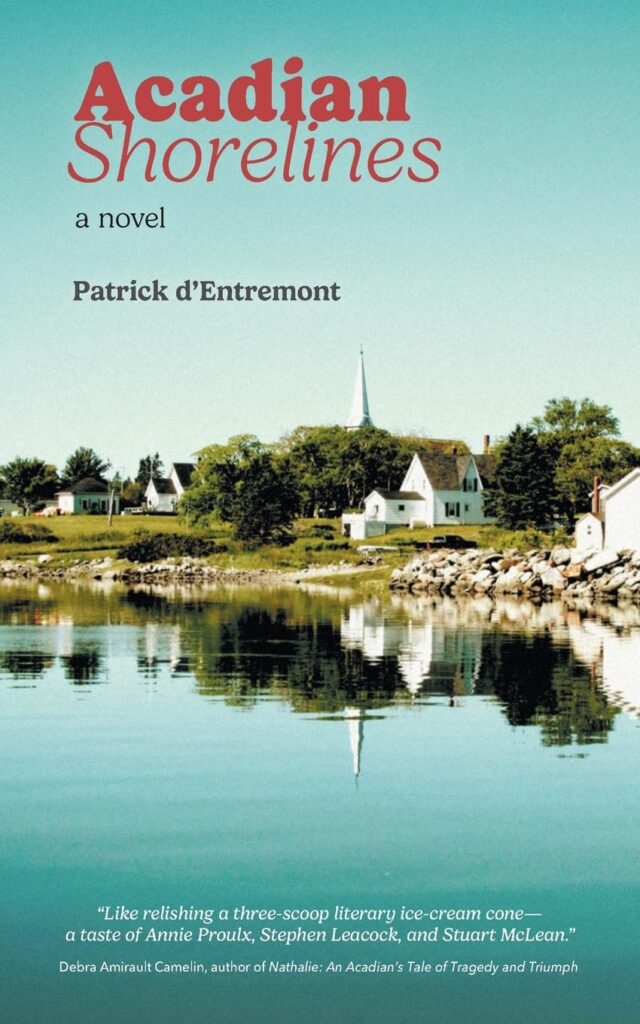
Acadian Shorelines relays the hijinks and heartaches of teenager Tommy Breau growing up in the late 1960s in a small Acadian fishing village in Nova Scotia, where American radio broadcasts of pop music, world news, and baseball come in more clearly than the Habs games from Montreal. Hilarious and heart-breaking in equal measure and featuring a rich cast of smart but clueless friends, wished-for girlfriends, and a loving if strict family, Acadian Shorelines has the adult Tommy looking back and wondering whether the French Catholic upbringing he was so eager to escape may have been the best years of his life.
About the book
What is the book about?
Once exposed to the world around him via television and U.S. radio stations, Tommy Breau, a teenager in an Acadian village in the 1960s, finds himself questioning everything about himself and his upbringing. He feels speaking French puts him at a disadvantage as “the world runs in English.” Narrated by the adult looking back and relaying the hilarity and heartbreaks of young Tommy, he ends up wondering if the upbringing he was so eager to escape may have been the best years of his life.
When did you start writing the book?
I started writing it in 2016. First it was a short story, then it was a series of short stories, all about the same characters, then it became a novel.
How long did it take you to write it?
It took me approximately six years to write, then another four years of editing and preparation for publishing. So ten years in all!
Where did you get the idea from?
The idea for the original story came from my daughter needing to do an essay for school. I told her it wasn’t that hard, and to prove it I wrote the first draft of what eventually became my opening chapter. I took some elements of my childhood and created a fictional story around it.
Were there any parts of the book where you struggled?
The main female character, a teenage girl, was hard for me to fully imagine. My wife helped me with that. Also, I was using two “voices”—the young protagonist in the moment, and the narrator as an adult looking back. Hitting the right level of narrator intervention was very difficult, and it took me several tries to get it right. I belong to a writers’ group that was a great help figuring that one out.
What came easily?
The protagonist’s best friend, Billy. He came fully formed right from the start.
Are your characters entirely fictitious or have you borrowed from real world people you know?
Billy was an exaggeration of a dozen boys I grew up with all combined. The protagonist, Tommy, is part me as a teenager.
Do you have a target reader?
Not really. Everyone was a teenager once and can relate.
About Writing
Do you have a writing process? If so can you please describe it?
I call it “Seeding, weeding, feeding, and heeding.” In my first draft, I simply put my thoughts down (seeding). Hopefully, I have a general theme or “truth” I want to share, but I don’t know precisely what the story is about, and I don’t really worry about it. I just want to get to know my characters in this early draft. Then I start the long process of revising, of going through the manuscript time and time again and removing anything that doesn’t contribute to the story—doesn’t illuminate the characters or mood, or propel the story forward (weeding). Up to this point, I’ve been “pantsing,” and after a while I usually end up with a bit of a mess on my hands, so I go back and rearrange, fill in gaps, fix inconsistencies, try to get story arcs to be engaging, etc. (feeding). Then after a while I’m sick of my own story and I hire an editor to give me another way of looking at it (heeding).
I usually have several stories on the go, all at different stages of development, so if I’m stuck on one, I go to another.
Do you outline? If so, do you do so extensively or just chapter headings and a couple of sentences?
I use a spreadsheet where I keep track of chapters and scenes within chapters. Sometimes I use colours to highlight which characters are in the scene, or which emotion I’m playing with, which gives me a quick visual as to story arcs. When I begin a story, I don’t outline at all; I just start writing and I see where it goes.
Do you edit as you go or wait until you’ve finished?
I edit as I go, for spelling and grammar, because later I’d find these too distracting. Plus I show works in progress to my writers’ group and they don’t need the distraction either. I do more intensive editing after I’ve finished a chapter, before going on to the next.
Did you hire a professional editor?
Yes. In fact, for Acadian Shorelines I hired three editors at different times and for different purposes.
Do you listen to music while you write? If yes, what gets the fingers tapping?
I certainly do. My stories are set in the late 1960s, early 1970s, and I play music from that era. It helps put me “right there.” Someday, I hope to be in a music trivia contest highlighting this time period, as I’m sure I’ll do well.
About Publishing
Did you submit your work to Agents?
Yes. While I received some positive feedback and encouragement, I never seemed to have what they wanted. Also I think my pitch was weak, and I didn’t realize what genre I was working in—historical fiction.
What made you decide to go Indie, whether self-publishing or with an indie publisher? Was it a particular event or a gradual process?
My last editor absolutely fell in love with the story and its characters, and was “shocked” (her word) when it didn’t get picked up. She knew a reputable and professional hybrid publisher and convinced me to go that route.
Did you get your book cover professionally done or did you do it yourself?
I got it professionally done by a designer hired by the publisher.
Do you have a marketing plan for the book or are you just winging it?
I’m sort of winging it but the publisher has lots of experience in marketing and is gently pushing me in certain directions.
Any advice that you would like to give to other newbies considering becoming Indie authors?
I’d say hire a professional editor before you submit your story anywhere. In my case, it was so fully edited that the publisher cut out the comprehensive editing phase, which saved me some money.
About You
Where did you grow up?
I grew up in a small fishing village in Yarmouth County, Nova Scotia, Canada, called West Pubnico.
Where do you live now?
I now live in Halifax, Nova Scotia.
What would you like readers to know about you?
I am a former newspaper and magazine columnist who now writes novels set in rural Nova Scotia, based on my childhood growing up in the 1960s. I grew up in West Pubnico, a fishing community in the Acadian region founded in 1653, where descendants of the original families continue to live to this day. My coming-of-age stories reflect how growing up in this milieu shaped who I became as an adult, a reminiscing that I hope resonates with many people, whether or not of Acadian descent. I now live in Halifax, Nova Scotia with my wife, Cindy.
What are you working on now?
I am working on a sequel, the protagonist now in university and struggling with “big words.” Also a prequel, which are the four or five months leading into the main story and where the protagonist is even more clueless than what we’ve seen to date; the prequel also gives the backstories of the major characters, and I hope it delivers a few “aha” moments. The sequel is now into its second draft and I am just letting it lie fallow for a while. I’m still working on the first draft of the prequel.
End of Interview:
Get your copy of Acadian Shorelines from Amazon US or Amazon UK.