I had always held a belief that people must, deep down, want to do good. They must be doing their best but lack the power, funds, or knowledge to do more. Sitting in board rooms and dinners with some of the wealthiest men in the country showed me how little interest the people with power have in changing the base evils of the system.
S.E. McPherson – 25 June 2026
The Back Flap
Logan technically doesn’t exist. He is terrified of the Black Lapels and their Swordsman church, who imprisoned his parents for bearing an unlicensed, “unnatural” child. When he’s taken to a home for unwanted boys, he meets Jace—a master liar who isn’t afraid of anything. Their world wants them to become Swordsmen and soldiers. All they want is a life together where neither has to hide. Wanted Boys is an adult queer dystopia where found family is the only thing that can save the boys who will change the world.
About the book
What is the book about?
Wanted Boys is about Logan Cardot, the boy who shouldn’t have been born, and Jace Evans, the boy who wants to change the world, as they struggle with their feelings for each other under a fascist regime. It’s a coming-of-age dystopian story of young men carving out a place for themselves.
When did you start writing the book?
I started writing this book during Trump’s first term, when the ugliest parts of society boldly took center stage.
How long did it take you to write it?
I wrote the entire Wanted Boys series over the course of about three years in the wee hours of the morning while I was working as an executive.
Where did you get the idea from?
I had always held a belief that people must, deep down, want to do good. They must be doing their best but lack the power, funds, or knowledge to do more. Sitting in board rooms and dinners with some of the wealthiest men in the country showed me how little interest the people with power have in changing the base evils of the system.
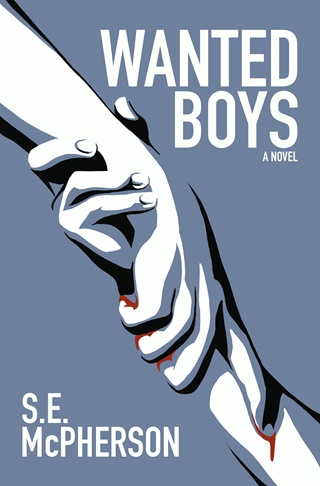
The people who do make positive change are typically those without the power or the money. They’re already dangling by their fingertips on a cliff’s edge and still reaching to grab the hand of someone who’s slipping. Wanted Boys became a story about trying to be the hand reaching out, trying to build life and community out of the scraps that you’ve been given—and then demanding more than scraps.
Were there any parts of the book where you struggled?
While the book deals with things like police brutality and religious authoritarianism that are very present in our current world, I wanted to abstract and simplify it enough that it wasn’t overwhelming to the reader and could be battled by our characters. Taking those massive, interconnected concepts and threading them through the background of this world without overshadowing the love story between Jace and Logan was probably the hardest part.
What came easily?
My favorite part of the process is slipping into the main characters’ skin—I even go so far as to take personality tests as them to get their enneagram or zodiac sign—and really getting a feel for who they are, what they know, what they’re dead wrong about, and what fears are going to reach up and bite them when they least expect it. Once I knew who Jace and Logan were as characters and had established the limits of their world, writing the book felt more like following them around and documenting what happened, so it all flowed pretty easily.
Are your characters entirely fictitious or have you borrowed from real world people you know?
I think it’s impossible to craft characters that feel real without adopting some of the traits, mannerisms, strengths, and weaknesses of the people you’ve interacted with in your life, but none of the characters in Wanted Boys are based on any specific person.
We all know how important it is for writers to read. Are there any particular authors that have influenced how you write and, if so, how have they influenced you?
I grew up on complex but accessible, character-focused dystopias by Lois Lowry and K.A. Applegate, as well as stories that emphasized characters’ autonomy by Gail Carson Levine. As an adult, I credit authors like Arundhati Roy, N.K. Jemisin, Xiran Jay Zhao, and Amal El-Mohtar for shaking up my worldview and my understanding of how stories are told in ways that helped me find a voice of my own.
Do you have a target reader?
Readers with a taste for dystopian and speculative fiction that features queer love, who really want to feel like the characters are people they could reach out and touch—and who enthusiastically recommend a book to a friend while they’re still crying from the emotional distress it caused.
About Writing
Do you have a writing process? If so can you please describe it?
Usually I get possessed by the spirit of a scene at an inconvenient time and have to hold my peace until I can dissociate properly in front of a keyboard. I tend to build a playlist of songs that vibe with the world and POV character of a book so I can turn it on and fall into the right mindspace for that story, and then I trail along on my characters’ heels like a bright-eyed, bushy-tailed reporter and document their adventures for posterity.
Do you outline? If so, do you do so extensively or just chapter headings and a couple of sentences?
I don’t often outline at first—I’m firmly a pantser—but once I reach about the middle of a book, I’ll pace out the rest by titling each chapter with 8-10 words about what I think needs to happen there. Now, do I stick to the outline? Rarely, but it helps me at least see the runway clearly so I can land the plane.
Do you edit as you go or wait until you’ve finished?
I typically write a first draft as messily as needed to get all the thoughts out. Then I open a fresh, blank document and start at the beginning with a complete rewrite, pulling in bits of the first draft that I particularly like, resculpting and adding in places, but mostly leaving a lot on the cutting room floor. In that draft, I do a lot of jumping back and forth between chapters to continually refine.
Did you hire a professional editor?
For the Wanted Boys series, yes, I hired an exceptional editor named Angela Brown. For other books, I’ve done the editing myself since editing and writing coaching were my bread and butter for many years.
Do you listen to music while you write? If yes, what gets the fingers tapping?
I absolutely listen to music while I write. Music is the easiest tunnel into the back of a character’s head so I can ride along and embody them for a while. Every book has its own entirely different playlist to fit the POV character, the setting, and the tone of the story. For Wanted Boys, Woodkid, Paravi, and Cody Fry featured pretty heavily on the list.
About Publishing
Did you submit your work to Agents?
That was the original plan, but I didn’t end up querying Wanted Boys.
What made you decide to go Indie, whether self-publishing or with an indie publisher? Was it a particular event or a gradual process?
I published my debut fantasy romance last year myself, and I fell in love with being able to control the process and the timing. At the same time, the state of traditional publishing, the unfortunate rise of generative AI, and the political pushes across the country to ban queer stories like mine made me wary of locking myself into the long cycles and corporate whims of a traditional publisher, especially for a series like Wanted Boys that has both a queer love story and pointed critique of militarization, religious authoritarianism, and fascist control, since it would likely be a riskier venture for any publisher.
Did you get your book cover professionally done or did you do it yourself?
I illustrated all of the Wanted Boys series covers myself, though I’ve worked with phenomenal cover artists for my other books.
Do you have a marketing plan for the book or are you just winging it?
Oh, I’m always thirty spreadsheets deep in marketing plans. I was a marketing exec for a long time, so it’s hard to take off that hat. Since this series will be released rapidly—two books this year, two the following year, and the final book in 2028—I knew I needed to be on top of the schedule and looking out at least six months ahead on paid and earned promotion.
Any advice that you would like to give to other newbies considering becoming Indie authors?
There is a lot of wisdom to be gained from other indies who’ve found success, and people are pretty free about sharing it, but I caution every new author against spending too much time comparing to others and trying to mimic another’s path to success. Let people tell you the pitfalls they fell into so you don’t have to make costly mistakes, but then establish your standards, your timeline, and your measures of success.
About You
Where did you grow up?
I grew up in Abilene, Texas, a small town that has held, at various points in my lifetime, the dubious honors of highest per-capita churches, highest rate of teen pregnancy, top forty highest rape rate, and most per-capita Trump voters.
Where do you live now?
I live in the Minneapolis-St. Paul area. Given the stories I tell and the environment I wanted my kid to live in, making the trek out of the Lone Star State to the North Star State was a necessary move. And it’s certainly been fertile ground for stories of dystopian society and the brave people fighting it this year!
What would you like readers to know about you?
There will never—never—be a scrap or shred of generative AI in my stories or my art. I firmly believe in and support human creativity, and the reconstituted cud of stolen imagination has no place alongside it.
What are you working on now?
I’m working on A Queen’s Lament, the final book in my fantasy romance series, the Heart-Mage Trilogy, where a queen, a mage-king, and their former-guard lover have to find a way to send the gods back beyond the veil before they destroy the world. (I’m also trying my hardest not to start a new dystopian fantasy series about shapeshifters that keeps trying to crowd its way into my brain.)
End of Interview:
For more from S.E. McPherson visit her website and follow her on Instagram, Threads, and TikTok.
Get you copy of Wanted Boys from Amazon US or Amazon UK.