In 1942, not only was the OSS brand new, but the hiring of women agents was almost unheard of. Consequently, OSS training was fast, furious, and barely adequate, even with the help of the more experienced British MI6 spy agency.
Pam Webber – 23 June 2026
The Back Flap
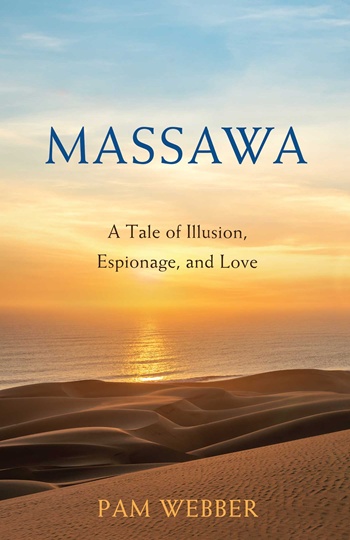
In 1942, during the height of World War II, Wild Bill Donovan, the director of the United States’ first spy agency, believes women are the key to winning the intelligence battle with the Nazis. To that end, he partners fledgling agent Kit Thomas with British MI6 agent Mark Williams and sends them to one of the most perilous places in the world—Massawa, Eritrea—to investigate the theft of millions of military payroll dollars.
In Massawa, Kit and Mark discover a conspiracy by Nazi sympathizers, known as the Vichy, to shut down the only Allied naval base on the Red Sea—which is an essential resource in stopping the Nazi invasion of North Africa. As they work to reveal the conspirators, Kit and Mark engage in a dangerous and tempestuous dance of trust versus mistrust.
About the book
What is the book about?
Synopsis: In 1942, during the height of World War II, fledgling OSS agent Kit Thomas is sent to North Africa to investigate the theft of millions of military payroll dollars. Partnered with British MI6 agent Mark Williams, the two spies commence a tempestuous dance of trust versus mistrust as they unravel a conspiracy by Nazi sympathizers, known as the Vichy, to shut down the only Allied naval base on the Red Sea, an essential resource in stopping the Nazis from capturing the Suez Canal and the oil fields of the Middle East. Whoever controlled these resources would win the war.
Discussion: In 1942, not only was the OSS brand new, but the hiring of women agents was almost unheard of. Consequently, OSS training was fast, furious, and barely adequate, even with the help of the more experienced British MI6 spy agency. This was especially true with regard to espionage tradecraft and sexpionage. I tried to infuse the character of Kit with a mix of intelligence, courage, and naivete to reflect this as she ventures halfway around the world to Massawa to investigate the stolen money.
The book also tells the true story of the Miracle at Massawa, a little-known piece of WW2 history.
When did you start writing the book?
In 2023, as soon as I finished my third historical novel, Life Dust. I’m often formulating ideas for the next books as I’m finishing up one.
How long did it take you to write it?
Two years to research and write Massawa and 6 months or more to edit.
Where did you get the idea from?
My brother, Carl Bayliss, aka Buddy. He is an amateur historian who’s really not an amateur at all. His knowledge base and insight into WWII history are phenomenal. I was having lunch with him one day, lamenting about what I would write about next, and he shared the story of the Miracle at Massawa. I knew instantly that it would be my next book.
Were there any parts of the book where you struggled?
There is so much background information that is needed when writing about historical events that I had to be careful to avoid information dumps. I rewrote the first chapter a dozen times for this very reason.
What came easily?
Kit’s character. I think she’s my wannabe, alter ego.
Are your characters entirely fictitious or have you borrowed from real world people you know?
Massawa is historical fiction, so the characters are a mix of real and fictitious. Kit, Jake, and Mark are fictitious. Captain Edward Ellsberg (later to become Admiral), the officer responsible for the Miracle at Massawa, was real. In fact, I worked with his grandson in developing my approach to his character in the story. Several of the minor characters are also real.
We all know how important it is for writers to read. Are there any particular authors that have influenced how you write and, if so, how have they influenced you?
David L. Robbins, a NYT best-selling author. I was in a creative writing group taught by David for two years.
I love real voices in novels. Authors who do this exceptionally well for me include Mark Twain, Fannie Flagg, Katherine Neville, Margaret Mitchell, and, of course, Harper Lee. Interestingly, her style was significantly influenced by Tay Hohoff, her editor, as noted in the differences between Go Set a Watchman and To Kill a Mockingbird.
Do you have a target reader?
While the statistics indicate that I have readers of both genders, women 18 and over are by far the largest group, especially those affiliated with book clubs. Many of the male readers were attracted to the military focus in Life Dust.
About Writing
Do you have a writing process? If so can you please describe it?
Anywhere, anytime, anyplace. I keep a notebook with me all the time because I never know when an idea will pop into my head. I write on a MacBook Pro, which goes with me most places. My favorite place to write is on my front porch (see pic below).

Do you outline? If so, do you do so extensively or just chapter headings and a couple of sentences?
Yes. Initially, I outline chapters and a few sentences to get started. Then, when I know the work each chapter has to do, I’ll make more organized notes within that chapter.
Do you edit as you go or wait until you’ve finished?
I edit all along and then extensively and repeatedly as different editors’ notes come in. I was thrilled that in getting a Kirkus Star Review they gave Massawa an A on editing.
Did you hire a professional editor?
Yes. I have a developmental editor that I’ve worked with for years and trust. I pay this editor out of pocket. Once we’ve finished editing, I submit the manuscript to the Publisher’s editorial team for another look at the developmental perspective and for a line-by-line edit.
Do you listen to music while you write? If yes, what gets the fingers tapping?
Occasionally. Most of the time I like it quiet. If I do listen to music, I like the 1970s, smooth jazz, and artists with extraordinary voices. My current obsession here is Sidney Christmas.
About Publishing
Did you submit your work to Agents?
No. Prior to writing historical fiction, I wrote a nursing textbook published by Lippincott, Williams, & Wilkins, later by Wolters Kluwer. When I made the switch to creative writing, my editor at WK directed me toward Brook Warner at SheWritesPress. Luckily, Brooke liked my first book, The Wiregrass, and agreed to publish it. I’ve been with her ever since.
What made you decide to go Indie, whether self-publishing or with an indie publisher? Was it a particular event or a gradual process?
I did not want to get into the rat race associated with looking for an agent and hoping to get a good one. I liked Brooke’s professionalism and vision. She has taken SWP to great heights and is now partnered with Simon & Schuster, so I’ve got a great publisher and one of the biggest global distributors in publishing.
Did you get your book cover professionally done or did you do it yourself?
It’s my publisher’s call. However, they allow me to submit pictures, ideas, and concepts. I then work with their cover designers to find something we both like.
Do you have a marketing plan for the book or are you just winging it?
SWP/Simon & Schuster have a great marketing team that starts working 9-12 months ahead of the book release date. In addition, I have a social media manager and a publicist that I work with, both for marketing and branding. I’ve also developed relationships with several very good book promoters with whom I work independently.
Any advice that you would like to give to other newbies considering becoming Indie authors?
Yes. As I found out, it take time and attention to develop your craft. Learn the rules for literary writing. If you need to take classes, find experts, and go to conferences. If you need help, find an editor (not your local English teacher) who works with professional authors. You will save yourself months if not years of work. Editors and publishers can read the first page of a manuscript and know if an author knows what she/he is doing. An excellent starting point if you need help is Writing Fiction by Gotham Writers. I still have this on my shelf.
About You
Where did you grow up?
I was raised in Amherst, Virginia, which is in the foothills of the Blue Ridge Mountains.
Where do you live now?
I live in Winchester, Virgina, which is in the Northern Shenandoah Valley.
What would you like readers to know about you?
I love creating stories that resonate with people for years, and I love connecting with readers. Their thoughts and impressions are invaluable.
What are you working on now?
The sequel to Massawa.
End of Interview:
Get your copy of Massawa from Amazon US.