The characters are fictional, but with all my writing I’m working from what I know first. Scenes like my lying beneath my Mother’s piano as she played becomes an early scene for young Conrad.
Nicole Conn 18 June 2026
The Back Flap
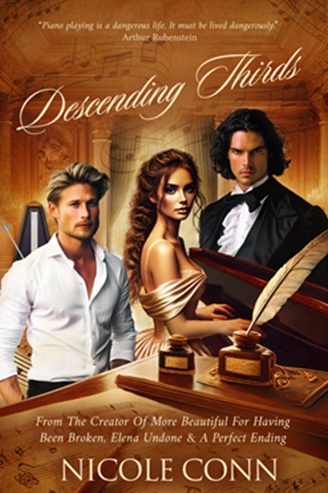
In the obsessive and rarefied world of classical piano, one woman becomes the dangerous harmony between two extraordinary brothers, both composers.
Set against the backdrop of an elite international piano competition inspired by the legendary Van Cliburn Competition, Descending Thirds follows Alexandra von Triessen as she finds herself torn between Sebastian — charismatic, seductive, and hungry for greatness — and Conrad, a brilliant savant who writes music not for fame, but because it lives inside him and must be heard.
What unfolds is an epic triangular love story spanning decades, countries, triumph, betrayal, devastating loss, and the unbearable cost of artistic excellence. Sweeping, sensual, intelligent, and deeply cinematic, Descending Thirds explores the question: What happens when love and genius demand the same sacrifice?
About the Book
What is the book about?
Descending Thirds is an epic period drama and sweeping triangular love story set in the high-pressure world of classical piano competition. At its center is Alexandra von Triessen, a gifted pianist who becomes emotionally and romantically entangled with two very different brothers — Sebastian, a magnetic virtuoso and showman, and Conrad, a quietly transcendent composer whose genius exists entirely outside the pursuit of fame.
But beyond romance, the novel is also about obsession, family expectations, artistic sacrifice, grief, identity, and the emotional cost of greatness. It asks what happens when music becomes not just a passion, but the language through which people love, manipulate, heal, and destroy each other.
The story spans decades and moves through Europe and America against the backdrop of the fictional International Ketterling Piano Competition, inspired heavily by the Van Cliburn Competition. It is very much a love letter to classical music and to the people who dedicate their lives to art.
When did you start writing the book?
The seeds of Descending Thirds were planted decades ago. Classical music has been part of my emotional DNA since birth. The day my mother brought me home from the hospital, my father had surprised her with a piano. She sat down and played while I lay in a crib beside her. That image has stayed with me my entire life.
I formally began writing the novel twenty-five years ago, but it evolved slowly over time as I continued making films, raising my children, and living enough life to understand the emotional depth the story required.
How long did it take you to write it?
In many ways, a lifetime. The actual writing process spanned many years because the novel became increasingly ambitious as it evolved. I wanted it to feel emotionally operatic and cinematic while remaining deeply intimate and human.
There was also an enormous amount of research involved — studying piano competitions, classical composers, performance psychology, and the culture surrounding elite classical musicians. I watched countless hours of Van Cliburn Competition footage and immersed myself in the world until it felt authentic enough to inhabit.
Where did you get the idea from?
The inspiration came from several places converging at once.
First and foremost, from my lifelong relationship with classical music through my mother, Christa Hoven, who was a gifted pianist herself and appears in the novel as Alexandra’s first piano teacher.
Second, from my fascination with the emotional violence of artistic ambition — particularly in the classical music world where perfection is demanded from childhood.
Thirdly, I had been asked to make changes to several other projects inside the studio system as well as television writing, and I began to make so many compromises I was sick in my soul. That became the basis for the theme, at what price success, fame and glory?
And finally, from my interest in complicated love stories. I did not want to write a conventional romance. I wanted to explore how two completely different men could awaken entirely different parts of the same woman — and how love itself can become both salvation and destruction.
Were there any parts of the book where you struggled?
Absolutely. The biggest challenge was making the classical music world accessible to readers who may know nothing about it while still satisfying readers and musicians who do.
Music is deeply emotional and experiential. Translating that onto the page without becoming technical or inaccessible was difficult. I wanted readers to feel the music emotionally rather than simply observe it.
The other challenge was balancing the scale of the story. Descending Thirds spans decades and contains enormous emotional turns, yet I still wanted the intimate moments between the characters to feel truthful and grounded.
What came easily?
The emotional intensity came very naturally. It’s a cornerstone of all my work. If anything, Alexandra is my straight alter ego – someone who may be technically thin but leads with the heart. We both suffered from imposter syndrome. It’s only now after decades that I feel comfortable knowing I’ve created a legacy with my entire body of work.
The characters arrived fully alive in many ways. Their emotional worlds felt deeply familiar to me. The romantic tension, longing, grief, and complexity of family relationships flowed organically once I truly understood who they were. But it wasn’t just the leads. The entire cast of characters are so real for me after all this time – I know them like I do all the actors on a set on one of my films.
Also, because film has been my primary storytelling medium for decades, no matter how many revisions I’ve gone through I’m always directing it like it’s a film.
Are your characters entirely fictitious or have you borrowed from real world people you know?
The characters are fictional, but with all my writing I’m working from what I know first. Scenes like my lying beneath my Mother’s piano as she played becomes an early scene for young Conrad. He emerged almost mysteriously – but with certainty. Sebastian and I definitely share a dark side.
We all know how important it is for writers to read. Are there any particular authors that have influenced how you write and, if so, how have they influenced you?
I would say the first book that seriously impacted me was Gone With the Wind, which I read in the 4th grade. Along with Wuthering Heights and authors like Emily Brontë influenced my understanding of high seas romance, obsessive love and emotional atmosphere. While I suffered through Tolstoy’s Anna Karenina it taught me scale and emotional complexity. Later, I would discover The Woman’s Room and later yet, Barbara Kingsolver and then my absolute favorite writer of all time, Margaret Atwood.
Do you have a target reader?
I’d say there are three general audiences. Readers who love immersive emotional storytelling who are drawn to stories willing to be sensual, devastating, romantic, messy, and human all at once.
Secondly, readers who enjoy epic romances, prestige historical dramas, complicated characters, and stories centered around art and music tend to connect deeply with the novel.
Finally, and most interestingly, many readers who initially thought classical music “wasn’t their thing” have ended up becoming completely absorbed by the world.
About Writing
Do you have a writing process? If so can you please describe it?
Music is very much a part of the early stages. I usually choose a specific composer or type of music to become the emotional spine of every project I create. With Descending Thirds, it was Rachmaninoff and Prokofiev.
As for process – the first thing I do in the morning (usually between 4:30-600 am) is puzzle. I can’t rave enough about puzzling. So good for the memory and concentration. And as you click the puzzle pieces together, story elements begin to coalesce and paint a fuller picture.
I then walk four miles to let my mind wander through all kinds of ideas, plot points, and fabulously witty dialogue. You can’t have a better drug than the endorphins ushering in the muse. After that, writing sessions stretch between one and a half to three hours, two to three times a day. Except the final version. I’ll work all day and all night to complete the manuscript.
Do you outline? If so, do you do so extensively or just chapter headings and a couple of sentences?
I rarely use an outline because I want everything to flow freely in the beginning. If things become super complex, I will outline as I go along. Mostly I just begin because the story line, the characters, the twists have already been living in my head, clattering around waiting to tell their story to me!
I first wrote Descending Thirds as a screenplay because I thought it was a film. Then I realized it had to be a novel so in this case, the script became my outline.
Do you edit as you go or wait until you’ve finished?
My Steadfast Rule – 1.) Vomit the first draft and include absolutely every single thought, all the pages you drafted here and there no matter how well they still connect to the story. 2.) Rewrite. Revise. Rework. Then do that again about two thousand times! To me writing is all about rewriting until it’s absolutely perfect. And then do that some more!
Did you hire a professional editor?
I used several editors and readers so that I could get feedback. No matter what you must realize you’re way too close to the material. Good editors can make the most massive difference.
Do you listen to music while you write? If yes, what gets the fingers tapping?
Constantly.
For Descending Thirds, classical music was absolutely inseparable from the writing process. Chopin, Rachmaninoff, Beethoven, Debussy, and Tchaikovsky all shaped the emotional atmosphere of the novel. Sometimes a single piano piece could unlock an entire chapter emotionally.
About Publishing
Did you submit your work to Agents?
Twenty five years ago I went out with the novel and script adaptation. Talk about what they call in the industry as a big f*** deal – everyone wanted the material. CAA, ICM, William and several others. I settled with William Morris New York, and my agent told me I would get seven figures, or he’d eat his shoe. Neither of those things transpired. But it was set up as a feature for nearly two years and then went into turnaround. At that time, I had a new baby and life took over and I returned to filmmaking.
In 2017 Ken Atchity became my manager and took the book out widely but we couldn’t get a deal. We then realized this material would be best served by becoming a limited mini-series. As I began working on that, we decided to go through his publishing arm, Story Merchant Books.
Coming from independent filmmaking, I have spent much of my career building projects outside traditional systems, so the indie publishing path felt surprisingly natural.
What made you decide to go Indie, whether self-publishing or with an indie publisher? Was it a particular event or a gradual process?
For decades I’ve created stories that larger systems often considered too niche, too emotional, too female-driven, or too risky. Yet audiences consistently found them and connected deeply. I’ve been able to continue putting projects out that are successful enough that I can move onto the next project. And I’ve been able to maintain my voice without conflict.
Indie publishing allowed me to preserve the scope, emotional intensity, and uniqueness of Descending Thirds without compromising its identity. It also gave me the ability to think expansively about the project beyond the book itself — including visual trailers and the current development of the story as a limited television series.
Did you get your book cover professionally done or did you do it yourself?
Professionally done. Because of my background in film, I’m very involved in visual design, but I absolutely value collaboration with talented artists and designers. I found a lovely designer to work with Nadia Afzal.
Do you have a marketing plan for the book or are you just winging it?
When I started out in the late nineties, I was blessed to a have three book deal with Simon and Schuster. Publishing was a different universe then. I got handsome advances and their marketing folks handled my book tours, etc. Now it’s twenty-five years later. I thought it was difficult to market in the indie film world. That’s nothing compared to the book publishing/distribution universe.
I was thrilled to work with Devon Blaine of The Blaine Group as my publicist for the paperback/hardcover release. And equally happy to be working with Jennifer Vance with Books Forward.
What has been especially exciting is discovering how passionately readers respond to the emotional experience of the story. Word-of-mouth has been incredibly powerful.
I’ve also approached promotion in a more cinematic way — trailers, interviews, visual branding, and positioning the story as both a literary experience and a prestige limited-series property.
Any advice that you would like to give to other newbies considering becoming Indie authors?
Write what you know. Protect the emotional truth of your work. The indie path requires resilience because you wear many hats at once — artist, marketer, strategist, promoter — often while still trying to remain creatively vulnerable. But there is also enormous freedom in that.
Do not chase trends so aggressively that you lose the thing that makes your voice unique. Readers respond to authenticity far more deeply than calculation.
About You
Where did you grow up?
I was born in Mesa, Arizona. But I grew up all over the place in US and Europe. I’ve been rather nomadic and have moved in excess of seventy-five times.
Where do you live now?
I’ve lived in Los Angeles since 1993, where I continue working across film, television, and publishing.
What would you like readers to know about you?
That I care deeply about emotional honesty in storytelling. Whether through film or novels, I’ve always been interested in stories that allow audiences to feel profoundly — stories about love, longing, grief, identity, family, resilience, and connection.
And also that Descending Thirds was truly written from the heart. It is probably the most personal artistic experience of my career. I definitely refer to it as my opus.
What are you working on now?
I’m currently developing Descending Thirds as a prestige limited television series while continuing to expand awareness of the novel. Do we not grieve is my next feature in development.
I have another novel I will be publishing in another year or so, Armand’s Tango and I’m beginning a multi-media memoir entitled, Breathing Required.
End of Interview:
For more from Nicole Conn visit her author website and her filmmaking website.
Get your copy of Descending Thirds from Amazon US or Amazon UK.