I think about myself as a kid, sitting for hours in the stacks of my local library, when finding a book felt like finding a gold nugget in a field of dirt. Or staying up late at night, too late, because I just have to finish this page, this chapter (I still do that). I want to create that experience for someone who loves books as much as I do.
Brad Barkley – 16 June 2026
The Back Flap
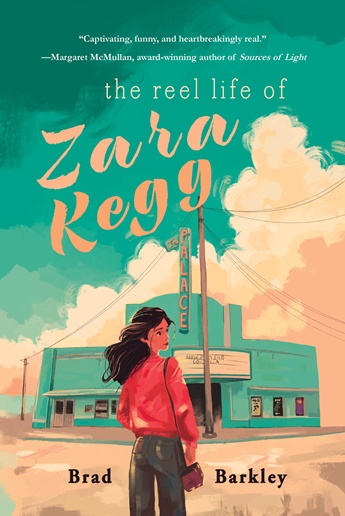
Sixteen-year-old Zara Kegg spends most nights alone in the projection booth of the Palace Theatre, a run-down movie house in Carolina Beach, N.C., showing old ’50s sci-fi and horror movies to whoever still wanders in. Three years after her mother’s death, she’s still trying to figure out where she fits—at the beach, in her family, in her world. Mostly she drinks too much coffee, does pushups in the booth between reel changes, and practices what she calls “the whole Zen loner thing.”
Then she meets Zachary, whose clothes don’t match, whose stories don’t always add up, and who might be the most interesting person she’s ever met. As they get closer, Zara starts to realize that people are rarely as simple as the categories we place them in, especially when grief and loneliness get involved.
At the same time, her boss decides the Palace should host a Valentine’s Day Godzilla marathon, complete with inflatable Godzillas on the roof of the theater, which tells you most of what you need to know about the tone of the book. It’s funny, but also very much about loss, silence, and the strange ways people try to protect themselves from being hurt again.
About the book
When did you start writing the book?
This will sound weird, but I honestly don’t remember. I wrote a first chapter that I liked a lot, and included some details about some of the old B-movies I love, but I had several other projects going and (somehow) was simultaneously taking a partial hiatus from writing. When I had the idea for the Godzilla festival, that gave me a target that I wanted to get to, so I started working on it again, and finished probably the entire last half in the summer of 2024 in one flurry.
How long did it take you to write it?
See the last answer for clues to my cluelessness. I guess if I added up the various stops and starts, I spent maybe two years on it.
Where did you get the idea from?
Almost always, with novels and short stories, I start with character, but for this one I may have actually had the setting first. As always with writing, several different rivers flow into the ocean of a full-blown idea. One is that when I was a kid, my father, because of his job, would take me through dilapidated buildings before they were restored, or torn down, or in one memorable case, imploded (the King Cotton Hotel in NC, from which I still have a large stack of 78 records I rescued from the ballroom). So I have always romanticized falling down buildings that hold ghosts of the past. A run-down theater in a run-down beach town in the dead of winter just pushed all of my buttons.
Were there any parts of the book where you struggled?
I think what I described above, the stops and starts, leaving it and then coming back—in the past that has felt like a struggle. And that’s not always random. In this book I had to write sensitively about mental illness, and that brought up a lot of stuff concerning people I have known and loved. Sometimes I think, why can’t I just sit down and write this thing straight through like a normal person? But now I accept it as part of my process. The book recently received a starred review from Kirkus, so apparently all the stops and starts eventually led somewhere useful.
What came easily?
Zara’s voice. I wrote the first line, “In the dark, you can see more than you’d think,” and I knew there were so many layers of meaning there, that she was aware of those layers, and that she was wise beyond her years–smart, funny, snarky, sad. I just felt her immediately, and her voice came with that.
Are your characters entirely fictitious or have you borrowed from real world people you know?
Both? I have never consciously thought of someone I know in real life and decided to include this or that personality trait in a character. But at the same time in retrospect I can see some of that once the book is finished. And I think every character I’ve ever created in all my work is some version of myself. As I like to tell students, you will never come close to knowing another person as well as you know yourself, so that will always be your deepest well to draw on for understanding who and what people are, what their hidden lives are like.
We all know how important it is for writers to read. Are there any particular authors that have influenced how you write and, if so, how have they influenced you?
Yes, too many to name, but I will name a few. For YA fiction, J.D. Salinger, John Knowles, E.L. Konigsburg. I read their books at just the right juncture: The Mixed Up Files when I was probably seven years old, A Separate Peace when I was in middle school, and Catcher in the Rye in high school. At each encounter, I had the feeling that I was seeing the real world that lives beneath the surface of things, the way people are beyond their public masks. This was important to me growing up in a family that worked hard to maintain that surface illusion. For everything else I write (novels and short stories for adults) I might name Eudora Welty, Flannery O’Connor, Don Delillo, Milan Kundera, and again J.D. Salinger, for their characters, their humor, their humanity, and their overall sense of weirdness.
Do you have a target reader?
Not a specific person, but I think about myself as a kid, sitting for hours in the stacks of my local library, when finding a book felt like finding a gold nugget in a field of dirt. Or staying up late at night, too late, because I just have to finish this page, this chapter (I still do that). I want to create that experience for someone who loves books as much as I do.
About Writing
Do you have a writing process? If so can you please describe it?
I do, but it evolves. I used to write late into the night when my kids were little, but now I tend more toward afternoons. I do everything on a desktop computer, but my first step of revision is to print it out and sit down with a pen in my hands, cutting things. I’m a “taker-outer,” meaning that my drafts are stuffed full, and then I revise, cut things, eliminate whole sections. Some people work in the opposite direction, with very thin drafts. I revise a lot, but quickly, with multiple passes. Quickly because I want to rely mostly on instinct; if I’m staring at the ceiling thinking about it, I’m doing it wrong. My one constant over all the years has been my desk, which I built by hand (with borrowed tools and zero skills) when I first started out. It’s just a simple trestle table, but every word I’ve ever written has been at that desk. I wrote about it for my very first blog entry on my website.
Do you outline? If so, do you do so extensively or just chapter headings and a couple of sentences?
Beyond academic papers, I have never outlined one thing I’ve ever written. Good writing (I think) comes from the same part of your brain that creates your dreams at night. If I sat at the edge of my bed every evening and “planned out” that night’s dream, it would never be as good or vivid or weird or engaging as what my subconscious gives me.
Do you edit as you go or wait until you’ve finished?
I might fix a sentence or two from the day before, but by and large I don’t start any serious editing until the draft is done. Like moving to a new place…don’t start rearranging until all the furniture is in the house.
Did you hire a professional editor?
I have never self-published, so having an editor has always been part of whatever publishing house I signed with. Also, I think it’s part of a writer’s education to learn to self edit.
Do you listen to music while you write? If yes, what gets the fingers tapping?
Interesting question. Music used to be forbidden at my writing desk, and I have very few hard-and-fast rules like that (except coffee…must have coffee). I would even tell students, No music! You need to hear the rhythm of your own sentences! Then I tried it one day and liked it. What can I tell you? Things change. But I can’t have music with words or the words distract me, so I usually end up listening to something like trip hop (Moby, Wax Tailor), or bands like Sigur Rós or Man or Astro-man?—weird instrumental surf-rock-space-noise that somehow helps me concentrate. Classical puts me to sleep, and jazz makes me jumpy.
About Publishing
Did you submit your work to Agents?
Yes, and I have a wonderful, amazing agent in Jenna Satterthwaite at Storm Literary.
What made you decide to go Indie, whether self-publishing or with an indie publisher? Was it a particular event or a gradual process?
I have come full circle. My first book was under contract when I was still in grad school, a collection of stories published by the late-great SMU Press with a staff of about three people, and they did an amazing job. After that I published six books with various Big Six publishers, including Norton, St. Martins, and Penguin. But I’m probably not spilling any secrets to say that Big Six publishing is having a bit of an identity crisis right now. Interesting how this mirrors 25 years ago when slick magazines stopped publishing short fiction and literary magazines stepped up in a big way to fill the void. We need small and indie presses more now than ever.
Did you get your book cover professionally done or did you do it yourself?
Regal House has an amazing in-house designer and they did it. I love the cover.
Do you have a marketing plan for the book or are you just winging it?
I have partnered with Books Forward for publicity matters, and they are doing an awesome job. I’m also as active as time permits on social media.
Any advice that you would like to give to other newbies considering becoming Indie authors?
It’s the age of indies and there has never been a better time or more opportunity. Indie presses, indie magazines, indie bookstores—is there anything better? My daughter is in an indie band (Short Fictions, out of Pittsburgh, where there’s a flourishing indie scene …one of their songs is on my Zara playlist, which you can find on my website). Jump in! The water’s fine!
About You
Where did you grow up?
I grew up in Greensboro NC, and spent a lot of time in Winston-Salem as well.
Where do you live now?
We are in the process of moving from Western Maryland to Gettysburg PA. The town where we live now, while beautiful and charming, will sometimes get individual snowfalls of 30 inches or more. So we are leaving for new adventures and less shoveling.
What would you like readers to know about you?
I mentioned earlier that I took something of a hiatus from writing for a while. This is probably blasphemy in some literary circles, but life is not all writing, nor should it be. Over the years, besides teaching, I’ve worked as a house painter, landscaper, telemarketer, editor, burger flipper, and bottle capper in a dairy factory. I’ve restored a 1965 Mustang, taught hang gliding, and spent a lot of time hanging from a carabiner a mile up in the sky wondering whether this was really a good idea. I think all of that matters. Life is strange and complicated and funny, and if we isolate ourselves too completely from it, eventually we stop having anything interesting to say on the page.
What are you working on now?
I recently finished revisions on a new novel called AmericaLand, which my agent Jenna Satterthwaite is currently shopping around. It’s a darkly funny literary novel set inside a failing 1950s-themed amusement park staffed by AI robots, which probably tells you something about the state of my imagination these days. At the same time, I’m making notes for a couple of other possible novels, thinking a little about what a sequel to Zara might look like, and packing boxes for the upcoming move to Gettysburg. Mostly the boxes, honestly. There are so many boxes.
End of Interview:
For more from Brad Barkley visit his website and follow him on Facebook.
Get your copy of The Reel Life of Zara Kegg from Amazon US or Amazon UK.