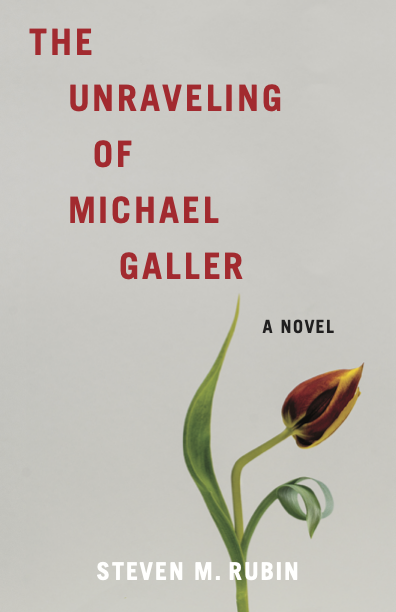
The book is about the ability of the human mind to interpret emotional trauma in some quite unique and compelling ways. And once we give that interpretation a name, it can take on a life of its own in our minds.
Steven M. Rubin – 12 May 2026
The Back Flap
After observing multiple terminal effects of varying illnesses of those close to him that he perceives as cancer, Michael Galler gains a heightened cognizance of the physical threats that can grow unknowingly inside a person. As a result, he dedicates himself to healthily fortifying his body against any comparable assault.
While growing up with his loving, widowed father and the younger brother he feels compelled to protect, Michael is able to balance the pressures of his young life—academic achievement, high school athletic competition, and even training for the Boston Marathon. But as he moves toward college life, he develops a promising relationship with a girl who too easily fills the gaps of his motherless upbringing—and his long-held fear of what he now thinks of as capital-C Cancer begins to take over. Everything he experiences, he experiences through the filter of trying to outrun a disease he thinks is pursuing him.
A dramatic coming-of-age tale with a dark psychological twist, The Unraveling of Michael Galler explores the motives of a teenage boy so overwhelmed by an obsessive fear that he loses his grip on reality.
About the book
What is the book about?
The book is about the ability of the human mind to interpret emotional trauma in some quite unique and compelling ways. And once we give that interpretation a name, it can take on a life of its own in our minds. In The Unraveling of Michael Galler, the titular character comes to believe that cancer can materialize as just about any type of disease that can grow, undetected, within our bodies. He is challenged to protect himself and his younger brother from what he perceives to be an insidious force manifesting itself within those he cares about. But what if he’s right? How can we defend against what’s inside us, and how far is he willing to go to safeguard those he cares about?
When did you start writing the book?
I don’t really know. But I entered an abridged version of Chapter 4 in the 1997 Marblehead Festival of Arts and came away with Best in Show honors for Short Fiction. That gave me some confidence that I might be on to something. It also gives a sense of how long I had been developing what I believe to be a complex fabrication of the plot.
How long did it take you to write it?
I couldn’t tell you exactly, but if it was twenty years, that would not surprise me. I don’t want to suggest I was writing it for twenty years, but when you have a full-time job and are also trying to raise a family, your available time for writing comes in fits and starts. I may have finished a chapter and gone months without starting the next one.
Where did you get the idea from?
I had already known I wanted to write a novel, but I needed a story and was thinking through some options, but none really interested me. One day I was at the airport waiting for my flight and I was on the phone dealing with a situation. When I hung up, my first thought was that the thing I was dealing with was “like a cancer”. My next immediate thought was, “what if it really was cancer?” I pulled out a pen and paper and started writing just prior to boarding.
Were there any parts of the book where you struggled?
I definitely struggled in attempts to create my antagonist. In my mind, I knew what it was and what I wanted it to be, but to create scenes that simultaneously hid and exposed it to the reader was quite challenging. I was constantly going down paths that I had to retreat from. Near publishing, my copyeditor pointed out occasional sentences that she didn’t quite understand the context. But what they were, were remnants of abandoned ideas that I hadn’t yet fully cleansed.
What came easily?
I needed a character who wouldn’t really come into play until later in the story, but I couldn’t just introduce him at the end, otherwise it would have seemed contrived. So, I started at the beginning of his story and the book returns to his arc about every four chapters. Oddly, this character, Tremont, who I created out of complete thin air, became the easiest for me write and to put him in compelling situations that allow him to grow through them. Although many of the experiences and dynamics of Michael Galler’s family are refabricated from my own experiences, Tremont was a complete unknown entity to me; I didn’t know who he was, I only knew what I wanted him to do. I learned about him as I wrote him. What should have been hard turned out to be way easier than I expected.
Are your characters entirely fictitious or have you borrowed from real world people you know?
All the characters are completely fictitious, although most either contain characteristics of people I know, or I had taken real-life stories I had heard and reimagined them or attributed them to the fictitious character. The two exceptions are that I had never been exposed to anything in Tremont’s world and had to completely imagine all of it, and I believe Michael’s father is an idealized version of my own father and representative of what he accomplished as a parent.
We all know how important it is for writers to read. Are there any particular authors that have influenced how you write and, if so, how have they influenced you?
I admire Ayn Rand’s ability to create incredibly round and deep characters. I admire John Steinbeck’s ability to attach meaning to some of the most benign objects, and I admire Thomas Harris and Cormac McCarthy for their ability to write compelling dialogue that moves a scene forward.
Do you have a target reader?
If you enjoy being immersed in the emotional connections of family dynamics, traveling along an unpredictable path, being challenged by the meaning of a particular scene or moment, to be spoken to in an intelligent voice, and further reflecting on the beginning and middle after you get to the end, then you are a target for this story.
About Writing
Do you have a writing process? If so can you please describe it?
When I write a chapter, I typically have two goals in mind: that it should read like a stand-alone short story and to have more than one thing happening at the same time within that chapter. By having multiple underlying themes of the chapter, or multiple characters with their own objectives, the ability to foster more overall ideas is enhanced. By treating it like a short story, I will always know where I am trying to get to and when it should end.
Do you outline? If so, do you do so extensively or just chapter headings and a couple of sentences?
Not necessarily. I might “title” an unwritten chapter so I know I need to write a chapter in that spot that achieves a specified objective (e.g., “Michael meets Julie”). If, over time, I think of a piece of dialogue, action, or idea related to that chapter, I will notate it on that relatively blank page. But I never start writing a chapter until I get to it.
Do you edit as you go or wait until you’ve finished?
I simply cannot start a new chapter until the one I am writing has been completely finished. So, I am constantly re-reading and editing while I am writing that chapter. When I start the next chapter, the one I am leaving is as edited as it is going to get. (At the publishing stage, it will certainly be reviewed and edited again as part of that stage, but relative to the writing process itself, I can’t go to the next scene until the one I am in is completed…just like life itself.)
Did you hire a professional editor?
I did hire a copyeditor to review the entire book as a last step before signing my publishing contract. One of the key objectives of that process was to reduce word count.
Do you listen to music while you write? If yes, what gets the fingers tapping?
I need quiet and solitude when I write. The only thing that gets the fingers tapping are ideas, and the exercise of finding the economy of words that take what is formulated in my head and putt it into yours.
About Publishing
Did you submit your work to Agents?
I had made submissions over many years without success. I’ve always been dumbfounded by how many books have been successfully published, and wondered how in the world that happened when it is so challenging.
What made you decide to go Indie, whether self-publishing or with an indie publisher? Was it a particular event or a gradual process?
I met someone at an author event and asked her how she had gotten her book published. She introduced me to the hybrid concept and SparkPress. I immediately dug out my book and took that path. Now that I am at the end of that process, with the book about to be published, I’m glad I took this path because it has given me a better sense of control and ownership over my work.
Did you get your book cover professionally done or did you do it yourself?
The cover was designed by my publisher, SparkPress, with input from me. But I’ll take no more than 5% of the credit for it, as the team at SparkPress did a great creative job with every facet of the book jacket.
Do you have a marketing plan for the book or are you just winging it?
I guess you could say I have a marketing plan that I am winging. But I have retained a publicist, Booksparks.
Any advice that you would like to give to other newbies considering becoming Indie authors?
Focus on the story, not the idea. Then believe in the story and it will bleed through into your writing.
About You
Where did you grow up?
I grew up in the small, unique town of Winthrop, MA. It is a 1.5 square mile peninsula with a 9-hole golf course in the middle and 19,000 residents. It is surrounded by water with only two roads in: one is a bridge and the other is a causeway. The Atlantic Ocean is on one side and Boston Harbor on the other. We love our sports and have had our share of state championships, and one Olympic gold medal hero.
Where do you live now?
A quiet suburban town in Fairfield County, CT.
What would you like readers to know about you?
The successes that I have had in life are directly related to the family I grew up in, the friends I’ve acquired, and the incredible wife I managed to find, convince to marry me, and convince to stay married to me. For everything I have achieved, a straight line can be drawn to any one of them, if not all of them.
What are you working on now?
I used to make up silly five-minute bedtime stories when I put my daughter to bed (“There once was a turtle who didn’t have a shell…”). One day, I decided to make up a story that would be continued each night, and that went on for well over a month. When I was done, I thought the ideas I created might be worth fleshing out into a true novel. I’m working on bringing that story to life.
End of Interview:
For more from Steven M. Rubin, visit his website and follow him on Facebook and Instagram.
Get your copy of The Unraveling of Michael Galler from Amazon US.