It is an adventure with young people as heroes, an allegory with warnings to our current world about planetary stewardship and apathy. It is an exposition about greed and cultural intolerance. Ultimately though, it is about hope and change.
J.D. Grant – 9 May 2026
The Back Flap
Call her Earth, or call her Gaia, years from now, our planet is almost uninhabitable as a result of environmental chaos and war. In the middle of the ocean, two small, conjoined islands still thrive and serve as home to a unique population of survivors, the Wiconi. These peaceful, agrarian-based islanders have genetically evolved affinities that allow them to influence earth, water, air, and fire, talents they use to protect and aid Gaia, the Earth Mother. They are her Guardians.
When three technology-laden ships from the dying outer world land on the islands, cultures collide. The newcomers, Terrans, build industries that quickly threaten the environmental health of the Wiconi lands. The island Guardians stage protests and increasing resistance to these destructive practices. The Terrans, blind to the dangers of their industrial expansion, put a bounty on the troublesome natives and begin hunting them like animals.
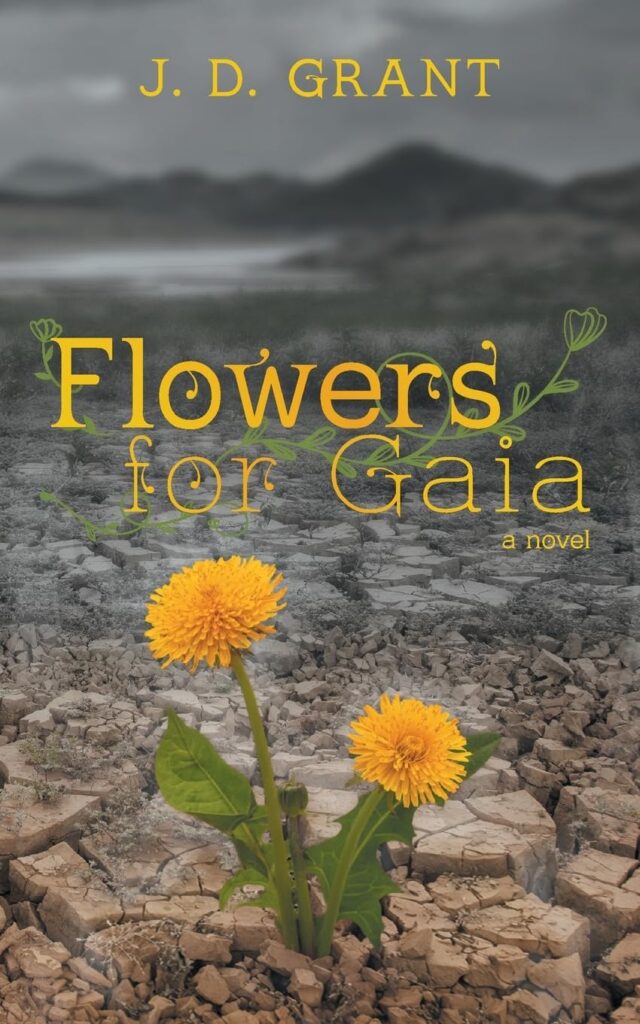
Calix, a young Wiconi boy, loses his parents, his memory, and the ability to speak all on the same day. Bounty hunters. An elderly Terran widow shelters him from the authorities. With her help, Calix works to reclaim his heritage and understand the elemental talents of his people and their catalyst flowers: the windflower for air, water lilies for water, red roses for fire, and the common dandelion for earth.
War is coming. Calix, his best friend, Brooke, and other talented Wiconi youth train hard to become Guardians. Can these young warriors heal the land and expel the Terrans? They are certainly going to try.
About the book
What is the book about?
Flowers for Gaia is about both the Earth and humanity. Our planet is in trouble, environmentally and socially. Within a dystopic fantasy setting years in the future, issues like pollution, cultural appropriation, corporate greed and industrialization provide backdrops to a story of hope.
The Wiconi people hidden as they are from the war ravaged, polluted outer world by a technologic storm wall, live in peace and harmony on their islands. Genetic mutations result in development of elemental talents that grant influence over water, fire, air and earth and spirit.
When they are ‘invaded’ and culturally denigrated by outer world Terran survivors, the Wiconi must use these elemental abilities to protect their small ecosystem and their people. They must learn to fight back.
The story follows Calix, a young orphaned Wiconi boy, and his friends – as they learn to master their elemental talents to combat the usurpers and protect their small piece of Gaia.
It is an adventure with young people as heroes, an allegory with warnings to our current world about planetary stewardship and apathy. It is an exposition about greed and cultural intolerance. Ultimately though, it is about hope and change.
\When did you start writing the book?
In 2020, during the COVID crisis.
How long did it take you to write it?
Five years. The first draft, took about 9 months. It was pretty basic and not very well written. I kept going back to it, adding details to enrich the story and the characters.
Where did you get the idea from?
Look around. Our air, water and land are polluted. Animals, both on land and in the sea are being either hunted to extinction or having their habitats made unlivable. Wars are raging. Bigotry and racism are rampant.
I am a fan of fantasy and science fiction. I wanted to provide a story that dealt with these issues but in a ‘let’s fix it” magical adventure kind of way.
Were there any parts of the book where you struggled?
Providing the characters with believable personalities and giving the story emotion that hopefully resonates with the readers was the hardest. In my previous career I wrote professional fact-based articles. Switching to the more demanding literary style that fiction requires took a lot of conscious effort and multiple edits and re-writes.
What came easily?
Designing the magic system and genetics of the Wiconi people and world-building.
Are your characters entirely fictitious or have you borrowed from real world people you know?
Fictitious
Do you have a target reader?
YA and adults.
About Writing
Do you have a writing process? If so can you please describe it?
First comes an idea, then research to define what I need to know and where I want to go. The characters seem to invent themselves, as does the story.
Do you outline? If so, do you do so extensively or just chapter headings and a couple of sentences?
Not to any great extent. Once I define my start point and understand the world in which my characters live, the narrative grows almost organically.
Do you edit as you go or wait until you’ve finished?
A bit of both.
Did you hire a professional editor?
Not until OC publishing agreed to work with me. It was a very positive experience.
Do you listen to music while you write? If yes, what gets the fingers tapping?
Mostly instrumental music.
About Publishing
Did you submit your work to Agents?
No.
What made you decide to go Indie, whether self-publishing or with an indie publisher? Was it a particular event or a gradual process?
The traditional publishing world for YA fantasy/Sci-fi is not easy for new authors to break into. Self-publishing may work for some, but it was not a comfortable fit for me. I did a workshop with Anne O’Connell the owner of OC Publishing and really enjoyed her enthusiasm for all things written. The hybrid model that she provides felt welcoming and the personalized assistance that editor Marianne Ward provided helped me get over most of my ‘putting it out there’ anxiety.
Did you get your book cover professionally done or did you do it yourself?
David Edelstein, lead designer at OC Publishing, designed the book cover and interior.
Do you have a marketing plan for the book or are you just winging it?
Part of the partnership agreement with OC Publishing includes marketing support during the months leading up to the launch of the book, including a virtual book tour. Sell sheets are sent out to select bookstores, and assistance is provided to develop an author profile on Amazon Author Central and Goodreads. In addition to my own Facebook and Instagram professional author accounts, an author page on OCP’s website links to several select online retailers. OCP also sends out advance review copies to podcasters, bloggers, and reviewers and helps set up a book launch gathering. Mine will be held in May of this year.
Any advice that you would like to give to other newbies considering becoming Indie authors?
Look for people that you can trust and be realistic in your expectations. Writing your novel is probably the easy part.
About You
Where did you grow up?
In Glace Bay on Cape Breton Island, located in northern Nova Scotia.
Where do you live now?
Wolfville, Nova Scotia
What would you like readers to know about you?
I have been married for 40 years. Together, she and I have 5 children and 6 grandchildren.
What are you working on now?
I have three different fantasy/sci-fi projects on the go, all at different stages of completion.
End of Interview:
Get your copy of Flowers for Gaia from Amazon US.