The farmers and agribusinessmen are fictional, but their stories are inspired by true events and historical figures.
Victoria Tatum – 26 March 2026
The Back Flap
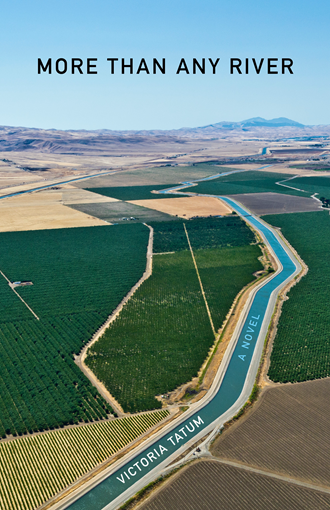
Inspired by true events, this Chinatown-meets–The Grapes of Wrath novel tells the story of California’s Sacramento Delta farmers facing off against agribusiness owners over the massive water tunnel(s) the state plans to build under hundreds of thousands of acres of prime Delta farmland.
Winter 2022-’23 inundated California with as much as three times the average rain and snowfall and pulled the state out of one of its biggest droughts in recorded history. But the truth is that the American West, from the Oregon border down to Mexico, is prone to drought—and in California, the biggest battle for water takes place in the Great Central Valley, where south-of-Delta agribusiness controls every stream feeding into the Sacramento and San Joaquin Rivers. The protagonists of More Than Any River are the family farmers fighting for the Delta, and the antagonist is the big agribusiness controlling its water—but ultimately, the Great Central Valley itself emerges as the central character in this gripping tale of divisive land politics and high stakes.
About the book
When did you start writing the book?
2009
How long did it take you to write it?
Ten years
Where did you get the idea from?
Every summer my high school best friend sailed with her family on their 28-foot sloop to an island where they docked in the Sacramento Delta. I was invited to spend weekends with them sleeping under the stars on the deck of the boat and cooking outdoors over coals in the communal kitchen. We would jump off the boat into the water for relief from the summer heat, and when I found out decades later that the water was no longer safe for swimming, I wanted to know why. San Francisco Chronicle stories about the prospective tunnels provided my answer, along with material for a novel.
Were there any parts of the book where you struggled?
Yes. Translating research into compelling fiction. It took ten years to get it right.
What came easily?
Research. I have a Humanities background, and was surprised by how much I loved delving into science to research the novel.
Are your characters entirely fictitious or have you borrowed from real world people you know?
The farmers and agribusinessmen are fictional, but their stories are inspired by true events and historical figures. The Presbyterian pastor in the novel is based on a close friend, as fiction could not produce a better character!
We all know how important it is for writers to read. Are there any particular authors that have influenced how you write and, if so, how have they influenced you?
I like the straightforward style and pastoral description of Ivan Doig’s novels. His books give me permission to write about what feels like a disappearing natural world.
John Steinbeck’s Grapes of Wrath emboldened me, among other things, to insert short sections of nonfiction.
Do you have a target reader?
This book is for anyone who has fallen in love with the West and cares about the future of the land, in particular its soil, and for anyone interested in the issue of water, particularly as it relates to California and the Great Central Valley.
About Writing
Do you have a writing process? If so can you please describe it?
I block out two days a week just for writing, averaging four to six hours on a good day. Morning is my favorite time to write, although I pay close attention to ideas that come in the middle of the night. I write them down, and if I can’t sleep I head to the computer to work on them, letting those ideas lull me back to sleep an hour later.
Do you outline? If so, do you do so extensively or just chapter headings and a couple of sentences?
I usually start without an outline, and as the story grows in complexity, create a chapter outline with key words, in order to keep track of events and decide on the best order for things.
Do you edit as you go or wait until you’ve finished?
Edit as I go, then edit afterward on many rewrites. Occasionally I print out the story, because a hard copy edit is also effective.
Did you hire a professional editor?
On more than one occasion I hired an editor to read it and provide feedback. This was essential. With the novel I have on the back burner, I plan to give it to several readers who are experts on the topics, and hope to exchange it with a fellow author for feedback on the writing itself.
Do you listen to music while you write? If yes, what gets the fingers tapping?
No music, only silence.
About Publishing
Did you submit your work to Agents?
I do. I recently submitted my memoir to an agent. I have a wonderful agent for my fiction.
What made you decide to go Indie, whether self-publishing or with an indie publisher? Was it a particular event or a gradual process?
My agent submitted to multiple publishers who all turned it down. After that I submitted to a small hybrid publisher, and when my agent got wind of that she pointed me to She Writes Press. The rest is history.
Did you get your book cover professionally done or did you do it yourself?
She Writes Press uses an artist to design the cover with input from the author.
Do you have a marketing plan for the book or are you just winging it?
She Writes Press advises their authors to hire a publicist, and I have done so. Having the support of a publicist makes all the difference.
Any advice that you would like to give to other newbies considering becoming Indie authors?
She Writes Press, Simon and Schuster as its Distributor, and the Publicist all give the author a boost. But working with any publisher, the author has to hustle and do the leg work to try to meet the goal of selling as many books as possible.

About You
Where did you grow up?
San Francisco
Where do you live now?
Santa Cruz, CA
What are you working on now?
I am working on the publicity. I am also looking for an agent for my memoir, and have another novel on the back burner that I’ll return to after this one is published.
End of Interview:
Get your copy of More Than Any River from Amazon US.