For me, this story is really about the unexpected ways we can heal. Sometimes healing doesn’t arrive the way we imagine it will. Sometimes it shows up filthy, injured, and uninvited…and refuses to leave.
Cynthia Johnstone – 5 November 2026
The Back Flap
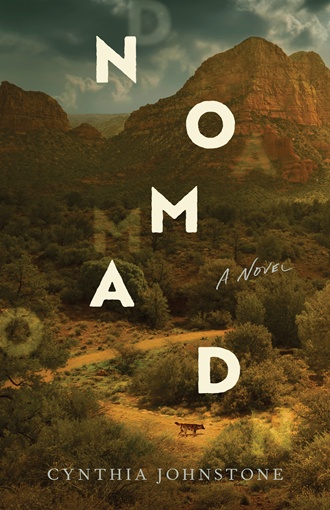
After the sudden death of her brother, Corey retreats to a remote ranch in Sedona, Arizona, hoping the silence of the desert can drown out the noise of her grief. But the quiet only deepens her isolation—until a mysterious stray dog appears, pulling her back into the world and forcing her to face what she’s been running from. Set against the stunning red rock canyons, Nomad is a lyrical, emotionally charged debut about trauma, resilience, and the wild grit it takes to heal. As Corey grapples with loss and the ghosts of her past, she’s drawn into unexpected relationships that challenge her guarded heart and crack open the possibility of love.
About the book
What is the book about?
At its heart, Nomad is a story about grief, guilt, and the courage it takes to let yourself love again. It follows Corey, a young woman who has spent ten years living alone on an off-grid ranch in the Arizona wilderness, hiding from a tragedy she believes was her fault. Then a wounded stray dog named Nomad wanders onto her land, and despite her best efforts to keep him at a distance, he slowly begins breaking through the walls she has built around herself. His arrival also brings Jack, Corey’s first love, back into her life and forces her to confront everything she has spent years trying to outrun.
For me, this story is really about the unexpected ways we can heal. Sometimes healing doesn’t arrive the way we imagine it will. Sometimes it shows up filthy, injured, and uninvited…and refuses to leave.
It is also about what the wild can teach us when we are willing to pay attention. Throughout the story, Corey turns to the land not only for refuge but also for answers. The forests, mountains, animals, and changing seasons remind her that nature is always adapting, enduring, letting go, and beginning again. The wild doesn’t erase her pain, but it shows her how to live alongside it and, eventually, how to grow from it.
When did you start writing the book?
I began working on this book in the summer of 2021.
How long did it take you to write it?
About five years, working on and off.
Where did you get the idea from?
The idea for Nomad came to me during a particularly difficult chapter in my life. I was carrying a lot of grief and uncertainty, and I couldn’t see how things were going to turn out—or how I was going to find my way through it all.
Whenever I feel lost or overwhelmed, I turn to the woods. Nature has always been the place I go to quiet my mind and work through challenging emotions.
So, one afternoon, I went for a hike and wandered into an area that had been decimated by a forest fire the year prior. The ground was blackened, and the trees were badly scarred. The entire landscape seemed to reflect how I felt inside. At that point in my life, it seemed as though so much had been stripped away, and I couldn’t imagine what might come next. I stopped and surveyed the land, completely in awe of the devastation, but when I looked more closely, I noticed that scattered across the charred forest floor were tiny shoots of bright green. New life was pushing its way through the wreckage, and I remember standing there and realizing this isn’t where the story ends for this forest. It will recover. It will grow again. It may never look exactly as it did before, but that doesn’t mean it can’t become something beautiful. And in some ways, it may even come back stronger.
That moment did something for me. The fire had changed the forest, but it had not destroyed its ability to begin again. Under all that blackened earth, life had been waiting for the right moment to return, and I began to wonder whether the same might be true for me. That image stayed with me long after the hike. It became a source of strength and, eventually, the first seed of Nomad.
Were there any parts of the book where you struggled?
Yes. The part I struggled with most was Corey’s initial rejection of the stray dog, Nomad. I have a soft spot for animals, especially strays. If a hungry, injured stray dog wandered onto my property, there is no chance I could turn my back on it. I would be inside gathering food, water, and blankets before the poor thing even blinked.
But Corey isn’t me. At that point in the story, she has spent years protecting herself from attachment because, in her experience, loving something means eventually losing it. Her refusal to help Nomad isn’t really about the dog; it’s about everything his presence begins to stir up inside her.
That section was genuinely difficult for me to write. I had to keep reminding myself, write what Corey would do, not what you would do. As uncomfortable as her reaction made me, it was important to honor where she was emotionally. Her resistance also made it that much more meaningful when Nomad finally earned his way into her heart.
What came easily?
This one’s easy—the setting. Writing about the landscape, the changing light, and all the beauty and quiet magic that Sedona has to offer felt very natural. It’s the kind of place that feels alive; the red rocks, the changing colors, the cacti, the wildflowers, and the vastness of the sky… all I had to do was pay attention.
Are your characters entirely fictitious or have you borrowed from real world people you know?
The characters are fictitious, although I’m sure I subconsciously borrowed small traits, mannerisms, or fragments from people I have known. I think that happens naturally when we write. Little pieces of the people we encounter find their way into our imaginations, sometimes without us even realizing it.
More than drawing from any one person, though, I wanted Corey to pay homage to the many strong women I have encountered throughout my life who have endured tremendous hardship without wearing it on their sleeves. These are women who quietly carry their histories with them while they continue to work, love, create, and move through the world. Their strength is not always obvious or celebrated, but it’s there. I wanted Corey to represent that particular breed of woman.
We all know how important it is for writers to read. Are there any particular authors that have influenced how you write and, if so, how have they influenced you?
There are honestly too many to name, and I’m influenced by different writers for different reasons. Mary Oliver has had a profound impact on the way I look at the natural world. Her work reminds me that if we slow down and pay attention, nature is always offering us something. Terry Tempest Williams and Edward Abbey have also shaped the way I think about landscape, particularly the desert, not merely as a setting but as a living presence with the power to challenge and transform us. And how they weave personal experiences into the natural world has always amazed me.
Along those lines, Barbara Kingsolver and Eowyn Ivey for the way they incorporate the natural world so deeply into their stories that the land becomes a character in its own right. That was something I hoped to accomplish with Sedona in Nomad. I wanted readers to feel the heat, the red dirt, the changing light, and the quiet force of the wilderness surrounding Corey.
Kristin Hannah has influenced me through the emotional depth of her storytelling and the strong, complicated women at the center of her novels. She isn’t afraid to explore grief, resilience, love, and survival in a way that allows readers to feel everything alongside her characters. And that, I love. Chris Whitaker has a similar ability to create deeply flawed, wounded people whom you cannot help but care about, and his writing style is just beautiful. I’m drawn to writers who allow their characters to be messy and human, who understand that strength and vulnerability are not opposites.
Do you have a target reader?
I’ve always struggled with the idea of a target reader because it requires making assumptions about people, which I try not to do. At the root of it, who am I to say who should, or shouldn’t, enjoy my book?
My hope is that Nomad finds anyone who is drawn to stories about the wilderness, survival, grief, forgiveness, and finding the courage to start over. It may speak especially to readers who have ever carried a loss, felt responsible for something they couldn’t change, found comfort in the natural world, or been rescued, emotionally or otherwise, by the love of an animal. And, of course, I hope it reaches people who simply enjoy a deeply human story with a little romance, some mystery, and an unforgettable dog at its center.
But if you’re looking for the official, administrative answer, it would be women ages 18-99. Though I would be delighted to hear from anyone outside that range who happens to love it too!
About Writing
Do you have a writing process? If so can you please describe it?
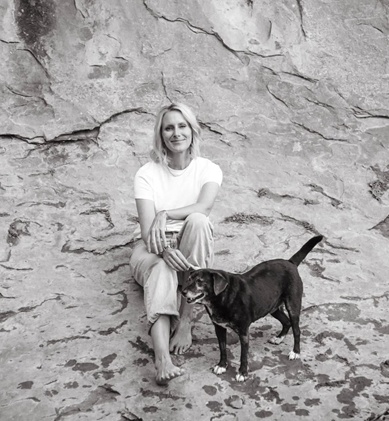
I love this question because I’m very particular about my writing process. Whenever the weather permits, I prefer to write outdoors. I settle into a lounge chair on my back patio with my dog nearby and my two cats roaming around me, chasing insects. The yard is surrounded by towering ponderosa pines and filled with flowers, and I’m fortunate to live in a very quiet neighborhood. It allows me to disappear into the story while still feeling connected to the natural world.
Every now and then, if I’m lucky, a deer will wander through. I’ve trained my dog to leave them alone, so we can all peacefully exist in the same space while I work. Those moments feel especially magical and often remind me why nature finds its way into so much of my writing.
When the weather doesn’t cooperate, I move inside. I put on quiet music, light a candle, and write with my dog curled up nearby. The surroundings may change, but the common denominator is always my loyal dog. Wherever I write, she is right there with me.
Do you outline? If so, do you do so extensively or just chapter headings and a couple of sentences?
No, I’m a pantser by nature. I don’t like to have too much of the story figured out ahead of time because part of the joy, for me, is discovering where it wants to go as I write.
In the beginning, I simply write. I don’t use chapter headings or impose any other boundaries that might control the direction of the story. I let it all come out in one long, continuous stream—ideas, scenes, dialogue, emotion, whatever comes up. The first few drafts are usually one giant, unruly blob of a story.
Only later do I begin shaping it into something more structured. I go back through the manuscript, find the natural pauses and turning points, and decide where the chapter breaks belong. So the story begins as something very fluid and instinctive, and then, through revision, I slowly mold it into its final form.
Do you edit as you go or wait until you’ve finished?
For the most part, I wait until I’ve finished. During the first draft, I try not to interrupt the momentum by stopping to perfect every sentence. If I begin editing too soon, it’s very easy for me to get caught in the weeds and lose sight of where the story is trying to take me.
That doesn’t mean I never go back and adjust something along the way. If a detail changes or I realize an earlier scene needs attention, I may make a note or a quick correction. But the real editing begins once the entire story is on the page.
Did you hire a professional editor?
Yes, I did. Spelling and grammar are not natural strengths of mine. I definitely need a professional to help catch all the errors I make!
Do you listen to music while you write? If yes, what gets the fingers tapping?
I do listen to music while I write, but because I’m very easily distracted, it has to be something without lyrics. Otherwise, I’ll start listening to the words, and before I know it, I’ve completely lost myself.
Instrumental lo-fi is my go-to. It has enough rhythm and funk to get my creativity moving, but it stays quietly in the background without interfering with my concentration. I find that it creates just the right atmosphere for me to settle in, tune out everything else, and disappear into the story.
About Publishing
Did you submit your work to Agents?
Yes, I did—without much luck. I had heard that the querying process could be daunting, and I can now personally attest that it is. There was a lot of waiting and a lot of rejection. It can be difficult not to take those rejections personally when you have poured so much of yourself into a book, but I kept reminding myself that rejection is part of the process and doesn’t define the ultimate destination.
What made you decide to go Indie, whether self-publishing or with an indie publisher? Was it a particular event or a gradual process?
I chose to work with an independent publisher because I felt they were more open to considering work that wasn’t attached to a celebrity, a major influencer, or an enormous online following. I wanted the manuscript to be judged primarily by what was on the page, and the indie publishing world seemed to offer more room for that.
I also liked the idea of having a professional team behind the book while still being involved in the process. For me, it offered the right balance of creative input, industry experience, and support.
Did you get your book cover professionally done or did you do it yourself?
The cover was professionally designed. This was one of those moments when I decided it was best to leave the work to the experts, and they did not disappoint.
I helped shape the initial direction by sharing the kinds of images, moods, and ideas I was drawn to, but the design team took those rough thoughts and created the final cover. I could not be happier with how it turned out. It captures the spirit of the story beautifully and feels completely right.
Do you have a marketing plan for the book or are you just winging it?
Once again, I decided to leave this part to the experts. I hired Books Forward to handle the marketing for Nomad. They understand the marketing industry in ways I never could, and quite honestly, I don’t have the extra time required to give the book’s marketing the attention it deserves.
There is already so much involved in writing and publishing a novel. Bringing in people who know the industry allowed me to focus more of my time and energy on the creative work…which is the part I love.
Any advice that you would like to give to other newbies considering becoming Indie authors?
Do it. Go for it.
It is so easy to waver and wonder, is this worth it? Do I really have what it takes? What I’ve learned is that writing requires a tremendous amount of time in the chair. It takes practice, patience, and a willingness to work through version after version and draft after draft.
But every word moves you farther along the path, even the words you eventually delete. They still taught you something. They helped you understand your characters, strengthen your voice, or recognize what the story needed. None of that work is wasted. Each draft makes you a better writer and brings you closer to the story you are trying to create.
So stay with it. Keep learning, keep revising, and don’t allow rejection or self-doubt to make the decision for you. The indie route can be a wonderful way to bring your work into the world, and the indie people tend to be awesome, open-minded people in general.
About You
Where did you grow up?
I grew up in Glen Ellyn, Illinois, a western suburb of Chicago. It was a lovely place to grow up, very picturesque and full of wonderful people, many of whom I am still close with, but these days, my heart feels very much at home in the mountains and wild spaces.
Where do you live now?
I live in Flagstaff, Arizona, surrounded by ponderosa pines, wildlife, and endless hiking trails.
What would you like readers to know about you?
I’m fairly shy at first and most comfortable around the people I know, love, and trust. I’m happiest writing behind a computer screen or spending time outdoors, so the public-persona side of being an author doesn’t come naturally to me. I’m still learning to step outside my comfort zone and share more of myself along with my work.
Writers can be an odd mix of things: quiet yet full of stories, private yet willing to reveal so much on the page. But it’s a wonderful mix of people, and I’m very grateful to be among them.
What are you working on now?
Ooh, I’m working on something I’m super excited about! It is tentatively titled Rae, and I’m already deeply attached to the characters and their story. I don’t want to reveal too much just yet, but it explores powerful female relationships, survival, and the extraordinary lengths women will go to for those they love (think Thelma & Louise). It is emotionally intense and incorporates some outrageous humor. I cannot wait to share more when the time is right.
End of Interview:
Get your copy of Nomad from Amazon US.