The idea grew out of my underpinning principle: the ultimate horror is something that should not be happening but is.
Todd Brown – 13 October 2026
The Back Flap
John Simons has built his career on facts. As a crime reporter in a city rattled by violence, he knows how to separate rumor from evidence and truth from noise.
Then the noise begins to acknowledge him.
A man in a dark hat starts appearing at the edges of John’s life. Taps in the wall sound like messages meant only for him. His boss Anna So’s smallest habits take on a terrible new meaning. As bodies surface across the East Side, John begins to fear he isn’t just chasing the story anymore.
He’s slipping inside it.
As dread hardens into obsession, John follows connections no one else can see, descending deeper into a reality that grows more intimate and menacing with every step. The closer he gets to the truth, the less he can trust his own mind or the people trying to pull him back.
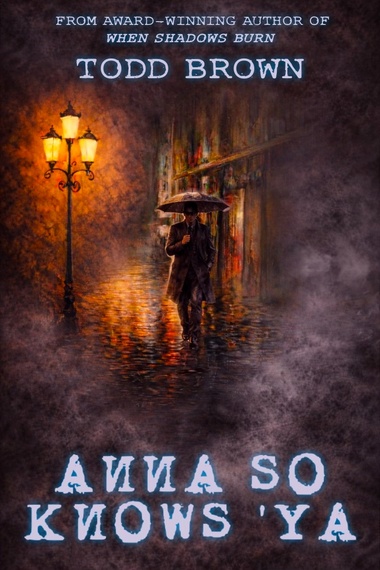
Anna So Knows ’Ya is a haunting psychological horror novel about grief, paranoia, and the terror of realizing reality no longer knows you.
About the book
What is the book about?
Anna So Knows ’Ya is a grounded psychological-horror novel about John Simons, a crime reporter who’s built his career around facts, evidence, and his ability to recognize patterns. When a series of deaths unsettles the city, John becomes convinced that a mysterious man is following him and may be connected.
As the story progresses, ordinary things begin to feel increasingly threatening. Tapping through an apartment wall, the clicking of a pen, and people whose behavior no longer seems trustworthy begin to frighten John. He attempts to investigate what’s happening with the same skills he uses as a journalist, but his ability to construct a convincing narrative becomes both his greatest strength and his greatest enemy.
At its heart, the book is also about friendship, love, grief, institutional failure, and the terrifying distance that can exist between what someone experiences and what everyone around them sees.
When did you start writing the book?
I began working on the book around June 2025. The earliest stages involved an enormous amount of research. That timeline is approximate, but I worked on the book, head down, for about three or four months.
How long did it take you to write it?
It took about six months to research, write, revise, and bring the manuscript close to its final form. I wrote the book pretty quickly but because of the subject matter it was far from a casual writing. The research portion took almost as long as the writing because I needed time to listen to people with greater expertise and lived experience.
Where did you get the idea from?
The idea grew out of my underpinning principle: the ultimate horror is something that should not be happening but is. Also, I really felt the need to tell a story from inside the perception of someone who is intelligent, articulate, professionally trained to gather evidence, and increasingly unable to distinguish what is genuine and what isn’t, which made John a particularly powerful and tragic narrator.
Were there any parts of the book where you struggled?
My biggest struggle was maintaining the balance between knowing and not knowing for the reader. I needed readers to inhabit John completely. If they dismissed him too early, the emotional experience would collapse. But I also could not manipulate the reader by hiding information unfairly. Everything had to make sense from inside John’s perception while also carrying a second meaning that becomes visible from outside it. The later sections were also difficult (the clinical documents). I must thank Dr. Janina Scarlet for her incredible insight and help.
What came easily?
The friendship between John and Lauren also came the easiest. Their insults, comic references, code words, and long history created some breathing room inside a very dark story. Their conversations allowed me to show who John was before things get dark. Also, I really enjoyed writing about the city itself. My debut, When Shadows Burn, is very rural so this time around, the traffic, steam, storefronts, apartment walls, newsroom noise, were a fun change.
Are your characters entirely fictitious, or have you borrowed from real-world people you know?
The characters and events are fictitious, and none of them were intended as a direct portrait of a particular real person. BUT they weren’t created in a vacuum. Certain details were shaped by real conversations and expertise. Lauren’s character was informed by watching and listening to Rachel Chaleff’s explanations of her experiences. Again, Dr. Janina Scarlet provided important guidance concerning the clinical files and notes. Advocates and family members also helped me better understand the obstacles people encounter in situations such as John’s.
Like always, there were creative influences. My publisher and editor, Jonathan Robbins (who is awesome) asked what would happen if the character named Lucas became a woman (now Lauren). Much like all my writing, the characters are fictional, but the understanding beneath them owes a great deal to people who generously shared their knowledge and experiences.
Do you have a target reader for this book?
I would say the primary audience is adult readers who enjoy grounded psychological horror, mounting dread, and stories that continue to trouble them after the immediate suspense is over. Anna should appeal to readers who like entering a mystery without being told exactly what kind of mystery they’re reading. From what I’ve heard so far, readers initially approach it as a stalker story, a serial-killer story, or a supernatural story, and I can say, happily, the book gradually complicates all of those interpretations.
I also hope it reaches families, advocates, clinicians, policymakers without it coming across as a lecture disguised as fiction. The story and characters always come first followed by social questions in order for the readers to care about John, Anna, and Lauren.
How was writing this book different from what you had experienced writing previous books?
This book was more psychologically enclosed and structurally experimental than my previous work. Instead of readers observing the horror from a secure distance, I wanted to place them inside the story. It also was a different kind of structure for me because I’ve never written a first-person narrative. Also, my last novel, When Shadows Burn, had close to thirty characters (ten main characters) and was a slow burn, whereas this one centers on three main characters and is a much faster paced novel. It also required more research, more outside guidance, and greater willingness to remove material that may have been dramatically effective but ethically careless.
What new things did you learn about writing, publishing, and/or yourself while writing and preparing this book for publication?
As a writer I learned how much power there is in repeated, ordinary details. A clicking pen, a knock on a wall, or a familiar scent can become deeply unsettling when its context begins to change. I also learned that suspense does not always depend on dramatic events. Sometimes the strongest tension comes from allowing the reader to notice that something familiar no longer feels quite right.
Also, I learned to trust uncertainty and resist explaining too much too soon (show not tell ain’t easy folks!). Anna required me to balance what the reader knows, what the characters believe, and what can remain just beyond reach, which became central to the novel’s atmosphere.
In publishing, I learned that expert readers and people with relevant experience should do more than review a manuscript after it has been completed. Their insight can change its structure, language, and moral center. The guidance I received not only helped me avoid mistakes but helped me understand what the story actually needed to become.
Personally, I learned that I could write something outside of my comfort zone. Anna required me to resist ‘easy’ and accept that love, intelligence, and good intentions may not be enough. This book, like Shadows, reinforced the idea that listening is part of writing.
End of Interview:
For more from Todd Brown visit his website and follow him on Instagram and Threads.
Get your copy of Anna So Knows ‘Ya from Amazon US or Amazon UK.