One part of the post-apocalyptic genre that I’ve always wanted to see explored in greater detail was people coming together to bring society back.
Glenn S. Robertson – 27 September 2026
The Back Flap
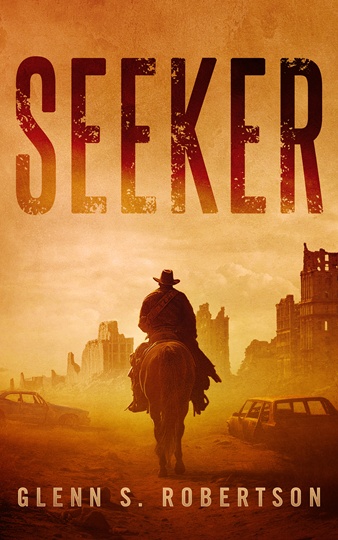
More than a century after a devastating plague collapses civilization, the American West has returned to older ways. Towns are small, the land is unforgiving, survival depends on reputation and violence, and justice can come from the end of a rifle – or a rope.
Ghost is a Seeker, a solitary rider hired to recover lost knowledge from the ruins of the old world. When a young girl is kidnapped by raiders from Denver, his search carries him across Wyoming’s plains and mountains, where every mile tests what remains of a person when the world strips everything else away.
Seeker blends post-apocalyptic survival with the soul of a western, telling a story rooted in character and place, where the land itself shapes those who endure it.
About the book
When did you start writing the book?
The first ideas for Seeker came to me in late 2016, when I moved to Cheyenne.
How long did it take you to write it?
I finally published it in April 2025.
Where did you get the idea from?
I’ve always been enamored with post-apocalyptic fiction, as well as westerns. I’ve often believed that while urban apocalypse, as seen in a lot of movies, shows and books, could be a terrifying hellscape, a rural apocalypse has a good likelihood of settling into something more akin to what we call westerns.
One part of the post-apocalyptic genre that I’ve always wanted to see explored in greater detail was people coming together to bring society back. There’s nothing wrong with the common thread, because it tends to be more exciting, but so much of current apocalyptic fiction is truly dystopian, and it’s focused on the point of failure, when society falls apart, then the immediate survival in its wake. Seeker aims at a different spot in that timeline.
Were there any parts of the book where you struggled?
Given that it took nearly a decade to write, there were long spans of time when I did little to nothing to work towards completing the book.
The catalyst to finally push forward and see it through came through one of the hardest times in my life. In April 2026, I lost my mother to cancer. On her last day, she told me point blank to “get it done.” I wrote more than 100 pages, finished the book, and got it to the editor about two months later.
What came easily?
The only thing that felt easy in the writing was the characterizations. For whatever reason, the characters in Seeker all felt larger than life to me, and I had little trouble creating their personalities, their mannerisms and habits, and their backgrounds.
Are your characters entirely fictitious or have you borrowed from real world people you know?
I think, as with most writers, I take inspiration in small ways from everyday interactions, and people I know will absolutely provide color for my characters in terms of their behaviors. That being said, none of my characters are people I know, lifted from real life and then put onto the page.
We all know how important it is for writers to read. Are there any particular authors that have influenced how you write and, if so, how have they influenced you?
I have drawn influence from more writers than I could list here; however, there are a few who have absolutely shaped my beliefs in literature. The first is Tolkien. From him I’ve tried to learn worldbuilding and creating foundations for my narrative. In fact, my histories are often primary to my narrative, and I have a ridiculous amount of notes to keep all of that together. Also, there is a theme that stood as the foundation of his storytelling, of the ordinary individual called to heroism. Craig Johnson is another who has influenced me to a great degree. First, his deep passion and knowledge of the state of Wyoming permeate through his narratives, and it’s something I hope to emulate. Second, his ability to create compelling characters is something I strive for.
Do you have a target reader?
While readers of westerns tend to skew a little bit older, I’ve had middle schoolers come up to me to tell me they loved the book. So, I would have to say that I don’t have a true target reader. It has some adult themes and stark, grim, violence, reflective of what I believe society would look like following a cataclysm, so it is not aimed at a young audience.
About Writing
Do you have a writing process? If so can you please describe it?
It almost shames me to say that no, I don’t really have much of a process. When the mood strikes me, I sit and I focus and I write. Unfortunately, I’m very prone to distraction due to ADD, so I consider myself lucky if I can at least create some notes, backstory or some kind of foundation if I’m not able to get any words on the page for the actual narrative.
Do you outline? If so, do you do so extensively or just chapter headings and a couple of sentences?
I’m really more of a pantser than a plotter, but I do try to create a general skeleton of where the story is going to go, with some primary scenes listed. I’ve tried to plan better, and the use of Scrivener has definitely helped with that. I’ve gotten better at organizing chapters and plot points since I’ve started using the software.
Do you edit as you go or wait until you’ve finished?
A little bit of both. I will agonize over a sentence and edit in real time, but I’ll take multiple passes over a completed chapter. However, when it’s “done,” and ready for the editor – I turn it over.
Did you hire a professional editor?
I did. I found Nicole Schroeder when searching for someone who’d be capable of working between AP and Chicago styles, and she did an absolutely fantastic job. I am hopeful to keep working with her for my future work.
Do you listen to music while you write? If yes, what gets the fingers tapping?
My musical tastes wander widely while I’m writing. Sometimes it’ll be Howard Shore and the Lord of the Rings soundtracks, sometimes it’s synth soundtracks like the theme from Terminator or Blade Runner. Other times, I’ve got Irish traditional music playing, but most of the time it has to be music without lyrics.
About Publishing
Did you submit your work to Agents?
I did not. Truthfully, I found that process to be a bit daunting.
What made you decide to go Indie, whether self-publishing or with an indie publisher? Was it a particular event or a gradual process?
It really comes down to control and timelines. Given the long timelines of the publishing houses and what I wanted to accomplish with Seeker, I felt that self-publishing was the right move for me.
Did you get your book cover professionally done or did you do it yourself?
My cover design was professionally done by Damonza, and I could not be more pleased with their work.
Do you have a marketing plan for the book or are you just winging it?
“Everybody’s got a plan until they get punched in the mouth.” While that may be hyperbolic, whatever plan I had in place before publishing was tested, and I’ve adapted the plan several times since April. One thing that I think has been crucially important was third-party validation in the form of professional reviews and award submissions.
Any advice that you would like to give to other newbies considering becoming Indie authors?
I honestly don’t feel like I’ve accomplished enough in this arena to give advice on how to be successful; however, I have learned a few things that have helped me not give up on writing. Be flexible, be realistic, and don’t lose hope. Sometimes, just having your work out there for readers has to be its own reward. Hugh Howey, Andy Weir, and Matt Dinniman are great aspirational figures, but none of them just “blew up” out of nowhere. There were years of grinding and hard work before they got to where they are today. Perhaps most importantly, and I do understand that budgets don’t often allow for top-shelf editorial work, everyone who wants to publish a book should find a professional editor to polish their manuscript. Readers are willing to forgive some things, but if your manuscript is published with spelling errors and grammar issues, you risk losing readers before they ever get a chance to engage with the story.
About You
Where did you grow up?
I spent my childhood moving a lot, as my father’s job found us relocating every 1-3 years. The most formative parts of my childhood were Southern California, Florida and Wyoming. I lived overseas a couple of times, as well.
Where do you live now?
I’ve lived in Cheyenne, Wyoming, for ten years.
What would you like readers to know about you?
My family is incredibly important to me. I keep pressing to make writing a career, because of them. I never feel like they’re not, but I want to make them proud. Also, a huge part of my story stems from my time in the military. I am a veteran of the Navy, and I’ve also worked as a civilian for the Air Force. My time around the military has provided a lot of inspiration for my writing.
What are you working on now?
My current work in progress is a sequel to Seeker, where Ghost and the others will have to face down an existential threat to the communities of the Rocky Mountain Free Zone, in the form of an army of a religious cult.
End of Interview:
For more from Glenn S. Robertson visit his website and follow him on Facebook.
Get your copy of Seeker from Amazon US or Amazon UK.