
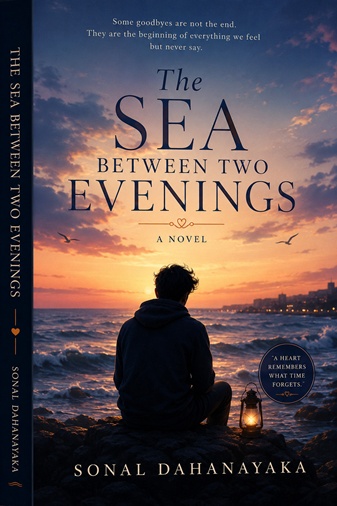
The book explores themes of love, memory, family expectations, and the choices we carry. It is both a romance and a coming of age story, rooted in the cultural rhythms of Sri Lanka.
Sonal Dahanayaka – 23 September 2026
The Back Flap
On a crowded Colombo bus, Nethmi meets Kavish — a boy with rain in his hair and a smile that hides more than it reveals. What begins as small talk between strangers grows into a fragile love story stretched between two cities: the restless streets of Colombo and the quiet sea breeze of Galle. But love in Sri Lanka is never simple. Families, traditions, and futures collide as Nethmi and Kavish learn that every choice carries weight. Tender, lyrical, and deeply rooted in everyday life, The Sea Between Two Evenings is a coming‑of‑age novella about memory, belonging, and the courage to hold on to love even when the world asks you to let go.
About the book
What is the book about?
The Sea Between Two Evenings is a Sri Lankan love novella that captures the fragile beauty of everyday life. It tells the story of Nethmi and Kavish, two young people whose relationship begins in the crowded buses of Colombo and grows through shared tea stalls, temple bells, and rain‑soaked evenings. The book explores themes of love, memory, family expectations, and the choices we carry. It is both a romance and a coming‑of‑age story, rooted in the cultural rhythms of Sri Lanka.
When did you start writing the book?
I began writing in 2025, inspired by the rhythm of daily life in Sri Lanka. The story grew out of my reflections on identity, belonging, and the way small, ordinary moments can become extraordinary when seen through love.
How long did it take you to write it?
The book took about a year to complete, including drafting, revising, and preparing for publication in 2026.
Where did you get the idea from?
The idea came from observing the small details of Sri Lankan life — bus rides, cricket arguments, temple bells, and the sea. I wanted to capture how love grows quietly in these everyday spaces, and how memory and place shape our relationships.
Were there any parts of the book where you struggled?
I struggled with balancing lyrical prose with narrative clarity. I wanted the story to feel poetic but still accessible to readers who may not be familiar with Sri Lankan culture.
What came easily?
The imagery came naturally — Colombo mornings, Galle evenings, rain on tiled roofs, and the smell of tea and vadai. These details are part of my everyday environment, so writing them felt like remembering rather than inventing.
Are your characters entirely fictitious or have you borrowed from real world people you know?
The characters are fictional but inspired by fragments of real people and experiences. They carry echoes of conversations, gestures, and emotions I’ve seen in everyday life.
We all know how important it is for writers to read. Are there any particular authors that have influenced how you write and, if so, how have they influenced you?
Michael Ondaatje influenced me with his lyrical style, Haruki Murakami with his blending of surreal and everyday, and Paulo Coelho with his spiritual undertones. These authors taught me that prose can be both poetic and accessible, both intimate and universal.
Do you have a target reader?
My target readers are those who enjoy literary romance and poetic storytelling, especially readers curious about Sri Lankan culture and everyday life.
About Writing
Do you have a writing process? If so can you please describe it?
I write mostly at night, when the world feels quiet. I draft in long sessions, then return later to refine. Writing at night allows me to focus deeply and capture the atmosphere of silence, which often shapes the tone of my prose.
Do you outline? If so, do you do so extensively or just chapter headings and a couple of sentences?
I outline loosely — just chapter headings and a few notes. I prefer to let the story evolve organically, guided by the rhythm of the characters and the setting.
Do you edit as you go or wait until you’ve finished?
I finish the draft first, then edit afterward. This helps me keep the flow of the story intact before polishing the details.
Did you hire a professional editor?
No, I self‑edited with feedback from peers and mentors.
Do you listen to music while you write? If yes, what gets the fingers tapping?
Yes, I listen to ambient and instrumental music — sometimes my own mixes, sometimes artists like Brian Eno or Nils Frahm. Music helps me create atmosphere and rhythm in my writing.
About Publishing
Did you submit your work to Agents?
No, I chose to publish independently.
What made you decide to go Indie, whether self-publishing or with an indie publisher? Was it a particular event or a gradual process?
It was a gradual process. As a musician and digital creator, I was already comfortable with independent distribution. Publishing my book the same way felt natural and gave me full creative control.
Did you get your book cover professionally done or did you do it yourself?
I designed the cover myself
Do you have a marketing plan for the book or are you just winging it?
I use my website, social media, and music platforms to cross‑promote the book. My approach is organic, focusing on building connections with readers rather than strict marketing strategies.
Any advice that you would like to give to other newbies considering becoming Indie authors?
Don’t wait for permission. Build your own path, use the tools available, and trust your voice. Independent publishing is about freedom and authenticity.
About You
Where did you grow up?
I was born in Galle, Sri Lanka, on November 9, 2008, and grew up surrounded by the coastal culture and history of the city.
Where do you live now?
I currently live in Colombo, Sri Lanka, where I continue my creative work.
What would you like readers to know about you?
I am an author, recording artist, songwriter, DJ, and digital branding creator. My creative journey spans writing, music, and web development — all connected by storytelling.
What are you working on now?
I’m working on new music projects, expanding my digital branding ventures, and developing ideas for my next book.
End of Interview:
For more from Sonal Dahanayaka visit his website and follow him on Facebook, Instagram, and Twitter.
Get your copy of The Sea Between Two Evenings from Internet Archive Open Library.