Readers who enjoy high-stakes political thrillers, technothrillers, and speculative fiction will enjoy “The Truth Chamber.” It will also appeal to anyone concerned about America’s present political malaise.
Duncan Ritchie – 19 September 2026
The Back Flap
In The Truth Chamber, America stands on the precipice. Two presidential candidates with radically different visions for the nation face off in an election billed as “potentially the most consequential in American history.” Democratic candidate Anna Hoffman—the “Lioness of Georgia”—warns that if her opponent, the “Red Caesar”, wins the presidency, the United States will slide into authoritarianism.
After a confrontation with a book burner, Anna’s longtime friend, Admiral Liam Driscoll, agrees to join her campaign. Together with a Stanford PhD student developing a revolutionary AI-enhanced lie detector known as the Truth Chamber, they set out to expose the forces driving an escalating wave of political violence. But there’s a catch: truth comes at a price, measured in “muddy footprints” on the US Constitution.
Can the truth save America?
About the book
When did you start writing the book?
The seed for The Truth Chamber was planted while I was working for a Japanese bank in Singapore in 2016, with the twin shocks of Brexit and Donald Trump’s election punctuating a decade-long global tilt towards right-wing populism. But the true catalyst came in 2022 after Russia invaded Ukraine, I watched University of California, San Diego professor Barbara F. Walter discuss her book How Civil Wars Start: And How to Stop Them; I devoured her book, and dozens of others, and began filling notebooks with “what if?” scenarios. Those notebooks became the foundation for The Truth Chamber.
How long did it take you to write it?
The research and background reading began in 2022 and ran parallel to the writing, which started in May 2023. I finished the first draft in fourteen months—that included a relocation to Tasmania, so realistically a year of writing. I then spent six weeks in the US over the 2024 presidential election, doing field research and visiting key locations in the book. After returning home, I spent a year rewriting and editing before entering the publishing phase. So, two solid years of writing within an overall four-year book creation journey.
Where did you get the idea from?
I have always been fascinated by humans’ capacity for deception. Nowhere is this more commonplace than in the political arena, where deception is often rewarded with power. I am also intrigued by how technology—and especially AI—can be used to benefit society. Those two ideas came together as The Truth Chamber.
Were there any parts of the book where you struggled?
One of the themes that runs through The Truth Chamber is the use of race as a political tool. ‘Sprinkle gunpowder on America’s racial fault line and light it up’, as one character puts it. I did extensive research on the subject, including reading several excellent but confronting books and reviewing the Reuters dataset of documented threats in Anatomy of a Death Threat (Peter Eisler, Jason Szep, Linda So and Sam Hart). Writing and editing the parts of the book dealing with racial violence was extremely challenging.
What came easily?
Probably much of the writing that ended up on the editing room floor—the first draft had a lot more descriptive detail, which was sacrificed for pacing. One aspect that I really enjoyed writing, which survived the gazillion editing rounds, is the interplay between Caitlin and her friend Sophie.
Are your characters entirely fictitious or have you borrowed from real world people you know?
For the main characters, I usually have a real-world person as a reference in my head, whether that’s something physical, a personality trait or a mannerism. But I try to let the reader form their own image and idea of the characters through their dialogue and backstory. In that way, elements of the story remain personal to each reader.
We all know how important it is for writers to read. Are there any particular authors that have influenced how you write and, if so, how have they influenced you?
Jane Austen is one of my favourite authors. I wish she’d written a political thriller. Among thriller writers, Tom Clancy is one of the best.
I also read a lot of non-fiction while researching The Truth Chamber. Rachel Maddow is one of the best writers on my bookshelves. She has a talent for making what might have been a dry subject in another’s hands thoroughly engaging.
All three are great storytellers. For me, that is the essential ingredient in great writing.
Do you have a target reader?
Readers who enjoy high-stakes political thrillers, technothrillers, and speculative fiction will enjoy The Truth Chamber. It will also appeal to anyone concerned about America’s present political malaise.
About Writing
Do you have a writing process? If so can you please describe it?
I start by jotting down copious notes, ideas and what-ifs, which gradually develop into a loose story arc. From there, I tend to write scene by scene, often with far too much detail and not necessarily in chronological order. The process is iterative—the story arc evolves as the characters and story reveal themselves.
Do you outline? If so, do you do so extensively or just chapter headings and a couple of sentences?
I outline at two levels: First, the story arc, which begins with rough notes and develops around organising events. Second, I’ll map out individual scenes before I write them. Neither is set in stone.
Do you edit as you go or wait until you’ve finished?
I absolutely edit as I go. Each morning, I typically read and edit what I wrote the previous day—or days—which helps get me back in the groove. Every two or three weeks, I’ll do a broader review and edit. Editing is a continuous process right up until the book is locked up and sent to the printer.
Did you hire a professional editor?
I hired a professional copyeditor (BookFox) and proofreader (Full Proof). I also had several beta readers read the manuscript at different points in its evolution.
Do you listen to music while you write? If yes, what gets the fingers tapping?
I love music a little too much, and find it distracting to listen to when I’m writing. There’s a whole playlist embedded in the pages of The Truth Chamber. Kirkus Reviews noted that the “numerous (yet subtle) references to iconic songs and musicians are symbolically powerful.”
About Publishing
Did you submit your work to Agents?
No.
What made you decide to go Indie, whether self-publishing or with an indie publisher? Was it a particular event or a gradual process?
A traditional publishing route would likely have added a couple of years to the book’s creation journey, so I elected to set up my own indie press, Aletheion Press, and publish The Truth Chamber through it.
Did you get your book cover professionally done or did you do it yourself?
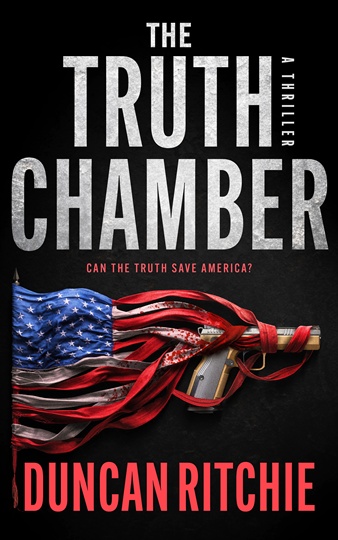
I hired a professional cover designer (Damonza). They developed three concepts, from which I chose the one with the “Lambeau” flag grappling the gun. Lambeau was the word that came to my French artist friend’s mind when I shared the cover concept with her—it means shredded or ragged, with an underlying idea of destruction.
Do you have a marketing plan for the book or are you just winging it?
I am working with a publicist—Books Forward—to raise awareness ahead of the book launch.
Any advice that you would like to give to other newbies considering becoming Indie authors?
Publishing is the business end of the book creation process. It requires a very different skill set—and mindset—from writing. Budding indie authors should learn everything they can about publishing—cover design, book formats and markets, distribution platforms (and the economics of each), and the tools available to them. Make a plan and give yourself adequate time, with contingencies. But also be flexible: I made a last-minute decision to do an audiobook because it’s a rapidly growing format.
About You
Where did you grow up?
I grew up on a plantation in Sabah, Malaysia—about 50 miles southeast of Sandakan.
Where do you live now?
In March 2024, I moved to Tasmania to focus on writing. I was roughly halfway through the first draft of The Truth Chamber—I named one of the minor characters after a street near my house so I know exactly where I was up to when I picked up the story in my new home.
What would you like readers to know about you?
I have a very demanding and impatient Malinois pup, Aletheia (Alé). She nudges my arm and puts her front paws up on my lap if she thinks I’ve been working too long.
What are you working on now?
I’m wrapping up a non-fiction companion essay to The Truth Chamber and percolating ideas for a new novel. Hopefully, I can shorten the book gestation period this time.
End of Interview:
Get your copy of The Truth Chamber from Amazon US or Amazon UK.