Although my knowledge of circus life came from my own experience working in a circus, this is not memoir or autobiography, and I worked hard to imagine fictional characters to interact with the historical time period.
Tim Schooley – 15 September 2026
The Back Flap
In 1974, the King Minos Circus is struggling to survive-until Christos “King” Minos unveils a dazzling new illusion: a vanishing elephant act starring Henrietta, the animal he loves more fiercely than he can admit.
But when Henrietta disappears during a parade, the trick becomes something far more dangerous.
Suspicion falls on Minos’s estranged daughter, Randi-an activist who has vowed to free the circus elephants-and on Ainge, the circus’s newest clown, a young man still haunted by his father’s rejection after learning he is gay. Minos feels betrayed by both and vows to recover Henrietta and bring those responsible to justice.
But are Randi and Ainge the villains Minos imagines? Their journey across the American West-through small towns, roadside shows, and shifting loyalties-forces them all to confront hard questions about family, freedom, and who truly belongs to whom.
Because in the end, the fate of Henrietta may not belong to the circus at all.
About the book
What is the book about?
Circus of the Vanishing Elephant tells of a circus traveling in the US in 1974 that is down on its luck because of a recession and an audience that is drifting away. But the circus revives its fortunes with a vanishing elephant illusion starring a young elephant named Henrietta. When Henrietta disappears during a circus parade, suspicion falls on the circus owner’s estranged daughter, who is an animal rights activist, and on the circus’s newest hire, a clown who is haunted by his father’s rejection.
When did you start writing the book?
Honestly, I’ve been thinking of writing a circus novel since I worked as a clown with Ringling Bros., and Barnum & Bailey Circus in the late 1970s. But a detour in life led me to law school and then a career as an appellate attorney. When I retired a few years ago, I published a historical fiction novel called The Wool Translator and then began working on my circus novel.
How long did it take you to write it?
Three plus years. But during that time, I also published and marketed The Wool Translator, and I started work on a sequel to that novel. So, probably a solid two years of work on this circus novel.
Where did you get the idea from?
The idea for the novel grew from my recognition that the Ringling Bros. Circus went out of business once it was forced by animal rights activists and changing societal mores to take its elephants and big cats off the road. (Ringling Bros. has just recently started up again, but without wild animals.) Lightning struck when I realized that I should center my novel around the plight of an elephant that is kidnaped (or, elephant-naped) during a circus parade. Although my knowledge of circus life came from my own experience working in a circus, this is not memoir or autobiography, and I worked hard to imagine fictional characters to interact with the historical time period.
Were there any parts of the book where you struggled?
Yes, I struggled with early drafts before I decided to center the novel around Henrietta the vanishing elephant.
What came easily?
Writing about circus life. I traveled all over the US when I worked as a clown with Ringling Bros. I lived on a circus train with most of the other performers, and with the animals, props, and equipment when traveling between towns. We played dozens of arenas, working our way north from Florida to cities on the east coast, then twelve weeks at Madison Square Garden, and then to cities across the US and up the west coast before six weeks in Chicago and then our final shows on Long Island. During that time, I paid attention not only to my own work as a “First of May” (first year) clown, but also to the jobs of the other circus folk – the workingmen who set up and tore down the circus equipment in each town, the other performers, the circus bosses, the backstage employees, and the animal handlers. And, of course, I spent a lot of time around elephants.
Are your characters entirely fictitious or have you borrowed from real world people you know?
Of course, I borrowed from my circus experience, although two of the main characters—the circus owner’s daughter and the newly hired clown—are entirely of my imagination. I was careful to create unique and original characters who are my clowns in the novel. As for the clowns with whom I worked—who were some of the funniest and most talented people I’ve ever met—I borrowed some of their antics but their characters are not based on particular people with whom I worked.
We all know how important it is for writers to read. Are there any particular authors that have influenced how you write and, if so, how have they influenced you?
I read a lot of historical fiction, as that’s the genre in which I mostly write. Among many brilliant authors who’ve influenced me, I’d single out two: Ken Follett for his ability to write sweeping historical sagas that hold the reader’s interest while covering hundreds of years of history. And Hilary Mantel—her Wolf Hall series is simply brilliant at putting the reader in the mind of her main character, Thomas Cromwell. I confess I’ve read every novel written by John Updike, another genius at getting inside his characters’ souls. And Toni Morrison’s novel, Beloved, should be at the top of every writer’s list—although we mere mortals can never hope to delve so deeply into a character’s psyche, the novel is a master class.
Do you have a target reader?
I suppose my ultimate target audience is people who have some nostalgia for the American circus. Those who grew up going to the Ringling Bros. Circus when it came to town should delight in this window into circus life. But the novel is also at its heart an adventure story, so I think people who enjoy a good adventure are certainly part of my target audience as well.
About Writing
Do you have a writing process? If so can you please describe it?
At the center of my writing process is walking. I live a couple of miles from a coffee shop. I begin my morning walk by reading (on my phone) what I wrote the day before, and then I listen to music as I walk to let my subconscious go to work. I find that by the time I arrive for my morning latte, my fingers skip across the keyboard.
Do you outline? If so, do you do so extensively or just chapter headings and a couple of sentences?
I outline the chapters of a novel at the start, but usually with only a short note of what I hope to accomplish in the chapter. And then I rework the outline extensively as I write, leaving plenty of room for the “writer’s high” to take over, that amazing experience of the characters and imagination taking a scene in an unexpected direction.
Do you edit as you go or wait until you’ve finished?
I am an obsessive editor. I edit constantly, although I’ve tried to discipline myself to edit the previous day’s writing rather than getting hung up on editing as I write.
Do you listen to music while you write? If yes, what gets the fingers tapping?
Great question. I listen to rock and blues rock—often Led Zeppelin and the Almann Brothers—as I take my morning stroll, to let my subconscious flow. I sometimes listen to classical music as I write.
About Publishing
Did you submit your work to Agents?
Not this time. I went straight to small house publishers that indicated they specialize in historical fiction and would consider direct submissions.
What made you decide to go Indie, whether self-publishing or with an indie publisher? Was it a particular event or a gradual process?
In part, it was my frustration at unsuccessfully seeking an agent for my first novel that stopped me from seeking an agent for the circus novel. But it was also my realization that many indie publishers are happy to receive unagented solicitations from authors. I’m just happy as can be that History Through Fiction Publishing agreed to work with me.
Did you get your book cover professionally done or did you do it yourself?
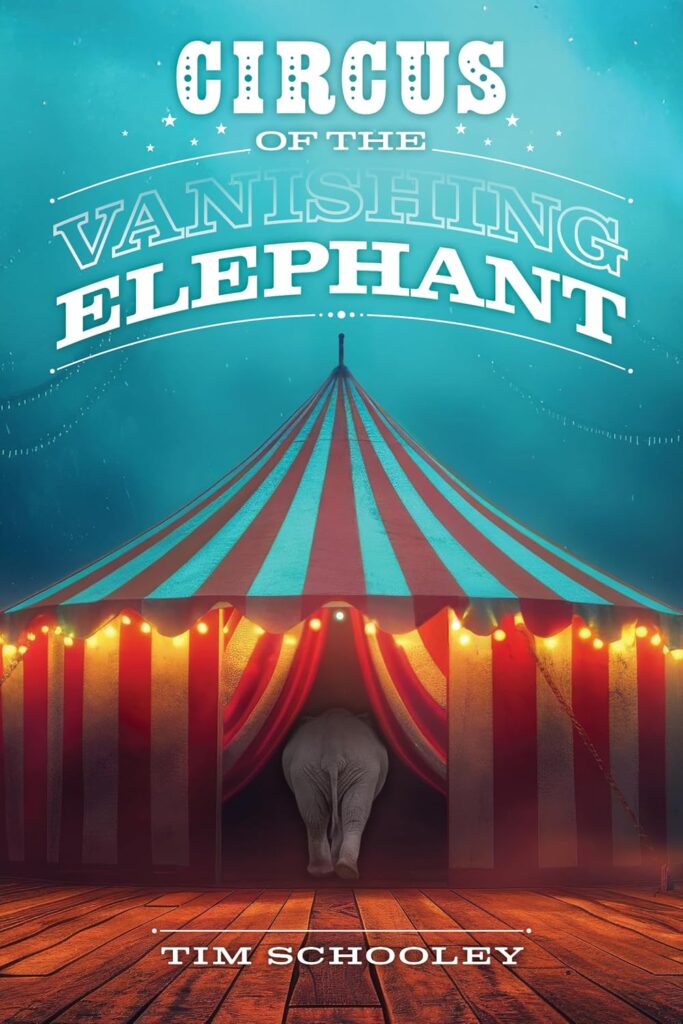
My book cover was created by professional book cover designer, Cathryn Huff, who gave me eight cover ideas. Working with the publisher, we settled on a cover that best expresses the novel’s story, an elephant vanishing into a circus tent. But I (and Cathryn) both loved the image she created of Henrietta wearing a tie-dyed T-shirt. Although Henrietta is a real elephant, the image reflects well the early 1970s, and the publisher agreed to include a small version of the tie-dyed elephant on the back cover.
Do you have a marketing plan for the book or are you just winging it?
We have a marketing plan. We’re using ARC readers, NetGalley, ABA Advanced Access, and a Goodreads giveaway to try to build early buzz for the novel. I’m reaching out to book reviewers, bloggers, and podcasters. I’m working on social media posting. And we have a small book tour developing.
Any advice that you would like to give to other newbies considering becoming Indie authors?
There is a world of small press independent publishers who are looking for submissions. Do your homework and reach out to those publishers interested in your genre. But also, don’t be afraid to go it alone – I self-published my first novel and sales have been quite good; you just have to learn the art of marketing as well as the art of writing.
About You
Where did you grow up?
In the South Bay area, south of San Francisco, back when there were more fruit trees than Silicon Valley startups.
Where do you live now?
In the foothills just east of Sacramento. My wife and I raised our family here and still love this part of the world.
What would you like readers to know about you?
Hah! I already spilled that I was once a circus clown. In my early years, I could juggle five balls, four clubs, torches, or machetes, so I wasn’t a bad juggler, either. And I rode a five-foot tall unicycle in the circus—it’s now in my attic, gathering dust. I have the most fun Facebook group, full of clowns and circus performers from all over the world. And I met my wife at a reunion of Ringling Bros. Clown College graduates.
But the other part of my life is a bit stodgier—I worked as an appellate attorney for 35 years, and during that time I taught appellate law at UC Davis Law School while also working as a staff attorney at the California Court of Appeal, Sacramento district; I retired after working as the managing attorney at that court.
What are you working on now?
I’m very excited that I recently finished the first draft of the sequel to my first novel, tentatively titled The Sultan’s Translator. I’m workshopping it now with my writer’s critique group. After I’m done with my obsessive editing, I’ll seek professional editing and proofreading, and then we’ll see!
End of Interview:
For more from Tim Schooley check out his website and follow him on Facebook.
Get your copy of Circus of the Vanishing Elephant from Amazon US or Amazon UK.