There was something special, and also haunting, about writing a book in the very locations where it all happened.
Leon Mitchell – 30 October 2026
The Back Flap
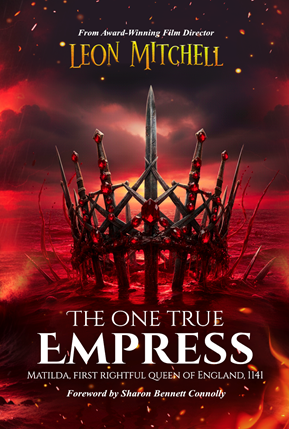
England, 1135. King Henry I is dead, a sacred oath is shattered, and a nation descends into chaos.
Empress Matilda returns from the continent to claim her birthright—the crown of England. But before she can reach Westminster, her cousin Stephen seizes the throne, backed by powerful barons who would rather tear the kingdom apart than bend the knee to a woman.
What follows is a brutal, decades-long war of attrition that history will remember as the Anarchy. Forged in the ruthless political courts of Europe, Matilda refuses to be sidelined or erased. From her legendary, snow-swept escape across the frozen landscape of Oxford to the relentless clash of steel outside castle gates, she must navigate shifting allegiances, bitter betrayals, and the sheer weight of a crown she was born to wear.
This is no mere dynastic dispute; it is a fierce battle for survival, sovereignty, and the very soul of England.
The One True Empress is a sweeping, cinematic historical epic that brings to life the untold fury, resilience, and unyielding spirit of England’s first rightful queen.
About the book
What is the book about?
The One True Empress is a story about power, betrayal, identity, love, and transformation. At its core is Empress Matilda, the first rightful female heir to the English crown and the daughter of King Henry I. It explores what happens when strength and vulnerability collide.
It’s a layered story that looks at royal ambition, legacy, and the emotional cost of becoming who you were always meant to be. While it has strong dramatic and psychological themes, it’s ultimately about fighting for what you believe in and the search for truth.
Empress Matilda was a woman in a world dominated by male rule, but she had the courage to raise an army and invade England when oaths were broken and her crown was taken from her. This was the beginning of a 19-year war known as The Anarchy.
When did you start writing the book?
The idea had been forming in my mind for quite some time—around two years. But I properly began writing in the summer of 2025, when I felt I had enough emotional clarity and creative direction to do the story justice.
I actually wrote much of the book at the locations where significant events happened in the story—Oxford Castle, Reading Abbey, and Wallingford Castle ruins. This really enabled me to fully immerse myself in Matilda’s story.
There was something special, and also haunting, about writing a book in the very locations where it all happened.
How long did it take you to write it?
The writing itself took around a year—not just putting words on the page, but refining the story, shaping the characters, and making sure every layer felt authentic and, in places, dramatic.
This book was new for me and unique in itself. It comes in two parts: the first half is the story itself, and the second is a historical archive, which required a great deal of research.
I also had the privilege of consulting with Sharon Bennett Connolly, the best-selling author and historian. Her knowledge and insight helped me with the facts and also the wider picture of those times.
Where did you get the idea from?
I never thought I would write a historical book. But the story of Matilda became too loud to ignore. Her breathtaking courage was undeniable.
I had watched The Last Kingdom and fell in love with this time period and the drama of it all. I started researching, and I stumbled across her name. The more I looked, the more I realised that I had to be her voice—I had to tell her incredible story.
I’ve always been drawn to stories that explore what lies beneath the surface of people—what drives them, what breaks them, and what ultimately defines them. Empress Matilda has it all; her life is both tragic and triumphant.
Were there any parts of the book where you struggled?
Yes—mainly the emotional balance of the story. Some sections demanded honesty and depth, and I wanted to handle those moments with care.
The challenge was making sure the emotional weight felt real without losing the momentum of the narrative.
Then there was adding the cinematic drama and dialogue. Because history has so many gaps, you have to fill them in. I wanted to give this book a big-screen feel, so dramatising the events while staying within historical context was a challenge.
What came easily?
The psychological aspect of Matilda came to me quite naturally. Once I understood who she was, her voice became very clear.
Her motivations, conflicts, and emotional truths were often the easiest part to connect with. In some strange way, she reminded me of a modern maternal figure fighting for her family.
The hardest part was trying to write from a female perspective and honour the feminine spirit.
Are your characters entirely fictitious or have you borrowed from real world people you know?
In this book, the characters are real, but I still draw inspiration from life—observations, conversations, emotions, and human behaviour.
Reality often gives you the most compelling material. This book is based on the life of Matilda and framed around actual events that took place all those years ago.
Do you have a target reader for this book?
This book is for readers who enjoy layered storytelling, strong characters, and emotional depth.
I think it will resonate with people who appreciate stories that challenge them to think while also drawing them into the emotional journey. It’s aimed more at young adults and older readers, especially those who enjoy big cinematic history with battles, betrayal, and royal politics.
How was writing this book different from what you’d experienced writing previous books?
This book felt more emotionally demanding and more ambitious in scope. It required deeper introspection and greater precision.
I found myself pushing harder creatively, which made the process both more challenging and more rewarding. I was writing about a real person, and I wanted to do her justice. I wanted her legacy to live on.
There was also the challenge of staying within the facts and historical records. But I believe I have achieved that.

What new things did you learn about writing, publishing, and/or yourself while writing and preparing this book for publication?
I learnt that writing sometimes requires more patience, trust, and discipline. You can’t rush meaningful work.
I also learnt that a story from over 800 years ago can still break your heart. It can still linger in your mind and leave unanswered questions.
On a personal level, the process reinforced how important resilience is—both in writing and in life.
I think we can all learn something from Empress Matilda, and I hope this book helps keep her hope and her beautiful legacy alive.
End of Interview:
For more from Leon Mitchell follow him on Instagram.
Get your copy of The One True Empress from Amazon US or Amazon UK, if you want an ebook for your Kindle. If you’d prefer a paper book go to Waterstones.