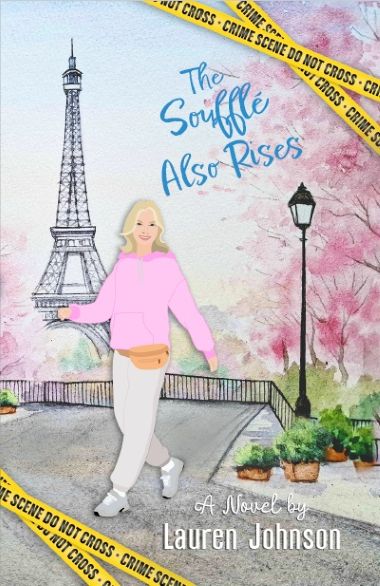
I spent a semester in Paris in undergrad and was nearly mowed down in Montmartre by a couple of flics (French cops) chasing a hot French bad guy on a motorcycle. After that, I knew I wanted to write a crime thriller set in Paris. And when I started having fantasies about riding on the back of the hot French bad guy’s bike while outrunning the flics, I knew it had to be funny as well.
Lauren Johnson – 1 September 2026
The Back Flap
It’s 2008 and Lizi just can’t catch a break. On the heels of a nasty divorce and a paltry settlement agreement—barely enough to reload her Starbucks card—Lizi is laid off from her job during the worst financial crisis since the Great Depression.
Flat broke, Lizi takes a job at Whole Foods where she meets Frankie, a twenty-seven-year-old artist half her age whose overly simplistic worldview is exactly what Lizi needs to get on with her life. But after an unfortunate incident involving her ex-husband, his pregnant girlfriend, and a carton of cage-free eggs, Lizi finds herself, once again, out of a job.
So what does a fifty-four-year-old woman with no money, no job, and no prospects do? She sells all her possessions and goes to Paris in search of her long-lost dream: to write her first novel. But when the airline loses her luggage and offers her a meal voucher for the famed Hotel Jolie, Lizi pounces on the opportunity while unwittingly setting off a chain of events which land her at the center of the notorious Harry Winston jewel heist. And when her young partner-in-crime joins her in Paris, the two must outrun the Serbian mafia while trying not to trip over the dead bodies left in their wake.
About the book
What is the book about?
The Soufflé Also Rises is a lighthearted crime thriller about a woman of a certain age who is forced to start over after discovering that her best friend has been sleeping with her husband. As she attempts to rebuild her life, she must also contend with menopause, middle age, and all the other joys that show up on the flipside of fifty—while staying one step ahead of the Serbian mafia.
When did you start writing the book?
Way back in college, I knew I wanted to write a lighthearted crime thriller set in Paris, but I had no idea what it would be about. I thought about it on an off over the years, but it wasn’t until 2009 that the story finally started taking shape, although I probably wrote a hundred different outlines over the next decade.
I didn’t actually start writing the novel itself until early 2020, just before COVID. In fact, I started writing it in Paris only ten days before the borders closed. Unfortunately, I was not one of those writers who emerged from COVID having written three novels, learned Italian, and mastered sourdough bread. I was the kind who kept telling myself I had all the time in the world, which turned out to be a surprisingly effective way to avoid writing until 2022.
How long did it take you to write it?
When all was said and done, it probably took about two and a half years of actual writing before I finished it, plus thirty-eight years of thinking about it.
Where did you get the idea from?
I spent a semester in Paris in undergrad and was nearly mowed down in Montmartre by a couple of flics (French cops) chasing a hot French bad guy on a motorcycle. After that, I knew I wanted to write a crime thriller set in Paris. And when I started having fantasies about riding on the back of the hot French bad guy’s bike while outrunning the flics, I knew it had to be funny as well.
As for what ultimately shaped the story, I was in my mid-fifties by the time I finally came up with a working outline. By then, menopause was in full swing and I was grouchy 24/7. But it was also when I realized how funny menopause could be once I stopped complaining about the inconveniently timed hot flashes and chin hairs and started embracing it. That’s when I decided my protagonist should be a postmenopausal woman.
Were there any parts of the book where you struggled?
Definitely. I wasn’t sure how to make murder funny. I mean, was it even appropriate? Then I read Helen Fielding’s Olivia Joules and the Overactive Imagination, and I realized that as long as my victims were assholes, I could get away with murder, so to speak.
I also struggled intermittently with the idea of a protagonist of a certain age. In this youth-obsessed culture, who in their right mind—besides me—was going to want to read about a postmenopausal protagonist with a sluggish metabolism trying to outrun the Serbian mafia in Paris?
Fortunately for me, I wasn’t the only one.
What came easily?
Lizi and Frankie’s friendship. For me, they struck the perfect balance.
I loved writing Lizi because she represented the vulnerable side of me—the part that still has a lot of fear, and worries about what people think. But as her friendship with Frankie grew, she grew, and in the process, so did I.
Writing Frankie was especially fun because I got to be an immature twenty-seven-year-old again. Maybe it’s because I never had children that I never felt that sense of urgency to become an adult. Unfortunately, I still live in a world where you’ve got to act like one if you want to be treated like one. Frankie gave me permission to be myself in a world that doesn’t always appreciate adults acting like children.
Something I learned early on was not to be afraid of being myself on the page. If I write honestly—about how I see the world and my place in it—all the pieces tend to fall together naturally. But if I start filtering myself because I’m worried about sounding too uptight or too immature, not only do I have a harder time putting the pieces together, but I also lose some of the best pieces along the way.
Are your characters entirely fictitious or have you borrowed from real world people you know?
Definitely borrowed! Lizi and Frankie are largely inspired by me and my best friend Maria. We’ve been friends since kindergarten, so we never really stopped laughing at farts and other bodily functions.
Sometimes I have to rein her in when we’re in public places, but just as often she has to remind me to loosen up. I think that’s why Lizi and Frankie’s friendship feels so natural to me. We’ve been striking that same balance for over fifty years.
We all know how important it is for writers to read. Are there any particular authors that have influenced how you write and, if so, how have they influenced you?
I love Nora Ephron. I love her wit, her vulnerability, and her uncanny ability to nail a universal truth with one simple phrase.
In 2006, she published a wonderful collection of essays called I Feel Bad About My Neck. The essays are about aging, vanity, self-image, and what it means to be a middle-aged woman. But honestly, it was the title that got me.
I Feel Bad About My Neck.
Not my career.
Not my lack of a significant other.
Not my life choices.
My neck.
With five words, she managed to capture everything funny, frustrating, ridiculous, and painfully human about getting older.
Do you have a target reader?
Yes. My ideal reader is a woman who can see a little of herself in both Lizi and Frankie. Like Lizi, she oftentimes overthinks, takes herself too seriously, and worries more than she’d care to admit about what other people think. But every now and then she surprises herself by doing something completely off the rails—like playing Marco Polo at Target with her bestie.
Like Frankie, she wishes she could be a little bolder, a little freer, and a little less concerned with social convention. She may not be ready to fart on the Target intercom herself, but she genuinely admires people who would.
Deep down, my ideal reader is someone who will root for both Lizi and Frankie—and perhaps for the version of herself that lives somewhere in between.
About Writing
Do you have a writing process? If so can you please describe it?
When it comes to my process, I do extensive character development before I start writing because I want to know my characters inside and out. That way, when I throw them into increasingly ridiculous situations, I’ll intuitively know how they would react. It also helps me keep their thoughts, decisions, and actions consistent with who they are.
So I always start with a spreadsheet—I love spreadsheets! Nothing says “creative genius” quite like a color-coded Excel workbook!
The first thing I do is make a list of each character and their role in the story. I include the basics: age, occupation, relationship status, living situation, and a physical description, including personal style.
Next comes the backstory column, where I keep track of past traumas, insecurities, hangups, and all the other baggage that gives people texture and makes them interesting. I also have a section for strengths and special skills, because it’s always helpful when a character knows something unexpectedly useful—like how to read lips because Grandpa was deaf.
Then come the questions. Lots and lots of questions.
Some of them may sound completely random, but they help me understand who my characters really are. If they could have dinner with three famous people, dead or alive, who would they choose? What kind of music do they listen to? What’s their favorite movie? Favorite season? What’s currently in their refrigerator? What kind of car do they drive? Are they a dog person or a cat person? And, perhaps most importantly: boxers or briefs?
Most of these details never make it into the book. But knowing the answers helps me write characters who feel like real people rather than just plot devices.
Do you outline? If so, do you do so extensively or just chapter headings and a couple of sentences?
I work from an extensive outline. I usually start with Joseph Campbell’s Hero’s Journey, where I sketch out a very rough structure of the story. From there, I build a version of a snowflake outline, expanding each stage of the journey into more detailed plot points.
Because each book in the series takes place over a relatively short period of time—at least in terms of the main action—I organize the outline by day. That helps me keep everything straight, and it also makes it easy to move scenes around if I need to restructure things later. Or, as I like to describe it, ripping out the guts so I can transplant them elsewhere.
It’s basically a very elaborate, highly organized system for making sure I don’t get lost in my own story.
Do you edit as you go or wait until you’ve finished?
There is absolutely no way I could write without editing along the way. My head would explode. My need to edit is like an itch that needs scratching. I’m constantly tweaking sentences midstream, rewriting dialogue, reshaping scenes—it’s just how my brain works.
Do you listen to music while you write? If yes, what gets the fingers tapping?
Yes, I definitely have to listen to music when I write. I like to surround myself with genius. Led Zeppelin, Johnny Winter, Bob Dylan, Stevie Ray Vaughan, Joni Mitchell, Tom Waits—they all make me want to be a better writer!
About Publishing
Did you submit your work to Agents?
Yes, I did. I used QueryTracker, which I would recommend to anyone going the agent route. It kept everything organized in one place, and I found it incredibly helpful for managing submissions and tracking responses.
What made you decide to go Indie, whether self-publishing or with an indie publisher? Was it a particular event or a gradual process?
While querying agents, I happened to read an article in Publisher’s Weekly about Simon & Schuster entering into a distribution deal with Rising Action Publishing, a women-owned, women-run publisher in Canada. As someone writing women’s fiction, the idea of a publisher focused on women immediately caught my attention. Having S&S behind them handling sales and distribution made it even more appealing.
So I submitted directly to Rising Action Publishing—without an agent.
And that’s how I ended up with a book deal.
Did you get your book cover professionally done or did you do it yourself?
Rising Action has their own design team, so the cover was professionally done. I gave them a loose idea of what I was thinking, and they took it from there and made something far better than anything I could have come up with on my own.
Do you have a marketing plan for the book or are you just winging it?
Rising Action has a marketing and publicity team, and I’m also working with a publicist at Books Forward. So I’m not exactly winging it, thankfully—I’ve got a lot of support on both sides.
Any advice that you would like to give to other newbies considering becoming Indie authors?
I think it’s a great route to go. A lot of writers dream about landing a deal with one of the Big Five, and of course that’s still an incredible achievement—but the truth is, it’s also very difficult. For me, I just wanted my book out there. I spent so much time writing it that I really wanted other people to be able to read it.
Years ago, I wrote a book that was published by an imprint of Penguin Putnam. It certainly had cachet, but I had almost no say in the actual publishing process. Fortunately, it wasn’t a huge issue because it was a TV trivia book and pretty straightforward. But it got me thinking—what if it had been my novel? My baby?
Working with an indie publisher has been a very different experience. I’ve had so much more control than I expected. That’s not to say I get everything I want, but I do get a real voice in the process, and I still get to play a meaningful role in how the book comes into the world.
About You
Where did you grow up?
I grew up in the Midwest, in the Chicago suburbs—all very normal, very suburban, very much the kind of place where you learn to entertain yourself when you’re young.
Where do you live now?
Same. I moved to LA years ago and lived there for about eight or nine years, but I missed my family and the Midwest, so I moved back.
What would you like readers to know about you?
That writing is like breathing for me. When I don’t write, I feel like I’m holding my breath.
What are you working on now?
I’m currently working on the third book in my Lizi Cleverly Midlife Badass Detective series. I wrote Book 2 last year and I’m gearing up for the editing phase—which, in practical terms, means reading my manuscript about fifty more times and convincing myself each time that I’m “almost done.”
End of Interview:
Get your copy of The Soufflé Also Rises from Amazon US.