The story, in a much simpler form, had been kicking around in my head for a few years before I decided to share it in a novel. I’m not exactly sure where the idea came from, but I think it germinated from a wish for a better world than what we have.
David Backman – 17 May 2026
The Back Flap
In the mid-21st century, a brilliant American physicist joins a secret mission to travel through the galaxy’s lone stable wormhole. When a series of challenges threaten the project, she must find another way to accomplish its objective: save the human race. With help from an unexpected ally, the young scientist races to harness the universe’s mightiest force and preserve humanity’s future.
About the book
What is the book about?
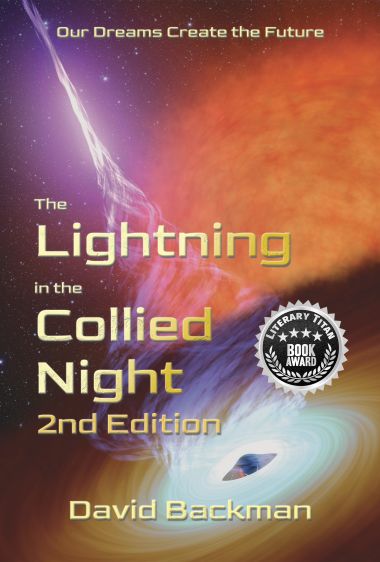
My debut novel, The Lightning in the Collied Night (now in its 2nd Edition), is a science-fiction tale about a brilliant American quantum physicist who joins a secret project in the mid-21st century to explore the galaxy’s only known stable wormhole. When the project goes sideways, she recruits an unlikely ally in a desperate attempt to achieve the project’s objective, to save the human race, by harnessing the greatest force in the universe.
When did you start writing the book?
I started in earnest when I retired from my IT career in mid-2023, but first I had to bone up on how to write fiction!
How long did it take you to write it?
It took about one year from starting an outline to publication-ready.
Where did you get the idea from?
The story, in a much simpler form, had been kicking around in my head for a few years before I decided to share it in a novel. I’m not exactly sure where the idea came from, but I think it germinated from a wish for a better world than what we have. There are a few hints in the book about the possible genesis of the story, but I don’t want to spoil it by sharing those here.
Were there any parts of the book where you struggled?
Pretty much all of it, as it was my first fiction writing since a short story in high school. But probably the hardest part to write was the final chapter. A lot happens in it, and it had to wrap up several threads. I rewrote it a couple of times before I was satisfied with it. Also, there were a few scenes that were difficult for me to write because they dealt with tragic situations.
What came easily?
After reading some books about how to write fiction, I decided to use a writing style that leaned heavily on dialogue and internal monologue for exposition, instead of using a lot of narration and lyricism. And because the story is set mostly on Earth 20-30 years from now, I wanted the characters to seem real and relatable. Once I got the hang of it, I found it was fairly easy for me to write natural-sounding dialogue and internal monologue—at least, that’s what reviewers have told me.
Are your characters entirely fictitious or have you borrowed from real world people you know?
Two characters are borrowed heavily from real-world people. In fact, initially those characters were those people, but I decided that would be problematic, in multiple ways. A few other characters and names of characters are homages to people I know. And because the story is set in the near future and I wanted it to seem as realistic as possible, there are a few real-world people mentioned in the book.
We all know how important it is for writers to read. Are there any particular authors that have influenced how you write and, if so, how have they influenced you?
Several authors have influenced my writing, but two who stand out are Charlie Jane Anders and Isaac Asimov. I think Asimov influenced my writing style. He’s known for using extensive, logical dialogue rather than descriptive prose, and that’s my style, also. Anders taught me many things, such as how to pen characters who have major regrets or do something unforgiveable, or who are at odds with their world; the difference between a story written with love vs. just doing your duty; the importance of writing a book that only I could have written, not what I think is popular and cool; and lots more, but especially, “Your daydreams could change the world.”
Do you have a target reader?
I think readers who like character-based fiction with a heart will enjoy my books. The science fiction in my stories is science-based (each book has a bibliography, unusual for novels) but accessible, such that people who don’t normally read sci-fi novels can enjoy them. Also, my books aren’t just science fiction; The Lightning in the Collied Night, in particular, has a big plot twist about two-thirds into the story that goes way beyond science fiction.
About Writing
Do you have a writing process? If so can you please describe it?
After I come up with a story idea, I sketch out the story and characters. Then I write an outline of scenes, which evolves into a chapter outline with dialogue snippets. After massaging that, I start writing chapters—and not in numerical order. Sometimes I’ll start at the beginning, but a couple of times I drafted the final chapter first. Once I have a first draft, I edit/refine, edit/refine over and over and over, removing and adding content as I go. At some point I involve alpha, then beta, readers, and when I think I have a near-final manuscript, I’ll send an ARC to trusted readers.
Do you outline? If so, do you do so extensively or just chapter headings and a couple of sentences?
My outline starts off with just a few sentences per scene, but it morphs into a verbose outline with sample pseudo-dialogue or even real dialogue. I’ve found that I can draft the chapters from such an outline fairly quickly.
Do you edit as you go or wait until you’ve finished?
I catch things as I go, but after I have a complete first draft, I start the end-to-end editing process, with many iterations before publication.
Did you hire a professional editor?
I hired professional editors for my first two books and learned a lot from them and from the editing process. I decided to do my own editing for my third book, but I hired two consulting editors due to its foreign (New Zealand) setting and its main characters being Māori.
Do you listen to music while you write? If yes, what gets the fingers tapping?
No. I may have the TV on in the background, though (mainly to keep my dog entertained while I work).
About Publishing
Did you submit your work to Agents?
Not yet, but I’m considering doing that to see if there would be interest in a screen adaptation.
What made you decide to go Indie, whether self-publishing or with an indie publisher? Was it a particular event or a gradual process?
I hired a hybrid publisher (a friend of a friend) for my first novel, but that didn’t go well (understatement!), thus I finished and published that book myself. I stuck with self-publishing for my subsequent books.
Did you get your book cover professionally done or did you do it yourself?
The cover for my first book, The Lightning in the Collied Night, was done by the hybrid publisher with my input. I tweaked that cover and designed and created the covers for my other books.
Do you have a marketing plan for the book or are you just winging it?
I developed a formal marketing plan for my first book. I used a stripped-down version of that plan for my subsequent books.
Any advice that you would like to give to other newbies considering becoming Indie authors?
You can do it! You’ll need at least one good story idea, a strong desire to learn, a few basic tools (I use a laptop, Word, Photoshop, and IngramSpark’s Book Builder tool), and some expert help (books on how to write fiction, a pro editor for at least your first book, sharp-eyed alpha and beta readers, and one or more people who will support your efforts).
About You
Where did you grow up?
Minneapolis, Minnesota
Where do you live now?
Apple Valley, Minnesota
What would you like readers to know about you?
I’m a native Minnesnowtan and naturalized Texan who’s lived most of his life in the Twin Cities. I retired in 2023 from a 44-year career in enterprise software architecture and development to focus on writing and volunteering.
What are you working on now?
The conclusion to the Lightning trilogy, Waves Toward the Pebbled Shore (coming June 2026).
End of Interview:
For more from David Backman visit his website.
Get your copy of The Lightning in the Collied Night from Amazon US or Amazon UK.