I’m a little like a magpie – I’m intrigued by shiny things. (Sometimes, what’s behind a ‘glossy’ façade is what’s the most interesting to uncover.)
Dylan Cody – 26 April 2026
The Back Flap
How to Build a Champion is a picaresque story of courage, resilience, quick wit, and joy, which follows Cassandra, a bright, outspoken young woman, through a British summer in a multi-cultural working-class neighbourhood, peopled with personalities, where the inner-city skyline changes in ‘fits and starts’.
Living among artists, musicians, trade-unionists, bohemians, students, writers, and educators defining what it is to live ‘successfully’ in the face of ‘progress’ in their shared city, Cassandra works with her uncle, Bobby, and his partner, ‘Toria, in their community-minded osteria. All is well, until their landlord, Harry, throws their lives into a tail-spin when he considers an offer from speculators, gentrifiers, and property developers who seemingly know the price of everything and the value of nothing. Raising their voices in opposition, Cassandra and her friends, street artists Mc, Pat, and Teddy, band together in a fly-by-night adventure, making mischief in their fight for the osteria, while a cunning lifestyle journalist ‘helps’ their cause.
Learn to question your first impressions; to look twice at what you see. Learn to live life, fully, whatever your circumstances. Discover How to Build a Champion.
About the book
When did you start writing the book?
Around summer 2021. (Before putting pen to paper I’d spent a few months gathering and going-through research; I considered characters’ personalities, how their traits could shape a storyline. I created detailed character biographies – drawing inspiration from different media sources – and these biographies influenced the development of the central plot and subplots, before I created a ‘flimsy’ storyboard outline, and detailed flash cards for each scene.)
How long did it take you to write it?
For this book: It took 4 hours a day – every day. I’d write the first version of a ‘scene’ in a morning; take a break for half an hour, then write the ‘scene’ over with any bits I’d noticed were ‘missing’. Then, I’d put it to one side. On the evening, after my mind had worked on other things, I’d write the ‘scene’ over again, then file the sheets of A4 paper into a plastic wallet and put the day’s work out-of-sight. (Not for any superstitious reason; I’d ‘clocked-off’ and I didn’t want to be reminded of work.) I followed the same rhythm – day-in, day-out – for around 6 or 8 weeks, until the first draft was finished.
Where did you get the idea from?
I paid attention to the things which interested me. (Community; street art and street artists; blended families; how our lives overlap and intersect; how we can choose to support each other when circumstances beyond our control throw our lives into a tail-spin; gentrification; people with courage, quick-wits, resilience, who fill their lives – and the lives of those around them – with joy.)
I’m a little like a magpie – I’m intrigued by shiny things. (Sometimes, what’s behind a ‘glossy’ façade is what’s the most interesting to uncover.)
Were there any parts of the book where you struggled?
There were a few scenes, which take place in Champions osteria, that I found difficult to write – not because of the content of the scenes; How to Build a Champion is a light-hearted book – as they’re central to the book’s climax and its denouement. (It was also great fun researching how an osteria works, and discovering various Italian dishes, too.)
What came easily?
Getting on with the work. I didn’t place the act of writing on a pedestal. I saw it as a task, like any other, to complete.
Are your characters entirely fictitious or have you borrowed from real world people you know?
I’m a little like a magpie; I created something new from disparate ideas, and I’m intrigued by shiny objects. (Sometimes, what’s behind a person’s ‘glossy’ façade is the most interesting to uncover. If you read How to Build a Champion, you can decide for yourself if that’s what I achieved.)
We all know how important it is for writers to read. Are there any particular authors that have influenced how you write and, if so, how have they influenced you?
I understand that you haven’t asked for the specific works of these particular authors, but I can’t reference an influential writer without referring to the works of theirs which most influenced me. Here’s my list:
Colette – particularly the works Break of Day, The Vagabond, and The Cat. (They’re engaging and they’re written with such descriptive language that your mind creates pictures as you read.)
Eve Babitz – Slow Days, Fast Company: The World, the Flesh, and L.A.: Tales. (Because Babitz has an eager curiosity and a sharp, observant wit in these tales.)
Laurie Colwin – More Home Cooking. (There’s an enthusiasm to Colwin’s essays; I agree with her sentiment that, “it is not just the great works of mankind that make a culture. It is the daily things, like what people eat and how they serve it.”)
Bertrand Russell – The Conquest of Happiness, and Authority and the Individual. (We’re all part of life’s carnival. Understand it, and enjoy yourself where you can.)
Gary Krist – The Mirage Factory. (I learned what it is to craft an engaging, quick-paced read.)
Do you have a target reader?
I’d like for as many people – as possible – to read How to Build a Champion. That said, I think if you’re someone who’s curious about alternative perspectives, who has an open-mind (or would like one, but not one so open the wind blows through), who seeks humour in ‘darker’ moments, you’d enjoy reading How to Build a Champion. (If we’re talking specific demographics: an adult in a transitory stage in their life – and yes, I know that covers a vast swathe of people, but I’m serious about as many people as possible reading my book.)
About Writing
Do you have a writing process? If so can you please describe it?
For this book: I wrote in long-hand, on lined A4 notebooks, seated on my bedroom floor. It took 4 hours a day – every day. I’d write the first version of a ‘scene’ in a morning; take a break for half an hour, then write the ‘scene’ over with any bits I’d noticed were ‘missing’. Then, I’d put it to one side. On the evening, after my mind had worked on other things, I’d write the ‘scene’ over again, then file the sheets of A4 paper into a plastic wallet and put the day’s work out-of-sight. (Not for any superstitious reason; I’d ‘clocked-off’ and I didn’t want to be reminded of work.) I followed the same rhythm – day-in, day-out – for around 6 or 8 weeks, until the first draft was finished.
Do you outline? If so, do you do so extensively or just chapter headings and a couple of sentences?
I couldn’t fly by the seat of my pants if I tried.
I begin with the writing’s purpose – is it to educate or to entertain the reader? (This purpose acts as an overarching aim which propels a project forwards; every scene I plot out is a ‘stepping stone’ in service of exemplifying the writing’s purpose.)
I think of the audience I’m writing for – what language do they use? What tone-of-voice are they most receptive to?
What does the reader need to ‘get’ by the end of this piece of writing?
What is the action I want them to take after reading?
In writing How to Build a Champion, I thought about the locations of where the story takes place; of the impact place has on people; of the personalities who would populate such a place, and the courage, optimism, resilience, and hope that they’d require to face the challenges placed on their intersecting paths. These dynamics informed the novel’s central plot, its conflict, and resolution.
I consider characters’ personalities, how their traits can shape a storyline. I wrote detailed character biographies – drawing inspiration from different media sources – and these biographies influenced the development of subplots, adding flavour, ‘colour’, and texture; all the components of an enjoyable meal.
When I had a central plot, and several subplots, I plotted the key points of each ‘scene’ onto post-it’s, and smoothed them onto a few sheets of coloured card. This was my ‘flimsy’ storyboard, outlined. I could see what was going to happen, when, and could easily move each ‘scene’ around to see if this framework, this ‘flimsy’ storyboard outline, worked.
Lastly: I found a deck of blank flash-cards, and I detailed each flash-card with a numbered ‘scene’ including INT./EXT. location; the time of day; which day it was; a cast list of the characters who are in the ‘scene’ (so I could refer to my character summaries while writing); and a brief, expanded summary of what happened in the ‘scene’ from the ‘flimsy’ storyboard outline. Then, I created a playlist of music that felt right, to cement each scene’s ‘vibe’ in my mind; listening to these songs for scenes before I began writing. Then, I wrote the first draft of How to Build a Champion.
Do you edit as you go or wait until you’ve finished?
Both. (I think I alluded to this with an answer to an earlier question, but to clarify: I’ll iterate several versions of a ‘scene’ in a day, then, I file that day’s work away. When I’m satisfied with a manuscript – assuming there’s no deadline – I’ll read the whole thing through a few weeks later, with ‘fresh’ eyes and make as few or as many changes as necessary.)
Did you hire a professional editor?
No. I have a friend – who is also a writer – who helped me by being the first reader of the first part of – what I thought at the time was – the final draft. (It was not. Not by a long shot.) I taught myself what I needed to know – by reading books, and paying attention to what I read. It’s surprising what you can teach yourself when ‘needs must’.
Do you listen to music while you write? If yes, what gets the fingers tapping?
I don’t listen to music while I write. I listen to music before writing. (I created a playlist of songs which fit the “vibe” of each ‘scene’ on those flash cards I spoke of, earlier.) I curated a soundtrack to accompany How to Build a Champion – which can be found on Spotify – and only a few of those songs, on my ‘Writing Playlist’ felt “correct” now. It’s funny how our sense of things changes over time. Isn’t it?
About Publishing
Did you submit your work to Agents?
I considered it. I researched agents, wrote querying letters, ‘the whole nine yards’. Then, I thought: I’ve not got the stomach for traditional publishing gatekeepers; the technology exists to DIY. So, why not? (Well, now I know why not: I’m talking about proofreading; formatting a manuscript; book cover design; social media management; creating a website and writing the copy for that website. The list goes on. But that said: handing control over my work to other people who are as capable as I am would only see a different outcome, not necessarily a ‘better’ one.)
What made you decide to go Indie, whether self-publishing or with an indie publisher? Was it a particular event or a gradual process?
I chose to self-publish as part of a gradual process. (See my answer, above.)
Did you get your book cover professionally done or did you do it yourself?
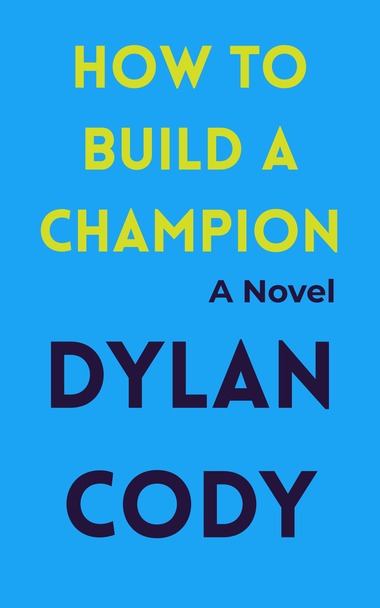
I did it myself. I looked at the books on my shelves, whose covers I liked, and I thought, ‘minimalism stands out in a sea of clutter.’ And I thought, ‘Which colours most represent the story within my book’s pages?’ (It’s set in summer; it’s full of light, and joy; a feel-good read.) So, I opened up YouTube, found a few useful tutorials. Then, I opened up Canva and got to work, experimenting with colours and fonts. (After trial and error, I found a combination of the fonts Lovelo and Montserrat worked well together.)
Do you have a marketing plan for the book or are you just winging it?
I absolutely have a marketing plan for How to Build a Champion. (And I’ve adapted that document each time a ‘hiccup’ has caused me to change course.)
Any advice that you would like to give to other newbies considering becoming Indie authors?
To quote an answer I gave to a similar question on Quora: “Writing a book, and writing the promotional materials to accompany the book, requires you to wear two different hats. It’s great to have an idea in mind for a story you want to tell. However, if it’s a time-sensitive topic, it can be pretty difficult to find the time to write, edit, and do all the due diligence you need to prior to promoting it – or even in tandem with writing the book – so you don’t leave yourself open to any legal troubles further down the track.
What I’m trying to say is: context is key. An author needs to ask themselves: Why are you writing this story – is it because you have a need to get this story written down, for yourself, or are you writing with an audience in mind and so creating a saleable product? (Because the end goal, and so the ‘success markers’ along the way to completing these respective journeys are very different.)
When you know what it is you want to do, and why, you’ll be in a much better space to plot out not only your book, but also the best way to bring it to market (if that’s what you’ve decided to do) and reach your target audience. (That said, even then, ‘success’ isn’t guaranteed. But then, that depends on how you define ‘success’, and how much cash you’re willing to throw at promoting ‘the product’ aka your book.)”
About You
What would you like readers to know about you?
As little as possible; I’d like to keep readers guessing. (That’s why I’ve published How to Build a Champion under a pen name.)
What are you working on now?
Starting over, somewhere new.
End of Interview:
For more from Dylan Cody visit his website and follow him on Bluesky.
Get your copy of Build a Champion from Amazon US or Amazon UK.