I wanted to give voice to the real victims, to imagine their inner lives with care and truth.
Fartumo Kusow – 31 March 2026
The Back Flap
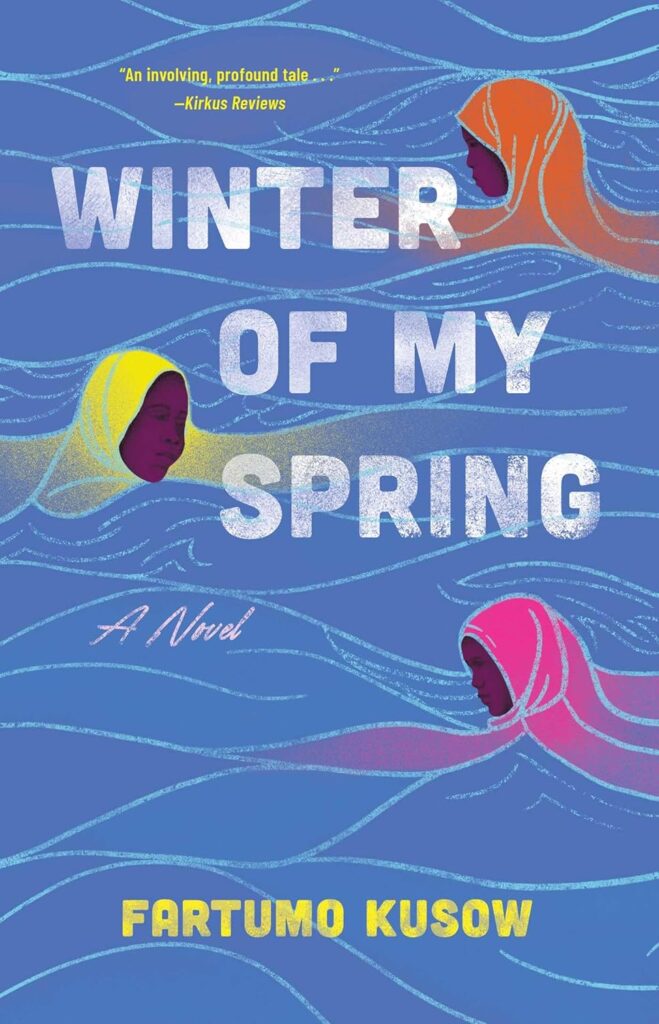
Winter of My Spring follows the harrowing and courageous journey of Rada, a 13-year-old Somali girl and her friends Mika and Sara whose adolescence is interrupted with a sudden abduction. Taken from their school, they are thrust into a world where girlhood is erased and resistance is punished. As they navigate captivity, forced marriage, and separation, the novel explores how systemic violence is disguised as tradition—and how sisterhood and memory become tools of survival. Written with lyrical intimacy and brutal honesty, this is a novel about what happens when the world stops seeing girls as human and what happens when one girl fights to remember who she is.
About the Book
When did you start writing the book?
I began writing Winter of My Spring in the summer of 2014.
Where did you get the idea from?
The idea came after watching the news about the kidnapped Chibok schoolgirls by Boko Haram. Like the rest of the world, I watched in horror. From Michelle Obama to Angelina Jolie, Hillary Clinton, Malala Yousafzai, and many others, people joined the rallying cry under the #BringBackOurGirls banner. It was remarkable to see global solidarity. But as powerful as the campaign was, I noticed something missing: the girls’ voices—their thoughts, their fears, their futures. I asked myself, If these girls could speak, what would they say? That question became the seed for this novel. I wanted to give voice to the real victims, to imagine their inner lives with care and truth.
How long did it take you to write it?
It took me over six years to get the manuscript to a place where I felt ready to share it beyond my writing group.
Were there any parts of the book where you struggled?
The most difficult parts to write were the scenes dealing with betrayal. One of the hardest moments was writing how Nora becomes Shaban’s greatest weapon. Rada’s heartbreak when she realizes Nora is not an ally, but their biggest enemy, was incredibly painful to capture. Also, when the girls work so hard to escape and return home, they face the greatest betrayal when the principal says they can’t return to school because they “have known a man’s bed.”
What came easily?
Writing Rada’s relationship with her father was the most joyful part. It allowed me to reconnect with the beautiful relationship I had with my own father.
Are your characters entirely fictitious or based on real people you know?
The characters aren’t based on specific people I know, but they are real in the sense that they reflect people who exist in the world. There may not be a Rada, Mika, or Sara in my life, but there are countless girls who go through similar experiences of rejection, violence, and resilience.
Are there any particular authors who have influenced how you write?
Reading has always been a source of comfort and peace for me. One of my favorite authors is Nuruddin Farah, a fellow Somali writer. His stories are set in Somalia, and I admire the way he writes deeply human stories that transcend geography, culture, and individual experience. His work has inspired me to write honestly about where I come from and the people I come from.
Do you have a target reader?
Winter of My Spring is a story for anyone who cares about justice, girlhood, and the power of voice. It’s for readers who want to see themselves in stories that are honest, painful, and full of hope. But it’s also for those who need to be reminded of what’s at stake when we silence the most vulnerable.
About Writing
Do you have a writing process?
I usually know where I want the story to end, but I don’t outline. I just write. I belong to a virtual writing group that meets twice a week. When I’m working on a new project, I share two chapters each week and take notes from their feedback. Once I finish the manuscript, I go back to the beginning and revise—often through at least five drafts—before sharing it outside my writing group.
I don’t wait for inspiration. I schedule writing time—at least one hour a day—and I make myself sit in front of the computer. I write in silence. Sometimes I can write a whole chapter in a day. Other times, I stare at a blank screen for an hour. But I show up. For me, writing is about building a routine just as much as it is about storytelling.
About Publishing
Did you submit your work to agents?
Yes, I submitted my work to agents before I connected with, She Writes Press, after winning a publishing contract with them.
What made you decide to go Indie? Was it a particular event or a gradual process?
Many writers dream of signing with a major publishing house, but there’s something to be said for indie publishing. For the first time, I felt like a true partner in the process, with an equal voice in everything from title selection to cover design to publication date.
Did you get your book cover professionally done?
Yes, my book cover was professionally designed.
Do you have a marketing plan or are you winging it?
I’m working with a publicist through my publisher.
Any advice you’d like to give to other new indie authors?
Don’t wait for permission to tell your story. Indie publishing can be empowering—it gives you ownership and voice. Trust your story, but also be open to feedback. Revision is where the real writing happens.
About You
Where did you grow up?
I was born in Somalia and lived there for the first 22 years of my life.
Where do you live now?
I now call Canada home.
What would you like readers to know about you?
I am a mother by devotion, a daughter by dedication, a sister by love, a friend by choice, an educator by profession, and a storyteller by birth.
What are you working on now?
I’m working on a YA novel set in North America. The main character is a 17-year-old boy born in Canada to Somali-born parents. The story explores the challenges of straddling two cultures and finding a place to belong.
End of Interview:
Get your copy of Winter of My Spring from Amazon US or Amazon UK.