I decided to chronicle my journey (while it was unfolding) as a way to heal my own heartache but to also offer an inspiring story of surviving and ultimately, thriving after heartbreak, as a way to help others.
Corey Seemiller – 10 February 2026
The Back Flap
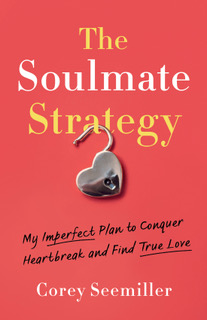
Days after Corey’s breakup, a photo of her ex wrapped in the arms of another woman goes viral on Facebook. Confronted with this gleeful boast about “happily ever after,” Corey, a forty-something lesbian, decides that she can’t live in a state of perpetual loneliness, plagued with the burden of her own failure in finding happiness and love. Armed with her meticulously crafted checklist, Corey embarks on a mission to heal, move on, and find “the one.” But no matter how many items she checks off her list or how faithfully she follows the sage wisdom of psychics, her breakup coach, and the legendary rapper Eminem, her hope in finding her one true love begins to fade away—until she’s suddenly torn between two. Now, with her heart unexpectedly on the line, Corey must find out what she really wants—and where her true happiness lies.
About the book
What is the book about?
This book is the story of my relentless quest to heal from heartbreak and find my soulmate after a devastating end to my seven-year relationship. Throughout the course of one year, I deploy 44 different strategies on a home-grown healing checklist I crafted, intentionally designed to help me move quickly through heartache to find love again. As I embark on each strategy, some with more success than others, I realize that neither healing nor love can be controlled no matter how ironclad any checklist might be. What unfolds is deep healing that comes in unexpected ways, two possible paths to love, and a journey that proves that happiness is often in plain sight.
When did you start writing the book?
November 2021
How long did it take you to write it?
I wrote from November 2021-July 2022. I then edited from that point until September 2025.
Where did you get the idea from?
My own heartbreak. I had been in a relationship for seven years, and it came to a tumultuous end that left me profoundly heartbroken. I began engaging in everything I could do to feel better, heal, and find love again. But, it wasn’t that easy. Some of the things I was doing were counterproductive (trying online dating too early, for example), and some simply didn’t work (love crystals, for instance). But, others did and really helped (Law of Attraction). I decided to chronicle my journey (while it was unfolding) as a way to heal my own heartache but to also offer an inspiring story of surviving and ultimately, thriving after heartbreak, as a way to help others.
Were there any parts of the book where you struggled?
The most difficult part of writing this book from a technical standpoint was crafting scenes and developing engaging dialogue. As a nonfiction writer of more research-based books, I had never really written anything of this magnitude that involved characters. It was exciting but also challenging to make sure the scene was descriptive, vivid, factually accurate, and engaging for readers.
In addition, for memoir, it can be challenging to tell your truth about your experience when it involves writing about others you care about. No matter how I portrayed some of the characters, even those in a positive light, some still were uncomfortable being in a memoir, and it forever changed our relationships.
What came easily?
What came easily was having an extremely strong calling to write this book. The process was very intuitive in that the words just flowed out onto the page as if the book was writing itself. While there was a lot of editing, the story itself just unfolded, affirming to me that this book was supposed to be written and shared with others.
Are your characters entirely fictitious or have you borrowed from real world people you know?
The characters are entirely real with fictitious names (silly, in some regard, based off my relationships with them). For example, a primary character in the book, my now best friend, is referred to as Naked and Afraid because we met at a pool party while talking about the reality show, Naked and Afraid.
We all know how important it is for writers to read. Are there any particular authors that have influenced how you write and, if so, how have they influenced you?
Most recently, I have loved reading other books in my genre and subject. All Signs Point to Paris: A Memoir of Love, Loss, and Destiny by Natasha Sizlo really helped affirm the need to focus in on the crux of the storyline. Miranda in Retrograde by Lauren Layne helped me figure out how to write descriptively about scenes I see in my head so readers can see them too. I also love The Let Them Theory as Mel Robbins authentically lays out her personal experiences in such a raw and vulnerable way. And, I enjoyed The Soulmate Secret by Arielle Ford, Single on Purpose by John Kim, and How To Not Die Alone by Logan Ury as they inspired me to use my story to help others navigate heartbreak in a purposeful way.
Do you have a target reader?
As a lesbian, I know first-hand that there are very few books that validate the life experiences, relationships, and heartbreak of women who love women. I know because I was on an endless search for them when I was suffering heartache. While my book may appeal to a variety of readers, my primary aim is to speak to women who want to hear stories about people like them.
About Writing
Do you have a writing process? If so can you please describe it?
This book emerged more intuitively than others I have written. The words just flowed onto the page, and I trusted what I wrote. While some content ended up being considerably edited or even cut entirely, the process of getting into the flow and not overthinking the story really helped it unfold.
Do you outline? If so, do you do so extensively or just chapter headings and a couple of sentences?
For this book, I did not outline. Other than the first 1/3 of the book that was reflective of past events that occurred within the four months prior, I wrote the book as my life was unfolding.
Do you edit as you go or wait until you’ve finished?
I edited as I went. If something didn’t sound right, I would re-read it with a fresh perspective (after taking a walk outside or sleeping on it). After that, I would then make edits.
I also hired a developmental editor early on and then several different content editors to help me with various aspects of the book. One specialized in scene development; one helped with creating engaging dialogue; and another helped me create a synopsis, so I knew how to best arc the story and link each chapter together. After I got a working synopsis, I consulted with the librarian in residence at my local library who helped me tighten it up even more.
In addition, I had a literary attorney read the book and give feedback to reduce any possibilities of defamation and violations of privacy. I also had insight from a therapist to ensure I was writing that portion of the story in a meaningful way, correcting any misuse of terms I had colloquially been using.
Once I was done with my draft, I was told by my memoir coach that I needed to cut 40,000 words. So, I got to self-editing at that point and consolidated sections, removed some content, and tightened up scenes and dialogue to get to the heart of the story.
I then used an editor for a final review and sent the manuscript off to She Writes Press, where my memoir coach worked. A proofreader there did a look-over and provided some edits as well.
After I got my first pages back, I asked four trusted friends to fact check and give me any last feedback about the book. I made those edits and did one more read-through myself (this time entirely aloud with an AI reader). This allowed me to tighten up sections that sounded clunky.
Do you listen to music while you write? If yes, what gets the fingers tapping?
I don’t listen to music as my intuition often shows up as wording or messages in my head. Thus, any sounds, particularly music with lyrics, mutes the intuition a bit. I also write when I’m called to write. Sometimes, I come in from a walk or pop right out of bed and am inspired to write. If I’m not inspired, I don’t write.
About Publishing
Did you submit your work to Agents?
I did. I had a few full manuscript requests, and several “not in my wheelhouse” replies. The majority went unanswered, though. I also submitted directly to publishers and had two traditional publishers make offers. Their limited reach and strict contracts led me to explore other options.
What made you decide to go Indie, whether self-publishing or with an indie publisher? Was it a particular event or a gradual process?
I went with a hybrid publisher. I had worked with Brooke Warner from what was then just She Writes Press (and is now part of a larger group called The Stable Book Group) who served as my memoir coach long before I considered She Writes Press for publishing. After finishing my proposal, she invited me to consider She Writes if I queried for a while and decided that the traditional publishing route wasn’t for me.
Did you get your book cover professionally done or did you do it yourself?
She Writes designers created my book cover.
Do you have a marketing plan for the book or are you just winging it?
I have hired a publicist and have several marketing ideas I plan to institute alongside their work – social media releases, a book launch, and other event-based experiences.
Any advice that you would like to give to other newbies considering becoming Indie authors?
Focus on your writing and find a good editing company, publisher, etc. to do the heavy lifting on the technical aspects of publishing. They know all the details in order to get your book edited, designed, and out there in the world, which leaves you more time to really refine your writing.
About You
Where did you grow up?
I’ve lived in a few different places – I went to elementary school in a Chicago suburb, middle school in Sarasota, Florida, and high school in Scottsdale, Arizona.
Where do you live now?
Tucson, Arizona
What would you like readers to know about you?
I am an award-winning professor of leadership and global generational expert. I have authored several books and articles and speak at events around the world. My work has been featured in major news publications and media outlets such as NPR, The New York Times, Time Magazine, and Newsweek, and my highly popular TED Talk has garnered hundreds of thousands of views. As an accredited life coach with specialties in Law of Attraction and intuitive development, I also co-host the Rock That Relationship! podcast, discussing debacles and successes with breakups, healing processes, dating, and relationships. I live in Tucson, Arizona and am an avid hiker and outdoor enthusiast.
What are you working on now?
I’m writing a follow-up book about strategies for thriving after heartbreak based on those I discuss in the memoir. It is a more practical, hands-on piece that will help readers actualize what I shared in the memoir.
End of Interview:
For more from Corey Seemiller visit her website and follow her on Facebook.
Get your copy of The Soulmate Strategy from Amazon US.