During the pandemic, my husband and I spent a lot of time walking the streets of our neighborhood and making up stories about the lives of our neighbors. We heard someone pounding on a drum set and decided it must be a kid who wanted to be a rock and roller. One of our neighbors always left all of their doors wide open, day and night, and we worried something bad could easily happen to them.
Mary Camarillo – 10 October 2023
The Back Flap
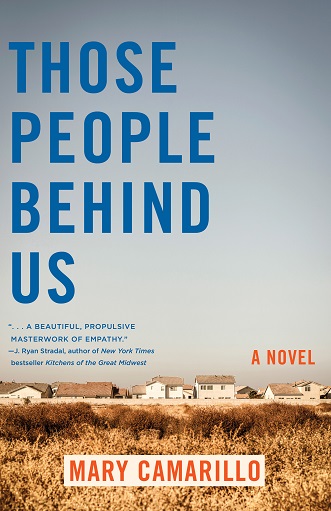
Those People Behind Us is set in the summer of 2017 in the fictional city of Wellington Beach, California, a suburban coastal town increasingly divided by politics, protests, and escalating housing prices. These divisions change the lives of five neighbors as they search for home and community in a neighborhood where no one can agree who belongs.
A real estate agent juggles her job, her shopaholic husband, a mother-in-law who knows how to push her buttons, and teenagers with ideas of their own. A haunted Vietnam vet cares for his aging mother. An ex-con lives in his car, parked near his parents’ house. A sixteen-year-old boy working through the shock of his father’s abandonment slams on a drum set. An aerobics teacher numbed by horrific tragedy, turns away from her husband and toward reckless behavior.
In the end, they all discover that despite their differences, they are more connected than any of them would have imagined.
About the book
When did you start writing the book?
I started writing this novel in 2019 in between doing final edits on my first novel, The Lockhart Women. I kept working on it after the book was published, in between all the marketing and publicity for my first book.
How long did it take you to write it?
I submitted the final manuscript to my publisher in January of this year, which means I finished it over a four-year period, although I didn’t work on it full time. It turns out that marketing and publicizing a book takes a lot of time and energy and uses a completely different part of my brain.
Where did you get the idea from?
During the pandemic, my husband and I spent a lot of time walking the streets of our neighborhood and making up stories about the lives of our neighbors. We heard someone pounding on a drum set and decided it must be a kid who wanted to be a rock and roller. One of our neighbors always left all of their doors wide open, day and night, and we worried something bad could easily happen to them. We were curious about the flags our neighbors flew, what they thought about, and how they spent their days.
We also saw a lot of suburban wildlife on our walks–coyotes, possums, skunks, racoons, herons, hummingbirds–and started paying more attention to the types of trees and plant life. Most of this ended up in Those People Behind Us.
Were there any parts of the book where you struggled?
I struggled in the beginning because I was hoping to write a murder mystery, where someone goes missing and ends up dead. In preparation, I read a ton of mysteries and craft books on how to write mysteries. However, my characters were not interested in going missing or in actually murdering anyone (although one of the characters does consider murder at one point.)
I always start with characters and then try to figure out what they want and what kind of trouble they will get into trying to get what they want. Invariably I’m surprised by their choices. The characters get into plenty of trouble in Those People Behind Us but it wasn’t the kind of trouble I expected when I started the novel.
What came easily?
Once I got to know each of the five main characters I had a great time finding ways for them to interact with each other. I love writing dialogue, and having a variety of voices to work with was challenging but a lot of fun.
I also really enjoyed writing about the suburban flora and fauna I see around me. Southern California is famous for its traffic, concrete, and over-population but there is also quite a bit of wildlife and natural beauty here. Our pandemic walks forced us to slow down and pay more attention to what was around us.
Are your characters entirely fictitious or have you borrowed from real world people you know?
My characters are entirely fictitious but inspired by real world people, as is the city of Wellington Beach, inspired by the coastal beach town where I live in Huntington Beach, California. I fictionalized everything because the story is a universal one.
In looking at maps and data about my own suburban neighborhood, I was surprised at how many people live here and how few of them I actually know. I also thought about the random connections we all eventually make. We all run into our neighbors out in the world, grocery shopping, eating at restaurants, walking dogs, dropping off kids.
We might not know all of the people who live around us very well. We might also assume that they are very different from us, but I believe that no matter where we live, we are all more connected than we might imagine.
Do you have a target reader for this book?
My target reader is anyone who enjoys contemporary stories, multiple points of view, and characters who make very human mistakes. I wrote it for anyone who is concerned about how divisive this world has become. We all tend to listen to those we agree with and to spend time with people who are like us. We all make assumptions about people we don’t know and/or don’t understand but in the end we’re all searching for connection and community.
How was writing this book different from what you’d experienced writing previous books?
My first novel The Lockhart Women was written from three women’s points of view, a mother and her two daughters. In Those People Behind Us, I’m writing from the points of view from three very different men at various stages of their lives, as well as from two female perspectives.
What new things did you learn about writing, publishing, and/or yourself while writing and preparing this book for publication?
The Lockhart Women was usually categorized as Women’s Fiction. Those People Behind Us is literary or contemporary fiction (although the post Trump pre pandemic era seem long enough ago to be classified as historical!)
The Lockhart Women was published in the middle of the pandemic, which meant there were few in real life events. Pretty much everything was online. I’m very happy that Those People Behind Us is being published in the post-pandemic world. I’m excited to get out there and do some in person events.
End of Interview:
For more from Mary Camarillo visit her website and follow her on Facebook and Instagram.
Get your copy of Those People Behind Us from Amazon US or Amazon UK.