This way, hopefully the reader will understand better how and why the characters in the book did and thought what they did, especially for younger readers who were not alive at the time.
Alan R. Warren – 14 April 2026
The Back Flap
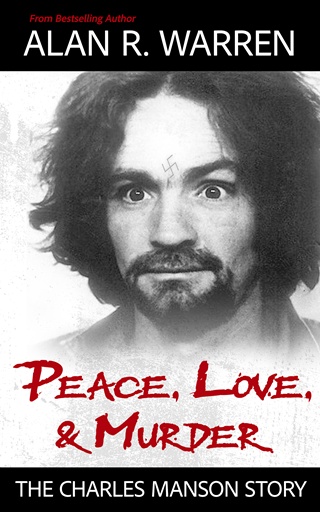
In the late 1960s, America’s promise of peace, love, and freedom collided with a nightmare that would forever change the nation. At the center of it was Charles Manson—failed musician, self-styled guru, and one of the most infamous figures in criminal history.
Peace, Love, and Murder: The Charles Manson Story goes beyond the familiar headlines to reveal untold details about Manson, his followers, and the culture that allowed him to thrive. Alan R. Warren explores how the chaos and counterculture of San Francisco and Los Angeles in the 1960s created the perfect storm for Manson’s rise.
Through meticulous research and vivid storytelling, Warren also shines a light on the lives of Manson’s “Family.” Each member’s background is explored, showing how personal struggles, vulnerabilities, and the allure of belonging drew them into Manson’s orbit—and into history’s most shocking crimes.
This is more than a true crime story. It’s the unsettling account of how an era built on dreams of love and freedom gave rise to murder and madness.
About the book
When did you start writing the book?
I began the research and doing the interviews for the book back in 2013, but didn’t begin the writing process until about two years ago.
How long did it take you to write it?
A total of thirteen years to complete this book, with the story writing process being around two to three years.
Where did you get the idea from?
While I was doing interviews with the different people who were associated with the Manson case, including some of his followers, I began to learn several things that I hadn’t heard before. I began to think that there were probably several other people out there who were in the dark as well, so perhaps I should put this information out there.
Were there any parts of the book where you struggled?
Including several of the historical things that were going on in or around San Francisco during the five years of 1965 – 1970, without it sounding like just an information dump to readers.
What came easily?
Definitely doing the research and reading the newspapers, police, and medical reports from the time.
Are your characters entirely fictitious, or have you borrowed from real-world people you know?
Everyone in the book is a real person; nobody is fictitious.
We all know how important it is for writers to read. Are there any particular authors that have influenced how you write, and if so, how have they influenced you?
There have been different writers who have each taught me something about different parts of writing that I needed to learn throughout the time that I have been writing.
Do you have a target reader?
Probably somebody who is more interested in setting and history. I really begin my books with that, so you’ll learn about where and when it is, how the people were living, what was important to them during that time, and any events going on around them. Then I will bring in the subject of the story. This way, hopefully the reader will understand better how and why the characters in the book did and thought what they did, especially for younger readers who were not alive at the time.
About Writing
Do you have a writing process? If so, can you please describe it?
It all depends on whether I am writing fiction or non-fiction. In fiction, I have to create and develop my characters first, decide who they are, and what their past consists of. How they talk, what they do, etc. Then I put them into the situation or story I have thought about, and it grows from there.
In the non-fiction, I already have the characters, so it’s learning them at the beginning of the process as well, only with real people, you learn who they are, I can’t change that, like with my fictional characters, I can.
Do you outline? If so, do you do so extensively or just chapter headings and a couple of sentences?
Generally, I will first map out how I want to tell the story, but I need to have most of my research done before this. Then I outline the chapter titles and a brief subject for each chapter.
Do you edit as you go or wait until you’ve finished?
I do both, depending on what the changes are that I want to make. Spelling or grammar, I usually wait until the end.
Did you hire a professional editor?
I use a professional editor before I even send a book out to any agent or publisher, or even self-publish myself. I met an editor that I really liked or connected with, who works for a larger publisher, and have used her ever since.
Do you listen to music while you write? If yes, what gets the fingers tapping?
Yes, sometimes I have music, a television show going, and my dogs running around while I am writing. It’s this kind of turmoil that keeps the flow going for me.
About Publishing
Did you submit your work to Agents?
Depends on what kind of project it is, and if I want it published at a certain time or a certain way. Once I figure that out, I’ll send it to the appropriate person.
What made you decide to go Indie, whether self-publishing or with an indie publisher? Was it a particular event or a gradual process?
Again, it’s usually how I want to see the book get out there. Also, what I think it needs is a publisher or just self-publishing. Agents and publishers can have a good forecast on the writing world and give some real advice on finishing touches for the book and who will buy it, therefore, how to market the book.
Did you get your book cover professionally done, or did you do it yourself?
Always done by a professional, either a cover designer that I or the publisher has hired.
Do you have a marketing plan for the book, or are you just winging it?
I usually make up a plan and use a publicist to market my books and or my connections from working in radio for 15 years, and do some interviews on shows set up by myself. There’s not a whole lot of difference these days, even if you go with a publisher, as they don’t do much marketing either. They can make sure it gets out to most bookstores properly and set up some promotion, but it’s not much more than my publicist.
Any advice that you would like to give to other newbies considering becoming Indie authors?
Pay attention to writers, publishers, and agents who work in the genre you plan on writing in. Also, focus on your writing more than anything else; that’s the most important thing. Create a great product. Marketing and editing will come later. Also, in today’s social media-driven world, try to avoid all the noise out there; it only takes your mind off what you are trying to accomplish.
About You
Where did you grow up?
Vancouver, B.C., Canada. Went to the University of Washington in Seattle.
Where do you live now?
In Western Canada, but not in the city anymore.
What are you working on now?
I have been doing a series of short story fictional mysteries, as well as a crime fiction novel, which was based on a true story out of Seattle, Washington, in the 1960’s.
End of Interview:
For more from Alan R. Warren, check out their website and follow them on Instagram.
Get your copy of Peace, Love & Murder from Amazon US or Amazon UK.