The story blends hard science with political thriller elements, and while the premise is ambitious, it’s grounded in a deeply human story that explores real scientific questions that are already beginning to surface today.
Peter McChesney – 27 January 2026
The Back Flap
“For fans of Andy Weir, Blake Crouch, and The Three-Body Problem comes a bold, futuristic, genre-bending debut challenging the conventions of religion, science, and political power.”
On the 100th anniversary of JFK’s challenge to land a man on the Moon and return him safely to the Earth, visionary US President Vince Quinto challenges America with an even more audacious goal: finding a way to conquer death before the century is out—by developing the scientific means to achieve resurrection.
As the 21st century draws to a close, advances in genetics, quantum physics, and artificial intelligence converge to make Quinto’s Challenge possible. The final breakthrough—hailed as the Theory of Everything—is made by Deeley Carr, a young, shy quantum physicist recruited to work on a top-secret US government project.
However, those privy to this highly classified science quickly realize that the power to bring about immortality is a double-edged sword—if it falls into the wrong hands, it would become the ultimate weapon of surveillance and control, a tool for the subjugation of all.
About the book
What is the book about?
While the blurb above gives you the high-level setup, what really drives the story is the tension between hope and power. Quinto’s Challenge imagines what happens when the promise of immortality, specifically being resurrected from the grave in one’s prime, becomes scientifically real, and governments, institutions, and individuals arrive at the doors of confronting the consequences. This monumental scientific breakthrough raises questions about justice, identity, memory, and control, as well as the ethics surrounding ever-advancing technologies that will alter the evolutionary course of humanity.
The book follows Deeley Carr, a brilliant but socially anxious physicist whose work unlocks this power, and explores how someone like her, idealistic, neurodivergent, and unprepared for political games, begins to navigate the weight of having changed the world.
I wrote it to challenge readers to think not just about where science could potentially go, but also as a form of secular hope for those who do not believe in an afterlife but would like to: that perhaps, one day, through science, an afterlife might be possible. The story blends hard science with political thriller elements, and while the premise is ambitious, it’s grounded in a deeply human story that explores real scientific questions that are already beginning to surface today.
When did you start writing the book?
I started developing the idea and jotting down notes in 2015, and began actively writing in 2016.
How long did it take you to write it?
It took a decade. For a good portion of that time, I kept feeling like I was only several months away from finishing, but little did I know that it would take until 2025 to actually complete. That was partly due to demanding jobs and family commitments, but mostly due to being new to writing a novel like this, where the scope of what I wanted to write about increased, and I was not aware of how much tweaking and polishing would be required.
Where did you get the idea from?
The idea came from a combination of personal experience, spiritual transition, and academic background. When I was a teenager in Australia, I converted to Mormonism. It became a very meaningful and valuable part of my life for around two decades. There was a strong sense of community, and it was a great north star. As an adult, though, I eventually transitioned away from the Mormon faith while retaining respect for the Church and its members.
That journey left me reflecting on some of the theological ideas I had grown up with, and one that always stayed with me was the way Mormonism treats science and religion not as separate domains, but as unified. In Mormon thought, there isn’t necessarily anything supernatural, just applications of science we don’t yet understand, but that God does. That even includes resurrection. So I began to wonder: if that were true, what would it actually take to make resurrection scientifically possible? That line of thinking was one of the core drivers behind the book.
Another influence was the emotional side of leaving faith. The idea of an afterlife can be profoundly comforting, and when you let go of that belief, there’s a kind of existential gap left behind. I wanted to explore whether science could offer a new kind of secular hope that death need not be the end.
The rest of the concept was shaped by my background in political science and my lifelong love of science and science fiction. Those threads came together in the idea of a government-backed resurrection initiative, something akin to the ambition and scale of the moon landing in the 1960s.
Were there any parts of the book where you struggled?
Two things come to mind. The first was in the early phases of writing, when I was focused on building out the world of the late 21st century, describing the technologies, how they worked, and what day-to-day life looked like in this future setting. But I found myself leaning too heavily into exposition, and the balance between exposition and narrative was off. Finding the right balance took time, recommendations from a developmental editor, and multiple revisions to get right.
The second challenge was scope. As a first-time author, I had a lot I wanted to include in this story, possibly too much for a debut, especially one that’s part of a series. Eventually, I realized that the book was simply too big and needed to be cut down to a more focused and manageable size. Much of what I originally intended for this book will now appear in the next one (and because of that there’s a mostly completed rough draft of Book Two). Figuring out what to keep in the first book and what to hold back, especially when there were scenes or concepts I was really excited about, was a real creative challenge.
What came easily?
The premise, characters, and plot came pretty easily. Even though the novel evolved over the course of its production, the core of the story was always clear to me. I had a strong sense of the kind of world I wanted to build and the journey I wanted the characters to go on.
Are your characters entirely fictitious or have you borrowed from real world people you know?
The characters are a mixture. Some are entirely fictitious, while others are influenced by people I’ve known personally or by certain types of public personalities. One interesting fictitious example is the main character, Deeley Carr. When our second child was on the way, whom we knew would be a girl, I had a vivid dream about that daughter to come. In the dream, I didn’t see the child herself, but I saw a trophy she had earned. I don’t know what the trophy was for, but it had her name on it: Deeley. Shortly after being influenced by that dream, I floated the idea of giving that name to our daughter, but that didn’t eventuate. Still, the dream stayed with me. When the idea for this book began to take shape, I decided to bring that dream to life in another way: by making Deeley the main character, and shaping her into someone I hope will inspire my children.
We all know how important it is for writers to read. Are there any particular authors that have influenced how you write and, if so, how have they influenced you?
Two books come to mind. One is Contact by Carl Sagan. I actually saw the movie first and was captivated by the hard science, the philosophical undertones, and the sheer scale of imagination. I eventually read the book and found it equally compelling. The idea of a brilliant, driven female scientist making a discovery that could reshape our understanding of the universe definitely influenced the character of Deeley Carr in my own novel.
Another influence is James Luceno’s Darth Plagueis, part of the Star Wars expanded universe. While very different in tone and genre, I admired the way Luceno described certain characters. There was a richness and clarity to his prose that really stuck with me. While my style tends to be more concise, I tried to bring some of that same sensibility into how I describe my own characters, particularly in the way they carry themselves or are perceived by others.
Do you have a target reader?
I think there is something in the book for everyone. While it may naturally appeal to those who enjoy science fiction, futurism, politics, or the predicaments brought about by emerging technologies, at its core, it’s a story about what it means to be human. Central to this is the universal dilemma: we are wired to want to live, but we are also designed to die. And at some point, in some way, each of us has to come to terms with that.
That’s why I hope the book resonates with readers who’ve transitioned from religious belief but still feel a longing for the idea of life after death, especially the hope of being reunited with loved ones in health and in our prime. Assuming then that a science-based resurrection is possible, while it might require science far beyond our current understanding to make it happen, if the story invites readers to consider that a path may one day exist, and that those in the future who achieve it could bring us back, then perhaps it can offer a form of comfort to those without religious belief as they confront our inevitable mortality.
About Writing
Do you have a writing process? If so can you please describe it?
Like many writers, my writing process is all over the map. Ideas would strike at random. While walking, doing chores, or lying in bed, and I’d often grab my phone and email them to myself just so I wouldn’t forget. Once, during a lunch break at a previous job, I was spending time in some gardens on campus and found them inspiring. They ended up becoming the model for certain gardens that feature in the novel, so I quickly jotted the details down.
Eventually I started using Apple Pages on my phone to store those random ideas (as Apple Pages on Mac was where the bulk of the writing was done), and sometimes I’d even drop them straight into the manuscript via the Pages app on the phone or iPad if they felt ready and I just needed to get it down.
As far as dedicating time to write, it usually happened during evenings or weekends when time permitted. Between demanding jobs, four young kids, and other family commitments, I didn’t have the luxury of writing at the same time every day. I had to fit it in wherever I could. There were also times where I would just take a complete break from working on it.
As to how the writing process unfolded, generally the first draft was written from start to finish, but the notes and ideas I’d routinely jot down throughout the entire process were scattered across different points in the story, quite a few of them pertaining to future entries in the series. But once the first draft of this first entry was down, I’d often find myself needing to pause, focus on a future section, or revisit an earlier moment that tied into something new. In short, I revised extensively. Some sections got polished over and over; others had to be let go entirely.
Also, given the story’s complexity and its references to events occurring at different times, I began highlighting anything that pertained to the timeline. One of my final steps was to review all those moments and make adjustments as needed, ensuring that dates harmonized correctly and that events made logical sense (e.g., presidential elections falling in the right years, etc.)
Eventually I reached the point of fine-tuning, but even then, it was hard to stop. I kept finding little things to tweak, even after the advance reader copies were printed.
Do you outline? If so, do you do so extensively or just chapter headings and a couple of sentences?
The many notes I made over the years, both for Quinto’s Challenge and the subsequent entries in the series, could be described as a form of outlining. I started with a basic structure, but I didn’t pre-write chapter headings until I was ready to tackle a specific section. Over time, the story evolved far beyond the original framework, especially as certain plot points naturally grew in importance. That process often felt organic, with more and more of the dots connecting themselves as the writing progressed.
Do you edit as you go or wait until you’ve finished?
I generally didn’t edit while drafting a section. I preferred to get the ideas out first, then return later to refine and work in the notes I’d collected for that part.
Once the draft reached a point where the overall story felt set, I went back over it repeatedly, tightening the language, adjusting the pacing, and sometimes cutting or rewriting entire sections. So while editing happened throughout the process, it came after the core of each part was already in place.
Did you hire a professional editor?
Yes. I worked with several professionals throughout the editing process. I remained hands-on the entire time, approving or rejecting their suggestions, and the final edits, for better or worse, were done by me.
After I had the story set and had done what I considered to be a sufficient degree of polishing, I researched the types of editing available and decided to start with a developmental editor. That editor helped me focus on story structure and refine the balance between exposition and narrative. After incorporating their feedback, I had that same editor do a beta read, and I also brought in a second beta reader for additional perspective.
Later, I hired a line editor who also offered some light developmental feedback, and then a proofreader to catch lingering issues. I also hired someone to review select sections of the manuscript for certain cultural sensitivity. All of their contributions were valuable, but given my continuous revisions that extended beyond their work, I didn’t want to continuously pay for editing or proofreading to be done every time I made tweaks, so the final round of edits and polishing was something I handled myself (with gratitude to a couple of family members who read the advanced reader copy and found some mild errors that slipped through the cracks).
Do you listen to music while you write? If yes, what gets the fingers tapping?
Music definitely played a role in the process, but I don’t write with music playing. I tend to work better in silence. That said, I often used music beforehand to help get me in the right headspace. If I needed inspiration or wanted to lock into a particular emotional tone before sitting down to write, I had a few go-tos.
One example is Sunrise from Also sprach Zarathustra, partly because I’m a big fan of Stanley Kubrick’s 2001: A Space Odyssey. The piece is often treated as a cliche now, but I really bought into the grandeur and majesty it evoked in the film, and I tried to channel that energy, especially when envisioning the climax of the book.
John Williams’ music has always been a source of inspiration, and it could definitely help me get in the zone. But another, admittedly very nerdy go-to, is the Universal Studios logo theme from the 1990s by James Horner, specifically the extended version used for Universal’s 75th anniversary. That music and logo always inspired me as a kid, evoking a sense of wonder of the Earth, space, and infinite possibility, especially the logo’s haunting final moments. I’d occasionally find it on YouTube, play it, and let it carry me in the right mindset before I started to write.
About Publishing
Did you submit your work to Agents?
No, I didn’t submit my work to agents. While the idea of being published through a traditional house had its appeal, I made the decision, at least midway through the process, that I would go the independent route.
What made you decide to go Indie, whether self-publishing or with an indie publisher? Was it a particular event or a gradual process?
The decision came after some reflection, such as how the opportunities available to indie authors today are unlike anything in publishing history. Also, the path to get to a traditional publisher can take years, and after spending a decade writing this book, I knew I couldn’t afford more years waiting on gatekeepers.
I also love the idea of retaining creative control. With independent publishing, I could guide every aspect of the process and ensure the final product matched the vision I had from the beginning. And while it’s always possible to transition to a traditional publisher later if the opportunity arises, the reverse isn’t usually true.
In the end, starting as an independent author through my own publishing company, Vivimus Press (a name drawn from a small reference introduced in this first entry), felt like the smartest and most empowering path forward.
Did you get your book cover professionally done or did you do it yourself?
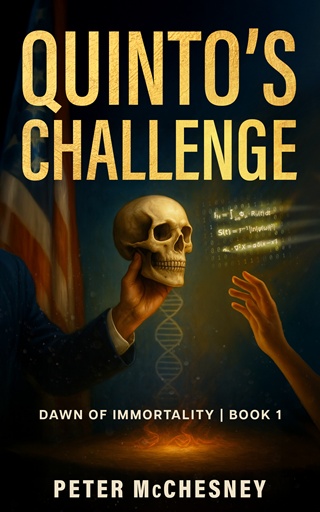
I started with a rough, hand-drawn sketch of the concept, one that originally showed the faces of the two featured characters, one of whom the main character. However, while I liked the general look of it (and had always wanted Quinto holding the skull to feature on the cover in some way), I didn’t want to define their appearance too distinctly for the reader. I preferred to leave room for the reader’s own imagination, so I adjusted the composition to place the characters mostly off frame.
Once I had something close to what I ultimately wanted, I sent it along with some instructions to a professional cover artist whom I hired. The final cover was the result of that collaboration, and I was happy with what they produced.
Do you have a marketing plan for the book or are you just winging it?
After spending a decade creating the book, I definitely wanted to give it the best possible chance to find readers. So I did my research and was fortunate to partner with Books Forward, a well-regarded literary publicity firm. They’re leading the publicity efforts, but I’m actively involved too, doing what I can to support the launch and get the word out. If you like Quinto’s Challenge, please share on your social channels!
Any advice that you would like to give to other newbies considering becoming Indie authors?
If you feel like you have a story within you, go for it. The opportunities for self-publishing today are more plentiful and effective than ever, so if you’re driven to share something with the world, don’t wait.
That said, be prepared for the journey to take longer than you might expect, especially if you’re aiming to make your work the best it can be. Stick with it. Get feedback from friends and family and hire professional editors if you can. Take breaks when you need to. But if you stay with the process and see it through, it will be an accomplishment you carry with you your whole life. And who knows what connections it might help you form along the way? You might just touch others with your words too.
About You
Where did you grow up?
Australia.
Where do you live now?
United States.
What would you like readers to know about you?
I’m a first-generation college student, one who also didn’t have any siblings to follow when it came to finding a path in higher education. So when I started university, I chose Communications: Writing and Publishing as my first major, because I’d always loved creative writing. From the time I was a child, I’d dreamed of becoming an author.
Although I completed my Communications degree, I went on to obtain additional and different degrees and spent most of my career in fields unrelated to them. Still, I’m grateful that things have come full cycle, giving me the chance to return to writing and draw on everything I have experienced along the way.
What are you working on now?
Right now, I’m focused on the final steps to prepare Quinto’s Challenge for publication and working closely with my publicist on the marketing campaign. So at the moment, there’s no active writing happening, but that won’t be the case for long.
As mentioned, a rough draft of the second book in the Dawn of Immortality series is already done, and I’m looking forward to diving back into it as the series will really flesh out all the themes introduced in Quinto’s Challenge. With all the lessons I learned from writing this first book, and the fact that this next one already has a foundation, I’m aiming to finish the next entry far more quickly than the first. I’ll have no choice but to, since I’ve mapped out several more books for the series and it’ll never get finished if each takes ten years!
End of Interview:
Get your copy of Quinto’s Challenge from Amazon US or Amazon UK.