As a mother, depicting my main character’s fierce devotion to her child came easily.
Cassandra O’Sullivan Sachar – 13 July 2025
The Back Flap
Natalie, a single mom, can’t afford medical treatment for the unexplained pain in her foot, so she tries to improve it on her own by quitting running and turning to yoga. During the meditation component of class one day, she follows the instructor’s prompt and envisions opening a door to a better future.
Instead, she unlocks something far more nefarious: a portal to another realm.
After she begins experiencing frequent blackouts, Natalie fears she will lose herself completely to the force controlling her body. Someone—something—has been waiting for this opportunity, and it won’t give up without a fight.
About the book
What is the book about?
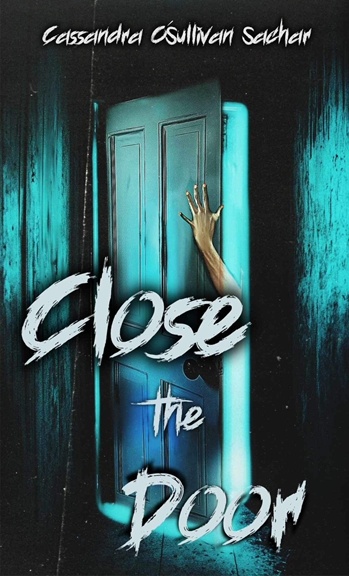
Close the Door explores one mother’s quest to save herself from a force controlling her body so that she can take care of her son. It’s a possession novel, but there are no priests and no demons.
When did you start writing the book?
I began writing Close the Door in May of 2024.
How long did it take you to write it?
I’m an English professor, so I spend most of my time during the semester preparing lesson plans and grading papers. When the semester’s over, though, I focus on my own writing like it’s my job. With this approach, I finished Close the Door in mid-July after several rounds of revision.
Where did you get the idea from?
There’s one part I can’t share since it’s too much of a spoiler! I had a specific idea kicking around in my head for years. The reason I started writing this book when I did, though, is because of a pain in my foot that kept me awake one night. As I struggled to fall asleep, the pieces of the story started fitting together. I knew that my main character would make a change in her routine because of a similar foot issue, and that simple act would be the catalyst for the havoc that followed.
Were there any parts of the book where you struggled?
I knew that the scene leading up to the climax would be complicated for various reasons, especially due to the research it entailed. While I had the vague outlines in my mind, I felt pretty stuck. Therefore, I skipped that part and wrote the final scene instead. After completing that hurdle, I felt confident and motivated enough to tackle the difficult scene. As a creative writing and composition professor, I share this advice with students: If something feels too hard to write at the moment, work on a different part. Any written work involves chipping away at a task, and every part of that matters and will bring you closer to surmounting it.
What came easily?
As a mother, depicting my main character’s fierce devotion to her child came easily. Many readers who are parents have commented on how realistically I portrayed Natalie’s love for her son.
Are your characters entirely fictitious or have you borrowed from real world people you know?
My characters themselves are always fictitious, but I often find inspiration in real life situations. For example, I almost drowned in Mexico about twenty years ago, and I drew from that to describe a similar experience for my main character in my YA thriller Lake of Secrets.
We all know how important it is for writers to read. Are there any particular authors that have influenced how you write and, if so, how have they influenced you?
Two of my favorite modern writers are Jennifer McMahon and Carol Goodman; I’ve read every novel they’ve written and will continue to do so. I appreciate their strong female main characters who are often troubled and must find a way to overcome various challenges. Reading books I love always motivates me to write more.
Do you have a target reader?
I really don’t—I’ve noticed that, at book signings, I sell more to women than men, but my work is written for everyone to enjoy. (Well, some of the content in my books is not child-friendly, but I have a middle-grade paranormal mystery, The Hidden Diary, that is appropriate for all ages.) While all of my longer works have female protagonists, I’ve received positive feedback from many male readers, as well, and my readers represent diverse age groups and backgrounds. My work is appropriate for readers who enjoy writing that has a literary bent to it but also a compelling storyline with some twists and turns.
About Writing
Do you have a writing process? If so can you please describe it?
While I’d describe myself as being very organized and having a Type A personality in most aspects of life, I’m a rather chaotic writer, doing little planning and letting the story take me in unexpected directions. I do well with the discipline of writing, giving myself a word count to reach on designated writing days, but there are times when I sit down to begin a session with only an amorphous idea about what I’ll write. To me, writing fiction often comes down to getting word—any words—on the screen and making decisions. I try things out and see what happens; sometimes I like it while other times I don’t. Either way, I know that I can always make changes.
I strongly believe that there are ways to overcome writer’s block and other obstacles, and I have many tools to utilize when my words aren’t flowing. In my creative writing classes, I have students complete creative spark activities where they jostle their brains to see what falls out. For example, I recently prompted students to write down the first memory they could think of when I listed different emotions, and then they had to choose one and fictionalize a scene based on it. I always take part in these to model the behavior, and my creative spark idea made it into the last short story I wrote where I needed a character to have a backstory.
Do you outline? If so, do you do so extensively or just chapter headings and a couple of sentences?
Nope! Never. If an idea comes to me that I want to make sure to remember, I write it down in my Notes app, but that’s usually just a phrase or sentence. I always start at the beginning of a story, but I sometimes skip around, writing the part I feel like writing and filling in missing pieces later.
Do you edit as you go or wait until you’ve finished?
While I fiddle a bit as I write my initial draft to make the prose make sense, I try not to lose my forward momentum. My first goal is to get the story out, even if it’s extremely messy with plot holes and continuity errors. I always say that I’m a better reviser than an initial creator, and I get a great deal of enjoyment in the revision process. I try not to sweat it if I don’t like how some of it is going since I know I’ll make it better later during my rounds of revision.
Do you listen to music while you write? If yes, what gets the fingers tapping?
Strangely, even though I write a lot of dark content, I always listen to Zen or reiki music when I write. About a decade ago, I realized that this music helps me concentrate, so I play it whenever I work, whether that’s grading papers, reading scholarly texts, or writing. I’m even listening to it right now as I type this!
About Publishing
Did you submit your work to Agents?
I’ve submitted to many agents over the years, but I haven’t done so since I became a published novelist, choosing to work with small presses instead.
What made you decide to go Indie, whether self-publishing or with an indie publisher? Was it a particular event or a gradual process?
While I received some bites and some personalized responses from agents, nothing ever worked out. I find small presses to be much more responsive—they act more like you’re doing something for them by submitting, while submitting to agents has made me feel more like I’m begging for representation. I may submit to agents down the road, but I’m happy sticking with indie publishers for now.
Did you get your book cover professionally done or did you do it yourself?
All of my covers, including the one for Close the Door, have been professionally done by digital artists.
Do you have a marketing plan for the book or are you just winging it?
At Baynam Books Press, through which Close the Door is published, there’s a marketing director who promotes the books and sometimes gives us good-natured challenges to self-promote. I like that there’s a strategy but also appreciate the flexibility to it. He understands that not everyone is comfortable or has the time to self-promote non-stop, but he also provides tips for us to use so that we feel supported.
Any advice that you would like to give to other newbies considering becoming Indie authors?
Don’t let rejections make you stop trying. Books and publishers need to be the right fit for each other. I also recommend joining a writers’ group to get feedback and continue to revise. Even though more revision will occur after the acceptance stage, the manuscript should be in its very best form to attract interest.
About You
Where did you grow up?
Though I was born in Illinois and also briefly lived in New Jersey, we moved to Kutztown, Pennsylvania when I was seven, so I consider that my hometown. I lived out in the country near Mennonite farms and rolling hills. Pennsylvania features prominently in my writing for this reason; two of my novels and many of my short stories are set in the fictional town of Blackthorn, Pennsylvania, and careful readers may notice some recurring places across these texts.
Where do you live now?
I moved to Delaware after college, but I’ve been back in Pennsylvania for the last decade. I now live in Bloomsburg, another small town.
What would you like readers to know about you?
An important fact about me is that I love trying to help other writers, whether they’re my students, friends, or strangers. I’m always happy to provide tips on writing as well as publication advice. I love motivating writers to keep writing and to submit their work, and I have hosted open mic nights to encourage writers to step out of their comfort zone and share their creative passion.
A goofy fact about me is that I’m obsessed with collecting Starbucks mugs in places that I visit. My husband and I went to seventeen Starbucks in Buenos Aires before finding one, and it is a treasured possession! I have mugs from around the world, such as Norway, India, and Peru. They’re my favorite souvenirs to collect from my travels, and I rotate using them to give them each their time in the sun.
What are you working on now?
I’m finishing up my second short horror story collection. I adore the endless possibilities of short fiction.
End of Interview:
For more from Cassandra O’Sullivan Sachar visit her website.
Get your copy of Close the Door from Amazon US or Amazon UK.