
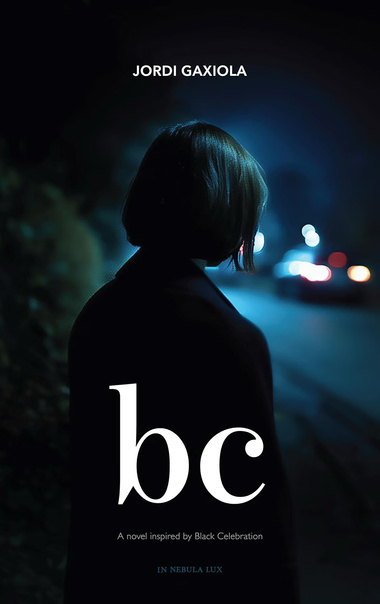
I think BC will appeal to readers who enjoy atmospheric fiction, intimate stories and a strong sense of place.
Jordi Gaxiola – 21 November 2026
The Back Flap
Basildon, Essex, 1986. Over eighteen days, a dark love story unfolds in a world shaped by music and the things people leave unsaid. Inspired by the atmosphere of Depeche Mode’s Black Celebration, BC brings the emotional world of a beloved album into an independent work of fiction. Place is as important as the people who inhabit it, drawing readers into the mood of a particular time and town. Written for readers drawn to music and atmospheric fiction, the novel has no affiliation with or endorsement from Depeche Mode.
About the book
What is the book about?
BC is a dark love story set in Basildon, Essex, in 1986. It unfolds over eighteen days in a world shaped by music and the things people leave unsaid. The atmosphere of Depeche Mode’s Black Celebration inspired the novel, while its characters and story are fictional.
The setting matters deeply to me. I wanted readers to spend time in that town and period, with the place becoming as important as the people who inhabit it.
When did you start writing the book?
I began writing BC around April 2025.
How long did it take you to write it?
About ten or eleven months, including revisions. The first draft established the main ideas of each chapter in a much leaner form. A great deal of the work came afterwards, developing those ideas and deciding when the final revisions had done enough.
Where did you get the idea from?
It began with my love of Depeche Mode’s Black Celebration and its approaching fortieth anniversary. I wanted to create an original fictional story inspired by the record, using the song titles in their album order as a framework.
I chose Basildon in 1986 as the setting. The book is not a fictional biography of the band or a retelling of the lyrics; the album gave me a starting point from which to build the characters and their world.
Were there any parts of the book where you struggled?
Finding a connection between the story and each song title took work. I was following an existing sequence, but the characters still needed to develop naturally within it.
The final revisions were also difficult. There is always another sentence you could change, and learning to recognise when the book was finished was part of the process.
What came easily?
The characters arrived quite naturally. As they began to inhabit the setting, their personalities and histories developed in a fluid way.
I also enjoyed the research: finding out about the pubs and places people went to, and learning about the working life and political circumstances of the period. The story was taking shape while I was discovering more about its world.
Are your characters entirely fictitious or have you borrowed from real world people you know?
They are entirely fictional. I spend time imagining their backgrounds, including things that never appear in the book. Knowing who they were before the story begins helps me understand how they might behave once it does.
We all know how important it is for writers to read. Are there any particular authors that have influenced how you write and, if so, how have they influenced you?
Thomas Harris, Bret Easton Ellis, Cormac McCarthy and Isaac Asimov are among the authors I admire. I find it harder to trace a specific influence from their writing into mine. My most direct creative influences tend to be music, songwriters and places.
American Psycho is probably my favourite novel. Its treatment of identity, and the uncertainty surrounding its narrator, are particularly compelling to me.
Do you have a target reader?
I think BC will appeal to readers who enjoy atmospheric fiction, intimate stories and a strong sense of place. Depeche Mode fans are an audience I would particularly love to reach, especially those with a personal connection to Black Celebration.
About Writing
Do you have a writing process? If so can you please describe it?
I usually begin with a small idea and discover the story by writing it. I imagine scenes almost as though I were watching a film, paying attention to the room, the sounds and how the characters move through the space. That helps me see details I might otherwise miss.
Early mornings are my best time for sustained concentration. At night, I am more likely to find myself imagining possibilities and collecting new ideas. I like having my dog Weston beside me while I work.
Do you outline? If so, do you do so extensively or just chapter headings and a couple of sentences?
Usually I do not begin with an outline, a fixed number of chapters or a word-count target. I let the story develop and discover its destination along the way.
BC was the exception in one respect: the album’s song titles and running order gave me a structure before I started. I still did not know the ending, but I had that sequence to work within.
Do you edit as you go or wait until you’ve finished?
I make many of the important revisions while I am writing. Once the manuscript is complete, I go through it more deeply, checking the characters, locations and dates as well as the writing itself. Visualising the scenes helps me notice where something needs more attention.
Did you hire a professional editor?
No. I handled the revisions and copy-editing of BC myself.
Do you listen to music while you write? If yes, what gets the fingers tapping?
Yes. Townes Van Zandt, Tom Waits, George Strait, Diana Krall, Angelo Badalamenti and Camille Thomas are among the artists I listen to while writing. During BC, I also listened to a great deal of Depeche Mode. Sound is an important part of how I imagine the world of a book.
About Publishing
Did you submit your work to Agents?
No, I did not submit BC to literary agents before publishing it.
What made you decide to go Indie, whether self-publishing or with an indie publisher? Was it a particular event or a gradual process?
It was a gradual process. My first book began as something I was writing for myself. After finishing it, setting it aside and returning to it as a reader, I realised I wanted to share it.
I publish my work through In Nebula Lux, my own independent imprint. It is a small, personal publishing project that grew out of that wish to bring the books into the world.
Did you get your book cover professionally done or did you do it yourself?
I designed the cover myself. Alongside writing, I am a designer and run a boutique design agency, so I was able to bring that experience to the book’s visual presentation. Working on the cover was another way of thinking about the atmosphere of the story.
Do you have a marketing plan for the book or are you just winging it?
I am developing a focused plan around the readers most likely to connect with the book. For BC, that means reaching out to book reviewers, music publications, reading groups and communities interested in Depeche Mode, as well as taking part in written interviews like this one.
I am still learning about promotion. My aim is to introduce the book in places where its connection to music and its atmosphere will mean something to readers.
Any advice that you would like to give to other newbies considering becoming Indie authors?
Start with the story you want to write. My first book was not written with publication in mind, and completing it was valuable in itself. After some time away from the manuscript, I tried to read it from a reader’s point of view. That helped me decide I wanted to share it.
There are ways for independent writers to put their work into the world. My advice is to begin, give the book the attention it needs, and leave yourself time to return to it with a little distance.
About You
What would you like readers to know about you?
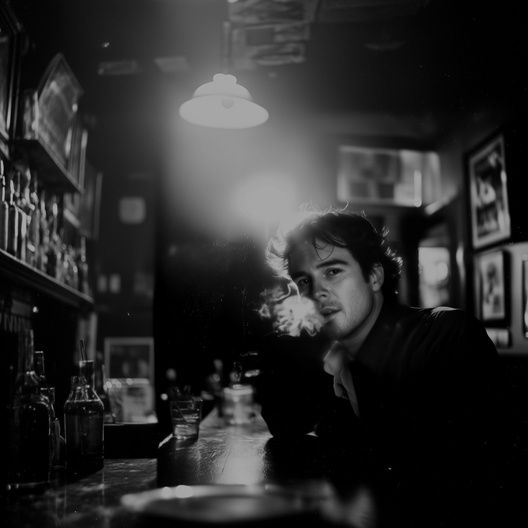
Music has been part of my life since childhood, and it remains central to my imagination. I am also drawn to rural towns, back roads and places with a history that is not immediately obvious.
Those interests find their way into my fiction. I enjoy the feeling of entering a world and spending enough time there to understand the people who live in it.
What are you working on now?
I am working on Willow Arms, the forthcoming sequel to The Silence on the Line. Together, the two books form The Frequency Files. The first follows an online crime sleuth whose involvement in a case becomes increasingly personal; Willow Arms is the second and final part of that story.
End of Interview:
For more from
Jordi Gaxiola visit his website.