I’ve long been fascinated by how secret power structures operate, and how technology collides with morality. The idea crystallized when I lived abroad and experienced firsthand what it means to live inside different political systems.
M.B. Courtenay – 9 December 2025
The Back Flap
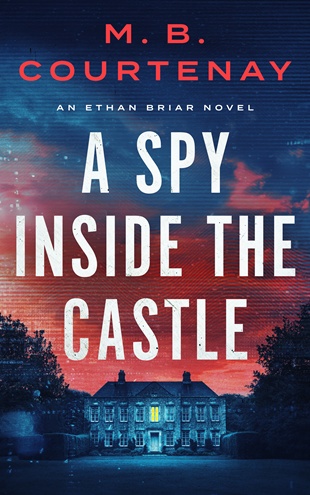
When intelligence analyst Ethan Briar is drawn into a covert mission on the windswept Isle of Skye, he enters a world where nothing is as it seems. An abandoned supercomputer, a defector’s warning, and the specter of a long-buried betrayal set the stage for a high-stakes investigation with global implications.
At Castlemartin Manor—a decaying stronghold for a once-cutting-edge surveillance program—Ethan is forced to navigate shifting loyalties, encrypted legacies, and the labyrinthine politics of modern intelligence. As the storm outside intensifies, so does the war within: between faith and cynicism, memory and manipulation, human judgment and machine prediction.
About the Book
What is the book about?
A Spy Inside the Castle is a modern spy thriller about surveillance, autonomy, and truth in an age of manipulated reality. It follows Ethan Briar, a reluctant intelligence operative, as he uncovers a global labyrinth of secret societies, AI-driven espionage, and the philosophical struggle between freedom and control. Think le Carré meets Black Mirror.
When did you start writing the book?
I began drafting it seriously in 2020 during the pandemic, though the earliest notes and ideas stretch back a decade earlier.
How long did it take you to write it?
Roughly four years of full development, including several complete rewrites and structural overhauls.
Where did you get the idea from?
From a mix of real-world geopolitics, philosophy, and history. I’ve long been fascinated by how secret power structures operate, and how technology collides with morality. The idea crystallized when I lived abroad and experienced firsthand what it means to live inside different political systems.
Were there any parts of the book where you struggled?
Yes. The balance between thriller pacing and philosophical depth. I didn’t want to write a dry treatise, but I also didn’t want just explosions and chase scenes. Finding that equilibrium required countless revisions. I wanted to avoid being just another spy thriller author.
What came easily?
Dialogue. My characters’ voices—particularly Ethan Briar and Diana Pagonis—came to life almost immediately. Their exchanges often surprised me as much as they might surprise the reader.
Are your characters entirely fictitious or have you borrowed from real world people you know?
They are fictional but influenced by real people I’ve met in different countries where I’ve lived. No one is a direct copy, but the shadows of reality linger in them.
We all know how important it is for writers to read. Are there any particular authors that have influenced how you write and, if so, how have they influenced you?
Oddly enough, I am a hardcore nonfiction reader. I’ve been heavily influenced by Will Durant and his sweeping historical style. Some of my characters draw inspiration from the real historical figures he describes. I also follow current events closely through the Financial Times, Foreign Affairs, and other sources. These themes inevitably seep into my novels.
Do you have a target reader?
Yes. Readers who enjoy thrillers but want more than surface entertainment—those interested in how ideas, history, and power collide. People who appreciate both espionage intrigue and philosophical depth.
About Writing
Do you have a writing process? If so can you please describe it?
I write in intense and immersive sprints—usually very early in the morning when my brain waves are still a bit mixed coming out of their sleep state. I need silence, coffee, and a sense of the philosophical theme I’m exploring before I let the characters run with it.
Do you outline? If so, do you do so extensively or just chapter headings and a couple of sentences?
I use a hybrid method. I sketch the major arcs and turning points, but leave space for improvisation. Characters often lead me into scenes I never anticipated. Outlining can be helpful, but I don’t want it to box me in.
Do you edit as you go or wait until you’ve finished?
I let it pour out first, then fix it later. From there, I do several rounds of editing that get progressively more specific, down to copy editing and proofreading with outside help. Word’s read-aloud feature is surprisingly useful—it lets me hear the flow of the text.
Did you hire a professional editor?
Yes. A professional editor was essential for tightening the manuscript and ensuring the pacing matched the tension of the story. She’s excellent, and I plan to enlist her help again for all sequels.
Do you listen to music while you write? If yes, what gets the fingers tapping?
Not while I’m writing, but afterward. I like to read passages over while listening to instrumental music—soundtracks, ambient scores, and atmospheric pieces. It helps me visualize tone and mood.
About Publishing
Did you submit your work to Agents?
No. I enjoy the freedom of self-publishing at this stage. There’s so much you can do yourself now, and I find the process rewarding.
What made you decide to go Indie, whether self-publishing or with an indie publisher? Was it a particular event or a gradual process?
Gradual. Indie publishing offered more creative control and speed. With a professional campaign and the right partnerships, it felt like the smarter way to build an audience while retaining ownership.
Did you get your book cover professionally done or did you do it yourself?
Professionally done by Damonza, a leading design studio. The investment was worth it—the cover communicates genre, tone, and quality instantly. I’d tell any new author to prioritize this. I even ran design iterations through a focus group of coworkers to see what resonated.
Do you have a marketing plan for the book or are you just winging it?
Yes, a plan. I’m working with BooksForward on a six-month campaign, including ARCs, podcasts, guest articles, and targeted influencer outreach.
Any advice that you would like to give to other newbies considering becoming Indie authors?
Treat it like a business. Invest in professional editing and design. Build a brand, not just a book. And understand that success is slow, cumulative, and requires as much resilience as creativity.
About You
Where did you grow up?
I’m originally from Chicago, but have lived all over: Washington, D.C., Beijing, and New York City.
Where do you live now?
Morristown, NJ.
What would you like readers to know about you?
That my writing aims to challenge younger and middle-aged adults—those coming into positions of greater power and influence—to think about the responsibility of leadership. In an age of extreme technological progress, an understanding of history and philosophy that humbles us can be the differentiator for society.
What are you working on now?
The sequel to A Spy Inside the Castle. It picks up with Ethan Briar as he confronts the next stage of Der Kreis’ plans, deepening the philosophical battle over freedom, power, and truth.
End of Interview:
Get your copy of A Spy Inside the Castle from Amazon US or Amazon UK.